

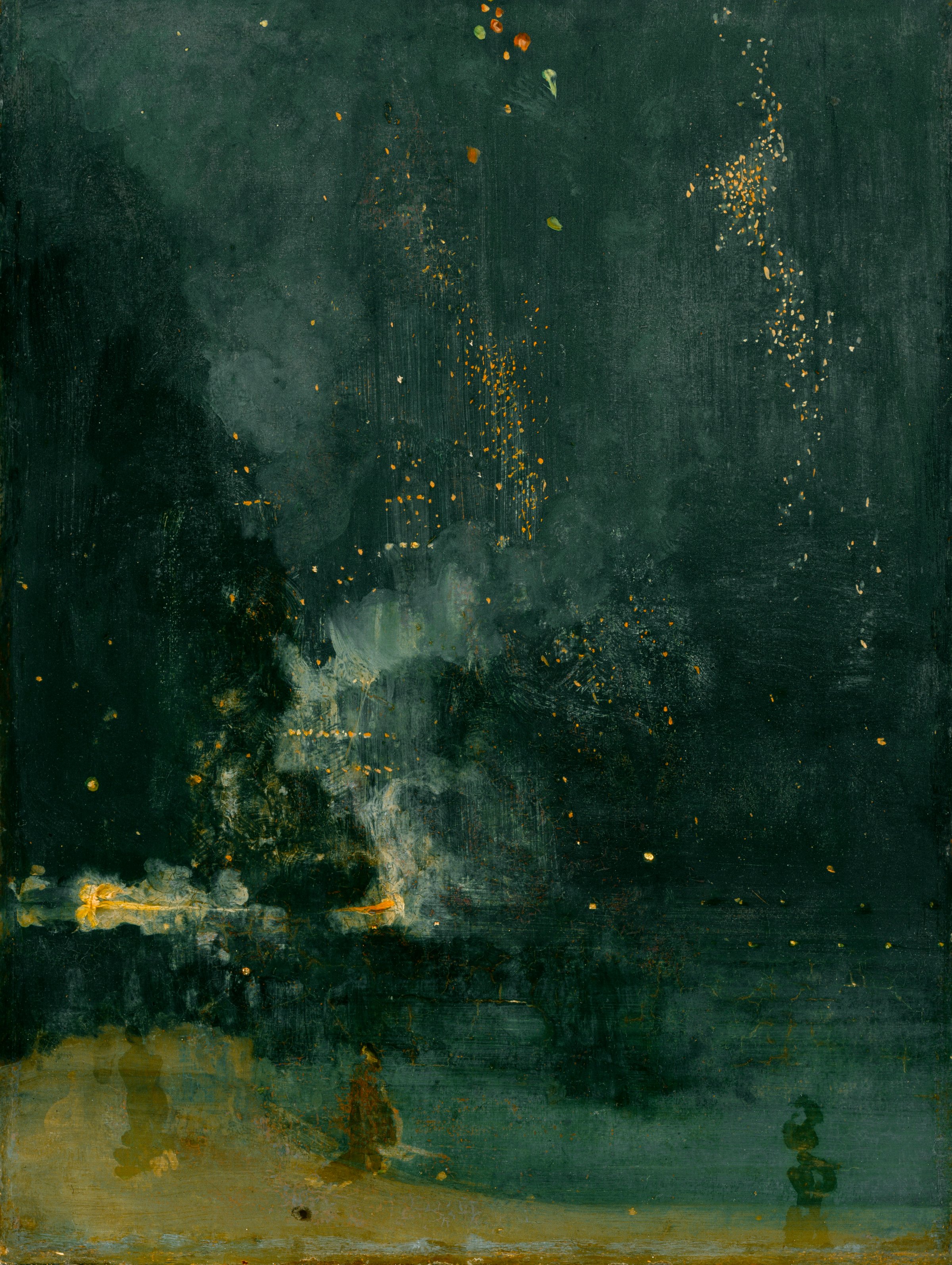
In July 1877, the Grosvenor Gallery in London opened with a show that included eight paintings by James McNeill Whistler. One of them was a small dark canvas called Nocturne in Black and Gold: The Falling Rocket. It depicted the night sky over the Cremorne Pleasure Gardens in Chelsea during a fireworks display, the falling sparks rendered as small dots of light against an almost-black ground.
The critic John Ruskin, then the most influential art writer in Britain, reviewed the show for his monthly publication Fors Clavigera. He compared the Falling Rocket unfavourably to coxcomb impudence and concluded with the sentence that became famous: "I have seen, and heard, much of Cockney impudence before now; but never expected to hear a coxcomb ask two hundred guineas for flinging a pot of paint in the public's face."
Whistler sued for libel. The trial took place over two days in November 1878 in the Court of Queen's Bench. The jury found for Whistler. They awarded him one farthing in damages, and split the costs between the parties.
What Whistler Was Doing
Whistler was an American painter who had moved to Paris in 1855 and then to London in 1859. He had studied with Charles Gleyre in Paris, fallen in with the Realist circle around Courbet, and developed an art that fused Realist observation with the formal seriousness he had picked up from Japanese woodblock prints.
By the 1870s he was painting what he called Nocturnes: small dark studies of the Thames at night, of the Cremorne Gardens, of Chelsea. The paintings were thinly applied, almost monochrome, and refused the narrative content Victorian audiences expected from a finished picture. Whistler claimed they were "an arrangement of line, form, and colour first" and "an anecdote second or not at all."
Ruskin
John Ruskin in 1877 was sixty-three. He had been the leading defender of the Pre-Raphaelites a generation earlier, but his moral framework for art was anchored in patient observation of nature and what he called "the duty of truth." A painter who finished a canvas in two days and called it Nocturne in Black and Gold offended every principle Ruskin held about labour, attention, and the worth of finished work.
The "pot of paint" line was not a slip. Ruskin's review was a deliberate attempt to use the moral authority of his critical position to drive Whistler out of the Grosvenor Gallery's roster and, by extension, out of the serious British art market.
The Trial
The case was heard by Baron Huddleston with a special jury of four. Whistler's counsel called him as the first witness. Under cross-examination by Sir John Holker, the Attorney-General, Whistler was asked whether the price he charged (two hundred guineas) reflected "the labour of two days." Whistler replied with what became the trial's most-quoted exchange: "I ask it for the knowledge of a lifetime."
Ruskin did not appear. He was unwell and his counsel argued the case on his behalf. The witnesses called for Ruskin included the artists Edward Burne-Jones and W. P. Frith, both of whom testified that the Falling Rocket was not a finished work.
The jury retired and returned with a verdict for Whistler. The damages they awarded — one farthing, the smallest coin in circulation — were a clear signal: yes, Ruskin had libelled him; no, the painting itself was not worth defending. Each side was to pay its own costs.
The Bankruptcy
Whistler's legal fees came to nearly £400 (the equivalent of around £40,000 today). He had no income reserves. Within seven months of the verdict he had filed for bankruptcy. His house on Tite Street in Chelsea, the White House, was sold along with his etching plates, his furniture, and most of his collection of Japanese prints.
The collapse forced him out of London. He went to Venice on a commission from the Fine Art Society to produce twelve etchings of the city. He stayed fourteen months, made fifty etchings and around a hundred pastels, and returned in 1880 with the work that would re-establish his financial position over the next decade.
What the Trial Decided
The legal point was small. Ruskin had committed libel, but the painting at issue was held by the jury to be of minimal worth. The cultural point was larger. The trial publicly tested the question of whether a critic's moral authority could be used to suppress a kind of painting the critic disliked. The verdict was ambiguous, but the principle the trial established (that artists could sue critics, that critics could be made to answer for their attacks) shifted the balance of power between artists and the press for the rest of the nineteenth century.
The other thing the trial established, which mattered to Whistler more, was the term Aestheticism. The defence Whistler ran (that a painting could be valued for its formal arrangement of line, form, and colour, independent of any narrative or moral content) became the founding argument of the movement. Walter Pater, Oscar Wilde, and the Symbolists who followed in the 1880s all drew on the framework Whistler had defended in court.
Ten O'Clock
In February 1885, Whistler delivered a public lecture at Prince's Hall in Piccadilly. It began at ten in the evening, an unusually late hour, and was called Ten O'Clock. It was his formal statement of the Aestheticist position. Art, he argued, is "selfishly occupied with her own perfection only" and "the master stands in no relation to the moment at which he occurs." Beauty was not a function of moral worth, or of social usefulness, or of careful labour. It was a thing the artist made and the audience either saw or did not see.
The lecture was a culmination of the argument Whistler had spent the previous decade defending against Ruskin. It was attacked at the time. It is now considered one of the founding texts of modernist aesthetics.
What the Farthing Bought
Whistler wore the farthing on his watch chain for the rest of his life. He died in 1903, having spent his last twenty years rebuilding the position the bankruptcy had cost him. He had become a kind of patron saint to the Aesthetes, was elected president of the Society of British Artists, and saw his paintings enter major museum collections.
Ruskin died in 1900, mentally ill in the last decade of his life and having largely withdrawn from public writing. The pot-of-paint review was not what he wanted to be remembered for. It is what he is mostly remembered for.
The trial cost both men. The painting Ruskin attacked is now in the Detroit Institute of Arts and is reproduced in every history of nineteenth-century art. The farthing is in the Hunterian Museum in Glasgow with the rest of Whistler's effects. The argument Whistler defended in court won in the long run. The argument Ruskin made about labour and seriousness still wins on most days at most easels, but it lost in 1878 and never quite recovered the authority it had before.


