


The Bayeux Tapestry is approximately seventy metres long and fifty centimetres tall. It is not a tapestry. A tapestry is woven; the Bayeux work is embroidered, with woollen yarn worked onto a linen cloth in eight different colours. It tells the story of the 1066 Norman Conquest of England in fifty-eight scenes, with a Latin inscription running above the figures throughout. It is the most extensive piece of pictorial narrative art surviving from the eleventh century.
The cloth has hung in various locations for nearly nine hundred years. It was almost certainly made within ten years of the events it depicts. It survived the French Revolution (when it was nearly cut up to cover a baggage wagon), the Napoleonic Wars (when Napoleon ordered it brought to Paris for examination), and the German occupation of France (when the Nazis nearly shipped it to Germany before the Allied advance forced them to abandon the plan). It now hangs in a purpose-built museum in Bayeux, Normandy, where it has been since 1983.
Who Made It
The cloth was almost certainly made in England, not in Normandy. The evidence is technical and stylistic. The embroidery uses techniques (laid-and-couched work, stem stitch, split stitch) that were specialties of Anglo-Saxon embroidery workshops. The same techniques are documented in surviving fragments of English ecclesiastical embroidery from the same period.
The Latin inscriptions use spellings characteristic of Anglo-Saxon Latin (such as "Eduardus" rather than the Norman "Edouardus") and include English place-names spelled in Anglo-Saxon orthography. Several scenes show details (the death of Edward the Confessor, the building of the ships) that match contemporary English accounts more closely than the Norman accounts.
The workshop where the cloth was made was probably attached to one of the great Anglo-Saxon monastic houses. Canterbury, with St Augustine's Abbey and Christ Church Cathedral, is the most likely candidate. Both had active embroidery workshops in the late eleventh century. The Canterbury hypothesis is supported by the close stylistic relationship between the tapestry's figures and the figures in surviving Canterbury manuscripts of the same period.
Who Commissioned It
The patron was almost certainly Odo, Bishop of Bayeux. Odo was the half-brother of William the Conqueror and one of the central figures in the Norman conquest of England. He fought at Hastings, was made Earl of Kent by William, and held vast English estates from 1066 onward. He was also the political patron of his cathedral at Bayeux, where the tapestry was eventually housed.
The case for Odo is circumstantial but strong. He had the resources to commission a work of this scale (an estimated 100,000 hours of embroidery labour). He had the political reason to celebrate the conquest. He had access to English workshops through his Kent earldom. And the tapestry's narrative gives Odo himself an unusually prominent role: he appears in three scenes, including one where he leads the Norman knights into battle at Hastings.
What It Shows
The narrative runs in fifty-eight scenes from left to right, with the Latin inscription above. The story begins with King Edward the Confessor in Westminster sending Harold Godwinson to Normandy in 1064. Harold sails across the Channel, is captured by Count Guy of Ponthieu, is ransomed by William of Normandy, fights alongside William in a Breton campaign, and (in a scene whose interpretation is still disputed) swears an oath on holy relics to support William's claim to the English throne.
Harold then returns to England. King Edward dies in January 1066. Harold is crowned the next day. A comet appears (the work shows Halley's Comet, which actually appeared over England in April 1066). News reaches Normandy. William begins building ships. The Norman fleet sails. The army lands at Pevensey. The Battle of Hastings begins.
The battle scenes (over half the surviving cloth) show the Norman cavalry charging the Anglo-Saxon shield-wall, the fighting at close range, and (at the end) the death of King Harold. The famous arrow-in-the-eye scene is here, though it has been recently re-interpreted: the arrow may not be hitting the eye, and the figure shown being hit by an arrow may not be Harold at all but a different soldier. The labelled "Harold" appears to be a slightly different figure, falling under the swords of mounted knights.
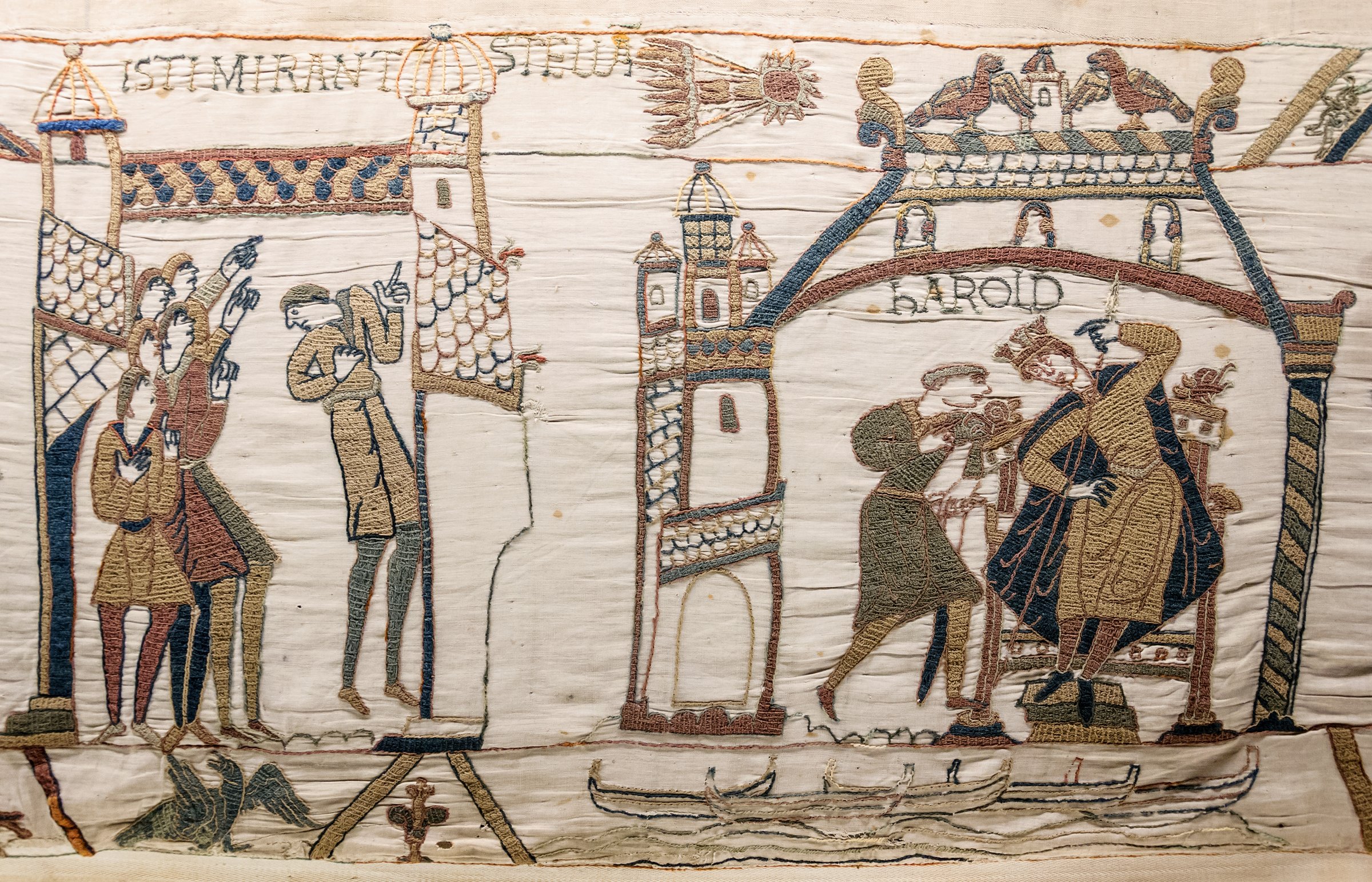
What Is Missing
The surviving cloth ends after the battle. The original almost certainly continued for several more scenes: the rout of the Anglo-Saxon survivors, the Norman march toward London, the coronation of William at Westminster on Christmas Day 1066. These scenes survive in summary form in the Latin chronicles of the conquest, but the embroidered version of them has been lost. The current end of the cloth is frayed and torn; some scholars estimate that as much as three metres of the original has been lost.
The end may have been lost relatively early. The earliest surviving copy of the cloth (a 1729 antiquarian drawing) already shows the same ending we have today.
The Lower Border
Above and below the main narrative band, the cloth carries decorative borders of small animals, fantastical beasts, and (in places) small figural scenes. The upper border is mostly decorative. The lower border, particularly in the battle scenes, shows dead soldiers, looters stripping the dead, and severed limbs. The borders comment on the main action: while the inscribed narrative shows the dignified violence of the cavalry charge, the border shows the same violence at ground level, with corpses and looters.
The borders also include several scenes that have been interpreted as moral commentary on the action. A fable of the fox and the crow appears in the border near the beginning, possibly suggesting that the diplomatic exchanges between Harold and William involved trickery on both sides. A scene of Aesop's wolf and lamb appears at a similarly sensitive moment.
Why It Survived
The tapestry was kept at Bayeux Cathedral from at least the twelfth century onward. It was displayed annually during the Feast of the Relics. It survived the cathedral fires of 1106 and 1142, possibly because it was stored in a separate building. It survived the French Wars of Religion in the sixteenth century, when the cathedral was sacked but the tapestry was hidden by clerics.
The closest the cloth came to destruction was during the French Revolution in 1792. A group of French national guards came to the cathedral to seize cloth for covering ammunition wagons. The tapestry was about to be cut up when a local lawyer, Lambert Léonard-Leforestier, intervened, arguing that the cloth was of antiquarian importance and should be preserved. The guards relented.
Napoleon had the tapestry brought to Paris in 1803, where it was exhibited at the Louvre as part of the propaganda campaign for his planned (and then abandoned) invasion of England. It was returned to Bayeux in 1804 and kept in the cathedral until 1842, when it was moved to a public museum.
The Museum
The current display building, opened in 1983, contains the tapestry in a long curved corridor with controlled lighting and humidity. The cloth is mounted behind glass under low light to slow further fading. The Latin inscription has been provided in translation panels. Audio guides are available in twelve languages. The museum draws approximately 400,000 visitors a year.
The cloth's planned move to a temporary display in the British Museum, announced and then postponed several times, has been a recurring point of Anglo-French cultural discussion since the 2018 visit of President Macron to London. The cloth, made in England and exhibited in France for nine hundred years, would return to England for the first time. As of 2026, the move remains under discussion but is not scheduled.
The seventy metres of embroidered linen continue to do what they were made to do nearly a millennium ago: tell the story of a single year that changed the political, linguistic, and cultural history of England, with a narrative clarity that no later medium has equalled.


