


In Sandro Botticelli's picture The Birth of Venus, the ocean is far more than a decorative backdrop. The sea represents both the physical medium of the myth, where divine foam yields the goddess, and a symbolic concept of divine fertilisation adapted by Renaissance humanists in Florence.
The Sea and the Mythological Arrival
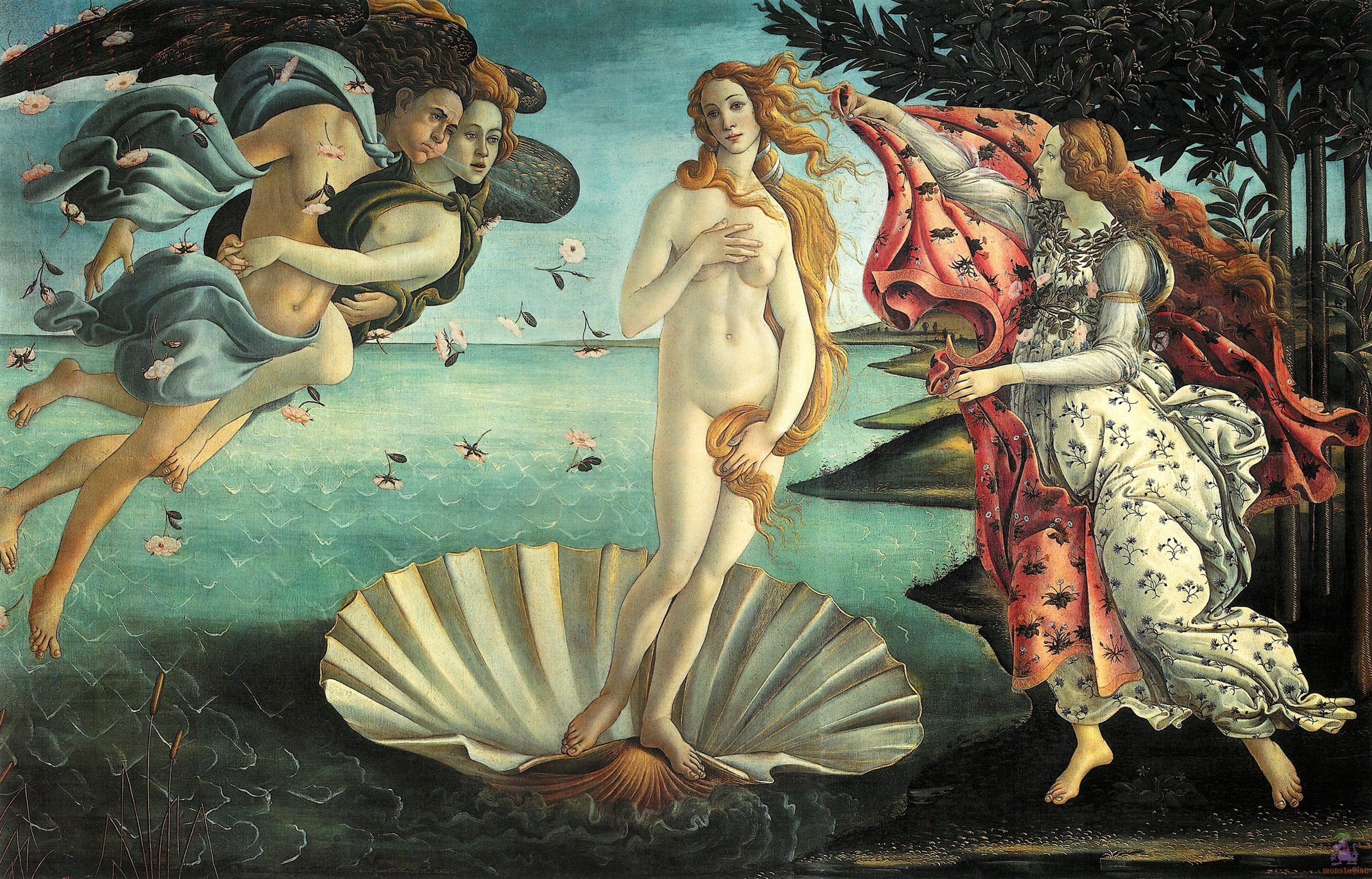
Sandro Botticelli painted The Birth of Venus around 1485 using tempera on canvas. The large painting measures 172.5 centimetres by 278.5 centimetres. Contrary to the title, the artwork does not depict the exact moment of the goddess emerging from the sea waves. Botticelli instead depicts her arrival at Paphos in Cyprus after travelling across the water on a giant gilded scallop shell.
The ancient Greek myth behind the scene is violent and gruesome. The god Saturn, also known as Cronus, castrated his father Uranus and threw his severed genitals into the ocean. The ocean waters were fertilised by this act, resulting in the creation of Venus. Botticelli altered the narrative by removing all gory details, presenting a delicate and harmonious scene to his audience.
Botticelli rendered the sea surface in a distinct, non-naturalistic style. He painted the water with simple V-shaped marks that transform into swirling patterns of lace-like foam near the shore. A flat blue sky sits behind the figures. Leonardo da Vinci later noted Botticelli's lack of interest in natural landscape painting, observing that Botticelli seemed to create background scenes simply by throwing a sponge soaked with colour against the canvas.
Sea Foam and Humanist Philosophy
The depiction of sea foam carries specific linguistic connections to the original myth. In Italian, the word schiuma translates to sea foam, but it also functioned as a slang term for semen. Viewers in fifteenth-century Florence understood this connection between the sea foam and the generative act that birthed the goddess from the ocean.
Humanist scholars associated with the Medici family provided a refined interpretation of the ocean myth. Marsilio Ficino, a leading philosopher of the Platonic Academy at the Medicean Villa Careggi, argued that the story should be understood symbolically rather than literally. Ficino asserted that the birth of Venus represented the birth of beauty in the human mind when fertilised by divinity.
This philosophical reinterpretation transformed the ocean from a site of mythological violence into a symbol of spiritual awakening. Ficino argued that contemplating earthly beauty allows the human soul to move upward toward divine beauty and God. The sea in Botticelli's painting thus fulfils a double purpose, combining pagan narrative elements with accepted Christian ideas.
Technical Canvas and Decorative Gold
Botticelli chose canvas as the painting surface for The Birth of Venus. In fifteenth-century Italy, canvas was a less expensive material than the wooden panels typically used for religious altarpieces and court paintings. Canvas was the preferred material for nonreligious and mythological subjects commissioned to decorate private country villas.
The large physical dimensions of the painting made a wooden support impractical. A panel of that size would have been heavy and prone to structural issues. Recent research shows that The Birth of Venus was not painted as a direct counterpart to Botticelli's Primavera. The two paintings differ in size, technique, and structural composition, and they were painted during different phases of the artist's career.
Botticelli applied real gold pigment extensively across the canvas to emphasise the divine nature of the subject. He painted gold accents onto the scallop shell, the hair of Venus, and the surrounding trees. Each dark green leaf in the orange grove features a gold spine and outline, while short diagonal gold lines mark the tree trunks.
Figures of the Wind and Shore
On the left side of the canvas, two winged figures float through the air with entwined limbs. The ruddy male figure is Zephyr, the Greek god of the west wind, who blows vigorously to push Venus toward the shoreline. Entwined with him is Chloris, a nymph who sighs warm breath. Pink roses with golden centres fall through the air around them, echoing the legend that roses first appeared at the birth of Venus.
On the right shore, a female attendant stands ready to receive the goddess. This figure represents a nymph or one of the Horae, the Greek goddesses of the seasons who attended Venus. She holds out a pink cloak embroidered with spring flowers, including red and white daisies, yellow primroses, and blue cornflowers. An anemone flower growing near her feet signals the arrival of spring.
The attendant wears a myrtle garland, which was the sacred tree of Venus, along with a sash made of pink roses. Behind her lies a grove of flowering orange trees representing the sacred garden of the Hesperides. The small white blossoms are tipped with gold pigment, reinforcing the decorative quality of the background.
Compositional Models and Sacred Parallels
For the pose of Venus, Botticelli drew upon the classical Venus pudica or modest Venus model found in ancient Roman sculpture. The goddess stands with one hand placed over her breasts and the other covering her groin. Botticelli depicted her as a virginal figure intent on preserving her modesty, using long streams of blonde hair touched with gold to cover her body.
The structure of the painting relies on established Christian visual traditions despite its pagan subject. The formal arrangement of the central figure standing near water flanked by attendant figures mirrors traditional depictions of the Baptism of Christ. Additionally, the posture of the nymph reaching out with the cloak closely resembles contemporary paintings of the Annunciation to Mary.
A persistent legend claims that Botticelli modelled Venus after Simonetta Vespucci, the wife of Marco Vespucci and mistress of Giuliano de' Medici. Simonetta died before Botticelli created the painting. Botticelli used a similar facial type for both Venus and the Virgin Mary, reflecting Ficino's concept that both figures represent emanations of divine love.
Botticelli's Career and Name
Alessandro di Mariano di Vanni Filipepi acquired the name Botticelli through his family. His older brother Giovanni, a successful pawnbroker, was nicknamed Il Botticello, meaning the Little Barrel. Because Alessandro lived in his brother's household, locals began referring to him as Sandro del Botticello, which eventually shortened to Botticelli.
Under the patronage of Lorenzo de' Medici, Botticelli established himself as a prominent painter in late fifteenth-century Florence. His artistic technique combined decorative Gothic contours with the humanistic emotion and spatial perspective of Florentine painting. His work created an ideal of beauty that reappeared in later compositions such as The Calumny of Apelles.
Although later owned by Duke Cosimo I de' Medici, the original patron who commissioned The Birth of Venus remains unknown. The canvas now hangs in the Uffizi Gallery in Florence, where it remains one of the most recognised depictions of classical mythology from the Italian Renaissance.


.jpg)