


Rain and rivers covered the earth until only Parnassus remained above the waves, carrying Deucalion and Pyrrha to safety after nine days and nights. Once the waters withdrew, they cast stones behind them, creating men from Deucalion’s stones and women from Pyrrha’s.
The Flood of Deucalion
Rain fell over the earth while rivers broke from their courses. Zeus had resolved to destroy humanity because people had become wicked. He called on the god of the sea, and together they covered the land with water from the sky and from the earth. The flood rose over the highest mountains. Parnassus alone remained above the waves, with a small piece of dry ground at its summit. After nine days and nine nights, a vessel carrying Deucalion and Pyrrha came to rest there. Deucalion was the son of Prometheus. Pyrrha was the daughter of Epimetheus and Pandora, and his niece. They were the only human survivors.
When the waters withdrew, the sea returned to its shores and the rivers to their channels. In one account, the north wind cleared the clouds at Zeus’s command, while the sea god sent Triton to sound the retreat of the waters. Deucalion and Pyrrha left their vessel and offered a sacrifice to Zeus, the preserver of fugitives. They then went to the shrine of Themis beside the river Cephissus. The shrine was covered with seaweed, and its altar was cold. They prayed for humanity to be renewed.
Zeus heard them and sent Hermes to promise that their request would be granted. Themis then instructed them to cover their heads and throw the bones of their mother behind them. Deucalion and Pyrrha understood the words to mean the bones of Mother Earth, the rocks lying beside the river. They cast stones behind them as they walked. The stones thrown by Deucalion became men, while those thrown by Pyrrha became women. In this way, the human race began again.
Zeus and Lycaon
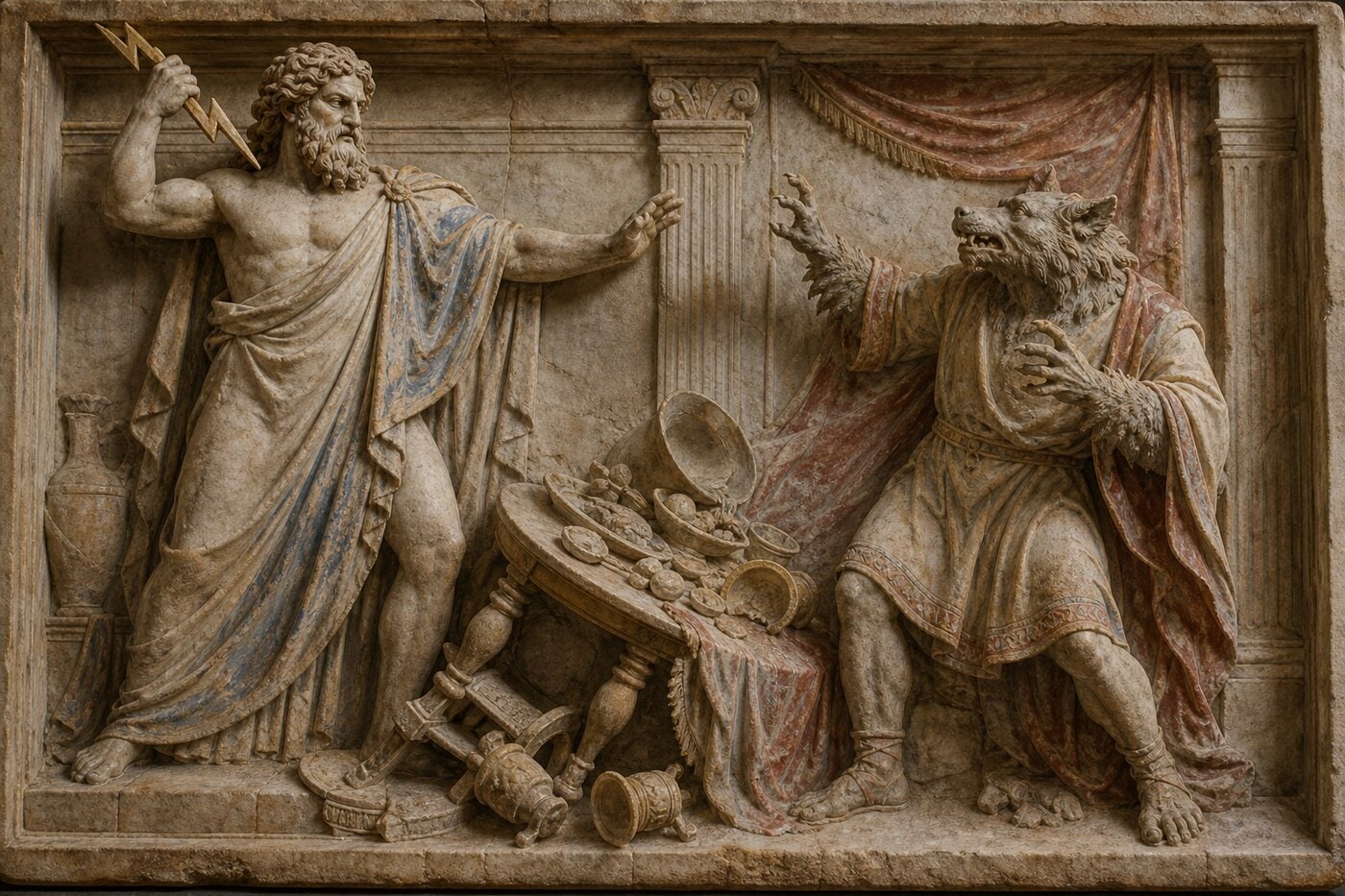
Zeus entered Arcadia in the form of a mortal to see whether reports of human wickedness were true. He reached the palace of Lycaon as twilight darkened the earth. He gave a sign that a god had arrived. The people prayed, but Lycaon mocked their worship. He decided to test the stranger and planned to kill him secretly during the night.
Lycaon then placed human flesh before his guest. Zeus recognised the deed and revealed himself. He overturned the table and punished the king by changing him into a wolf. Lycaon’s house was destroyed, either by a thunderbolt or by a flood. His punishment followed his contempt for the gods and his treatment of the divine visitor.
One account gives a different explanation for the feast. Lycaon had warned his subjects that Zeus often came to inspect their conduct. When he announced that the god would visit, some of his sons carried out the deed to discover whether the visitor was truly Zeus, since a god would recognise what they had done. In another version, Lycaon himself, angered by Zeus’s seduction of his daughter Callisto, served his grandson Areas to Zeus. Zeus overturned the table and changed Lycaon into a wolf in response.
Zeus and Typhon
Typhon rushed towards Olympus, and the gods fled in terror to Egypt. They disguised themselves as animals. Zeus became a ram, Apollo a crow, Dionysus a goat, Hera a white cow, Artemis a cat, Aphrodite a fish, and Ares a boar. Hermes became an ibis. Athene alone stayed behind and taunted Zeus for retreating. Zeus resumed his true form and attacked Typhon with thunderbolts.
Typhon was the child of Gaia and Tartarus, born in the Corycian Cave of Cilicia after the destruction of the Giants. He was the largest monster ever born. His legs were coiled serpents, his outstretched arms reached a hundred leagues in either direction, and countless serpent heads formed his hands. His ass-head touched the stars, his wings darkened the sun, fire flashed from his eyes, and flaming rocks came from his mouth. His many voices included the speech of a god, a bull’s bellow, a lion’s roar, a dog’s yelp, and a snake’s hiss. He challenged Zeus’s rule over gods and mortals.
In the continuing fight, Typhon overpowered Zeus and removed the sinews from his limbs. He gave Zeus’s thunderbolts to Gaia and went after the source of music played by Cadmus. Cadmus told him that he would enjoy a lyre strung with Zeus’s sinews, then hid the sinews in another cave and continued playing. While Typhon was distracted, Zeus recovered his thunderbolts. When the music stopped, Typhon returned to his cave and found the weapons gone. He unleashed destruction across the world. Animals were devoured, rivers turned to dust, and seas became dry land.
Hermes restored the sinews to Zeus in one account. Zeus returned to Olympus on a chariot drawn by winged horses and pursued Typhon with thunderbolts. At Mount Nysa, the Three Fates gave Typhon fruits that seemed to restore his strength but instead doomed him. At Mount Haemus, he hurled whole mountains at Zeus. Zeus struck them with thunderbolts, sending them back against Typhon and wounding him. Typhon fled to Sicily, where Zeus buried him beneath Mount Etna. Fire still belches from its cone.


