

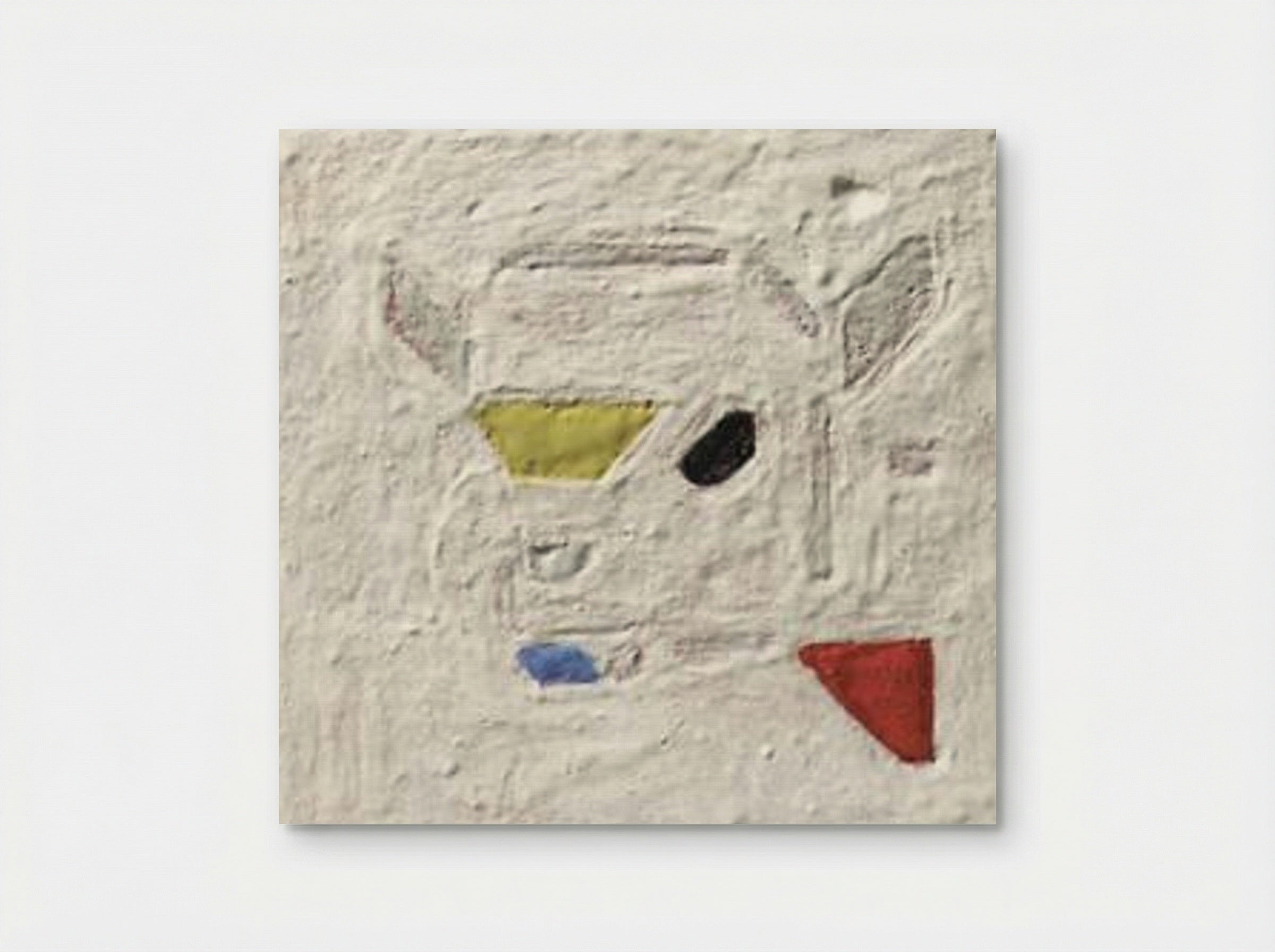
Young Goat - Bart van der Leck
Archival giclée
Frames arrive ready to hang
Secure checkout
Made to order
Description
An abstract depiction of a young goat by Dutch artist Bart van der Leck, rendered in simplified geometric shapes and a restrained palette of white, yellow, black, blue, and red. This work exemplifies the artist's association with the De Stijl movement.
Bart van der Leck (1876-1958) was a Dutch painter, designer, and ceramicist. He is associated with the De Stijl movement, known for its abstract geometric style. Van der Leck's work often features simplified forms and primary colours, reflecting the movement's emphasis on essential geometric forms and a limited colour palette. He aimed to create a universal visual language, reducing objects to their basic elements. His style evolved from representational to increasingly abstract, influencing the development of modern art in the Netherlands. He later distanced himself from the strict tenets of De Stijl, pursuing a more individual artistic path. 'Young Goat' exemplifies van der Leck's abstract style. The subject is rendered in a highly simplified manner, with the goat's form reduced to geometric shapes and lines. The colour palette is restrained, featuring white as the dominant colour, with small areas of yellow, black, blue, and red. The composition is flat, with minimal depth or perspective. The thick application of paint adds texture to the surface, enhancing the abstract quality of the work. The overall effect is a striking example of early abstract art, demonstrating van der Leck's exploration of form and colour.
Return policy
Because every print is made to order, we don't offer change-of-mind returns, refunds or exchanges. If your order arrives faulty, damaged or incorrect, we'll replace it free of charge — just contact us within 48 hours of delivery. See our refunds page for full details.
Shipping
We ship worldwide, printing at the production hub nearest to your delivery address. Delivery times and costs vary by destination — you'll see the options available to you at checkout.
Manufacturing
Each print is produced to order using 12-colour giclée printing on FSC-certified archival paper. Designed in Britain and printed at your nearest production hub to reduce waste and speed up delivery.
Care and materials
Specific Features
Every Solis piece is made to order with archival, gallery-quality materials built to last.
- Museum-grade giclée printing for rich, fade-resistant colour
- Archival matte fine-art paper, FSC-certified
- Multiple sizes and framing options available
- Frames in black, natural wood, dark wood or white
- Framed prints arrive ready to hang
Care & Cleaning
To keep your artwork looking its best:
- Dust gently with a soft, dry cloth
- Avoid prolonged direct sunlight
- Never use liquid cleaners on the print or canvas surface
- Keep in a dry, room-temperature space
- Handle prints with clean, dry hands
Materials & Sizing
Museum-grade giclée on FSC-certified archival matte paper, with framed and canvas options.
- Paper sizes: A4, A3, A2, A1, A0 and B2 (50×70 cm)
- Canvas: XS (20×30 cm) to Large (60×90 cm)
- Frames: black, natural wood, dark wood or white
Young Goat - Bart van der Leck

Artist Biography
Bart Van Der Leck
When Van der Leck, Mondrian, and Theo van Doesburg co-founded De Stijl in 1917, Van der Leck was already developing his signature method: abstraction from representational sources rather than from theory. His Triptych converts observational sketches made at a Spanish mine into forms that read as pure geometric composition. He was, as the critic Jed Rasula described it, literally ab-stracting: pulling observable subjects apart until only geometric coordinates remained.
The movement did not hold him long. Financial support from the art dealer and critic Hendrik Bremmer was central to Van der Leck's survival, and Bremmer's aesthetic tolerance had limits. As Van der Leck's painting became more abstract, Bremmer withdrew his allowance. Unlike Mondrian, who refused the same pressure and permanently lost that support, Van der Leck returned to figurative work to have it restored. He described Bremmer years later in Museumjournaal as generous but also stubborn and domineering, a patron determined to have his own way.
Away from easel painting, Van der Leck worked productively in applied design: interior commissions including the St Hubertus Hunting Lodge (1919-20), textile and packaging work for Metz and Co. from 1930, and a typeface he designed in 1941 for the avant-garde magazine Flax, later digitally revived as Architype van der Leck in 1994. He died in Blaricum in 1958, aged 81.
Why Choose Us ?
Damage-free delivery guarantee
Fast Shipping
Museum-Quality Materials
You May Also Like