

Fine Art Poster
From £28
A giclée print on 200gsm matte fine art paper, using a twelve-colour process for accurate, fade-resistant colour. Supplied unframed, delivered flat or rolled.



Archival giclée
Frames arrive ready to hang
Secure checkout
Made to order
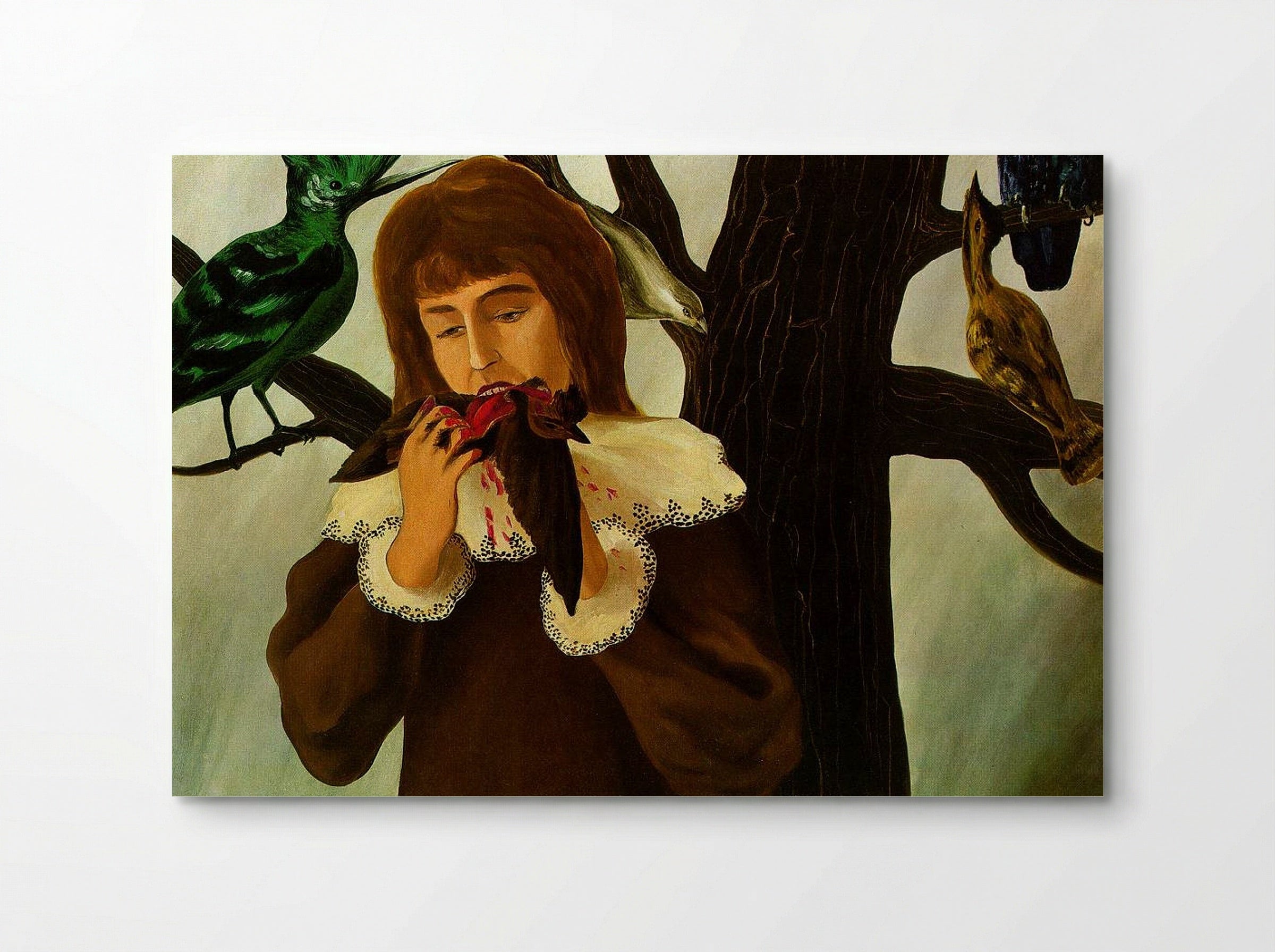
René Magritte's unsettling 1927 painting, Young Girl Eating a Bird (The Pleasure), juxtaposes innocence and violence, depicting a young girl consuming a bird amid oblivious perched birds, challenging conventional notions of beauty and pleasure.
René Magritte's 1927 painting, Young Girl Eating a Bird (The Pleasure), presents a disquieting scene that challenges conventional notions of beauty and innocence. The painting depicts a young girl, dressed in a brown frock with a lace-trimmed collar, consuming a bird with evident bloodstains around her mouth and hands. This central figure is framed by a stark, leafless tree, upon whose branches several birds perch, seemingly oblivious to the gruesome act taking place below. The birds themselves are rendered in a variety of colours, including green, brown, and blue-grey, adding to the unsettling atmosphere. Magritte's work often explores the uncanny and the paradoxical, and this painting is no exception. The juxtaposition of the girl's youthful appearance with the violent act creates a sense of unease, prompting viewers to question the nature of pleasure and the hidden aspects of human nature. The painting's dreamlike quality is characteristic of Surrealism, an art movement that sought to unlock the creative potential of the unconscious mind. The flat, almost naive style of painting further enhances the unsettling effect, drawing attention to the symbolic content of the image rather than its realistic representation.
Because every print is made to order, we don't offer change-of-mind returns, refunds or exchanges. If your order arrives faulty, damaged or incorrect, we'll replace it free of charge — just contact us within 48 hours of delivery. See our refunds page for full details.
We ship worldwide, printing at the production hub nearest to your delivery address. Delivery times and costs vary by destination — you'll see the options available to you at checkout.
Each print is produced to order using 12-colour giclée printing on FSC-certified archival paper. Designed in Britain and printed at your nearest production hub to reduce waste and speed up delivery.

Artist Biography
Our Features
Designed for Lasting Impact
Every Solis piece is made to order with archival, gallery-quality materials built to last.
To keep your artwork looking its best:
Museum-grade giclée on FSC-certified archival matte paper, with framed and canvas options.
Made to order
Every piece is printed to order. These are the five finishes, and what makes each one different.
From £28
A giclée print on 200gsm matte fine art paper, using a twelve-colour process for accurate, fade-resistant colour. Supplied unframed, delivered flat or rolled.

From £45
The same fine art print in a solid wood frame with UV-protective acrylic glaze and rigid backing. Five frame colours. Arrives ready to hang.
Why Choose Us ?
Damage-free delivery guarantee
Fast Shipping
Museum-Quality Materials
Artist Biography
René Magritte
You May Also Like
We use cookies to measure our marketing and see which prints people love.We use cookies to measure our marketing.
By continuing to browse, you agree · Privacy Policy