

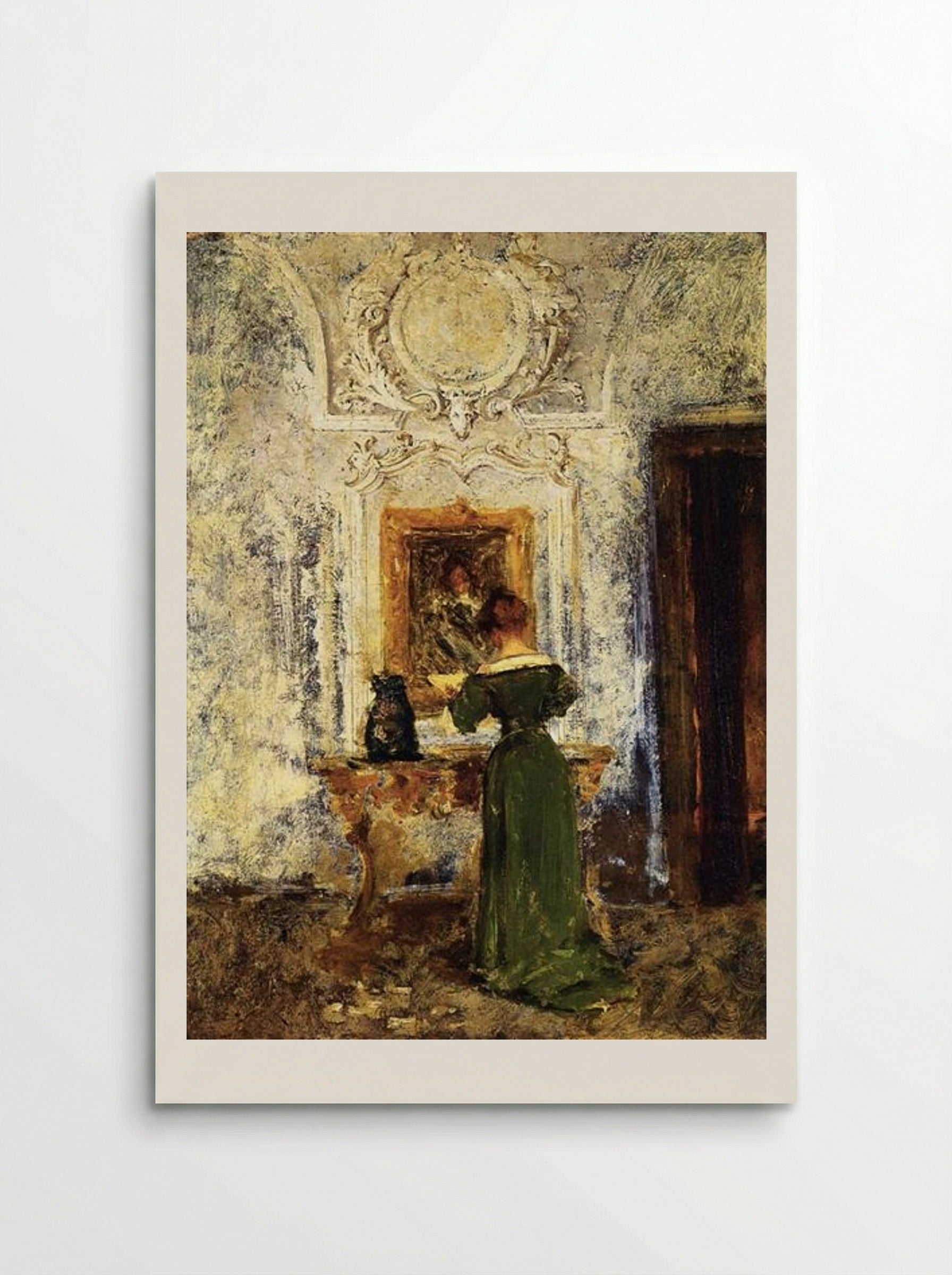
Woman in Green - William Merritt Chase
Archival giclée
Frames arrive ready to hang
Secure checkout
Made to order
Description
A woman in a green gown stands before a gilded console table, examining a painting in William Merritt Chase's "Woman in Green". The painting exemplifies Chase's American Impressionist style.
William Merritt Chase's "Woman in Green" presents a woman standing before a gilded console table, her back turned to the viewer. She is dressed in a long, dark green gown with a white collar. A small black dog sits on the table beside her. The woman appears to be examining a painting hanging on the wall, which depicts two figures in a similar style to Chase's own work. The setting is an ornate interior, with decorative plasterwork and a dark doorway visible in the background. Chase's loose brushwork and attention to light create an atmospheric effect, typical of American Impressionism. The composition is carefully arranged, drawing the eye through the space and inviting contemplation on the relationship between the woman, the artwork, and the surrounding environment. The painting's muted palette and intimate scale contribute to its quiet, contemplative mood. Chase was known for his portraits and interior scenes, often depicting women in elegant settings.
Return policy
Because every print is made to order, we don't offer change-of-mind returns, refunds or exchanges. If your order arrives faulty, damaged or incorrect, we'll replace it free of charge — just contact us within 48 hours of delivery. See our refunds page for full details.
Shipping
We ship worldwide, printing at the production hub nearest to your delivery address. Delivery times and costs vary by destination — you'll see the options available to you at checkout.
Manufacturing
Each print is produced to order using 12-colour giclée printing on FSC-certified archival paper. Designed in Britain and printed at your nearest production hub to reduce waste and speed up delivery.
Woman in Green - William Merritt Chase

Artist Biography
William Merritt Chase
He studied at the Royal Academy of Munich, came home with a technique influenced by Velazquez and the dark tonalities of the old Dutch masters, and became one of the most important art teachers in American history. His pupils included Georgia O'Keeffe, Edward Hopper, Charles Sheeler, Joseph Stella, Marsden Hartley and Rockwell Kent. The list reads like a syllabus for twentieth-century American art.
In 1891 he founded the Shinnecock Hills Summer School on Long Island, the first plein-air painting school in the United States. His friend Stanford White designed his summer house there, with an integral studio. He taught outdoors, painting the dunes and scrubland of the South Fork with a luminous palette that anticipated the Impressionism he would later formally adopt. He was invited to join The Ten, the leading American Impressionist group, in 1902.
His most famous still-life subject was dead fish: whole fish lying on a plate against a dark background, painted with the same tonal precision he brought to landscapes and portraits. The subject sounds monotonous but the paintings are extraordinary, each fish rendered as an individual study in colour and light.
He was not modest. He decorated his studio with antiques and costumes and posed for photographs wearing a top hat. He believed art was a serious profession that deserved serious presentation, which for Chase meant looking like he meant it.
Our Features
Designed for Lasting Impact
Specific Features
Every Solis piece is made to order with archival, gallery-quality materials built to last.
- Museum-grade giclée printing for rich, fade-resistant colour
- Archival matte fine-art paper, FSC-certified
- Multiple sizes and framing options available
- Frames in black, natural wood, dark wood or white
- Framed prints arrive ready to hang
Care & Cleaning
To keep your artwork looking its best:
- Dust gently with a soft, dry cloth
- Avoid prolonged direct sunlight
- Never use liquid cleaners on the print or canvas surface
- Keep in a dry, room-temperature space
- Handle prints with clean, dry hands
Materials & Sizing
Museum-grade giclée on FSC-certified archival matte paper, with framed and canvas options.
- Paper sizes: A4, A3, A2, A1, A0 and B2 (50×70 cm)
- Canvas: XS (20×30 cm) to Large (60×90 cm)
- Frames: black, natural wood, dark wood or white
Why Choose Us ?
Damage-free delivery guarantee
Fast Shipping
Museum-Quality Materials
Artist Biography
William Merritt Chase
He studied at the Royal Academy of Munich, came home with a technique influenced by Velazquez and the dark tonalities of the old Dutch masters, and became one of the most important art teachers in American history. His pupils included Georgia O'Keeffe, Edward Hopper, Charles Sheeler, Joseph Stella, Marsden Hartley and Rockwell Kent. The list reads like a syllabus for twentieth-century American art.
In 1891 he founded the Shinnecock Hills Summer School on Long Island, the first plein-air painting school in the United States. His friend Stanford White designed his summer house there, with an integral studio. He taught outdoors, painting the dunes and scrubland of the South Fork with a luminous palette that anticipated the Impressionism he would later formally adopt. He was invited to join The Ten, the leading American Impressionist group, in 1902.
His most famous still-life subject was dead fish: whole fish lying on a plate against a dark background, painted with the same tonal precision he brought to landscapes and portraits. The subject sounds monotonous but the paintings are extraordinary, each fish rendered as an individual study in colour and light.
He was not modest. He decorated his studio with antiques and costumes and posed for photographs wearing a top hat. He believed art was a serious profession that deserved serious presentation, which for Chase meant looking like he meant it.
You May Also Like