

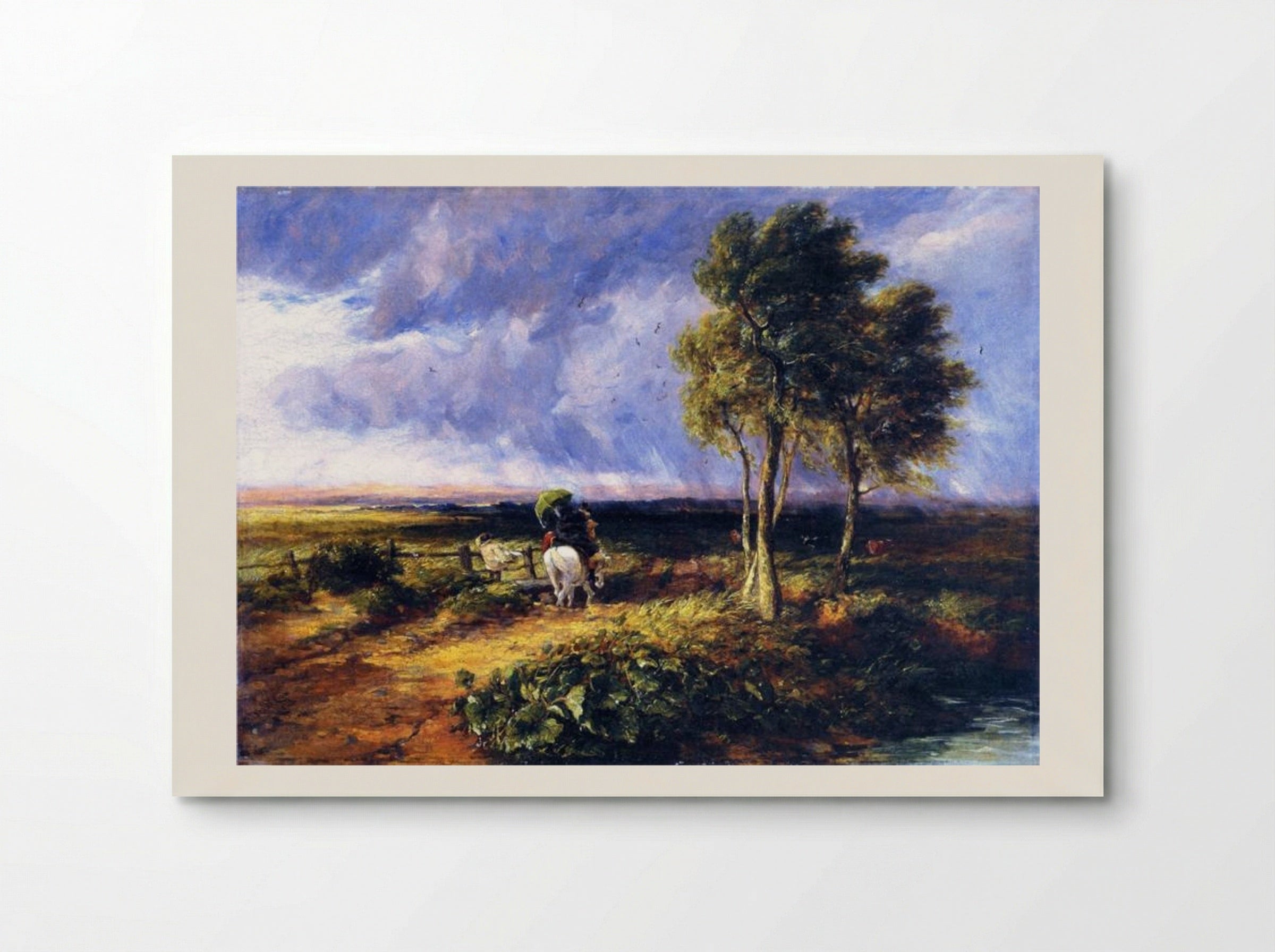
Wind, Rain and Sunshine - David Cox
Archival giclée
Frames arrive ready to hang
Secure checkout
Made to order
Description
A figure on a white horse travels through a blustery British landscape under a changing sky. David Cox uses loose brushwork to capture the physical sensation of wind and rain.
David Cox painted this work during his later period when he increasingly turned to oil as a medium. The composition depicts a figure on a white horse navigating a path during a sudden change in weather. A green umbrella provides some protection against the elements. The trees on the right lean heavily under the force of the wind. The sky shows a mixture of dark rain clouds and patches of bright light. Cox was a member of the Birmingham School. He is often associated with the transition between traditional topographical art and the more expressive styles of the mid-nineteenth century. His brushwork here is loose and energetic. He used thick applications of paint to convey the physical sensation of the wind and the dampness of the air. This technique differs from his earlier, more precise watercolour works. The artist moved to Harborne, near Birmingham, in 1841. This move allowed him to focus on oil painting and explore the effects of light and weather on the English countryside. The scene captures the atmospheric instability of the British climate. The low horizon line allows the sky to dominate the upper two-thirds of the canvas. Birds are visible in the distance, scattered by the gusts. The foreground contains rough vegetation and a muddy track. These elements are rendered with earthy tones that contrast with the cool blues and greys of the storm. The white horse acts as a bright point of contrast against the dark, shadowed ground. Cox often visited the coast of North Wales and the sands of Lancashire. These locations provided the inspiration for his studies of shifting weather patterns. This painting is currently held in the collection of the Birmingham Museum and Art Gallery.
Return policy
Because every print is made to order, we don't offer change-of-mind returns, refunds or exchanges. If your order arrives faulty, damaged or incorrect, we'll replace it free of charge — just contact us within 48 hours of delivery. See our refunds page for full details.
Shipping
We ship worldwide, printing at the production hub nearest to your delivery address. Delivery times and costs vary by destination — you'll see the options available to you at checkout.
Manufacturing
Each print is produced to order using 12-colour giclée printing on FSC-certified archival paper. Designed in Britain and printed at your nearest production hub to reduce waste and speed up delivery.
Wind, Rain and Sunshine - David Cox

Artist Biography
David Cox
He was born in Birmingham in 1783 and was largely self-taught. He became one of the great masters of the English watercolour tradition, painting Welsh and English landscapes with a directness that his contemporaries found crude. He taught drawing for much of his life and published influential treatises on watercolour technique. He died in 1859.
Our Features
Designed for Lasting Impact
Specific Features
Every Solis piece is made to order with archival, gallery-quality materials built to last.
- Museum-grade giclée printing for rich, fade-resistant colour
- Archival matte fine-art paper, FSC-certified
- Multiple sizes and framing options available
- Frames in black, natural wood, dark wood or white
- Framed prints arrive ready to hang
Care & Cleaning
To keep your artwork looking its best:
- Dust gently with a soft, dry cloth
- Avoid prolonged direct sunlight
- Never use liquid cleaners on the print or canvas surface
- Keep in a dry, room-temperature space
- Handle prints with clean, dry hands
Materials & Sizing
Museum-grade giclée on FSC-certified archival matte paper, with framed and canvas options.
- Paper sizes: A4, A3, A2, A1, A0 and B2 (50×70 cm)
- Canvas: XS (20×30 cm) to Large (60×90 cm)
- Frames: black, natural wood, dark wood or white
Why Choose Us ?
Damage-free delivery guarantee
Fast Shipping
Museum-Quality Materials
Artist Biography
David Cox
He was born in Birmingham in 1783 and was largely self-taught. He became one of the great masters of the English watercolour tradition, painting Welsh and English landscapes with a directness that his contemporaries found crude. He taught drawing for much of his life and published influential treatises on watercolour technique. He died in 1859.
You May Also Like