

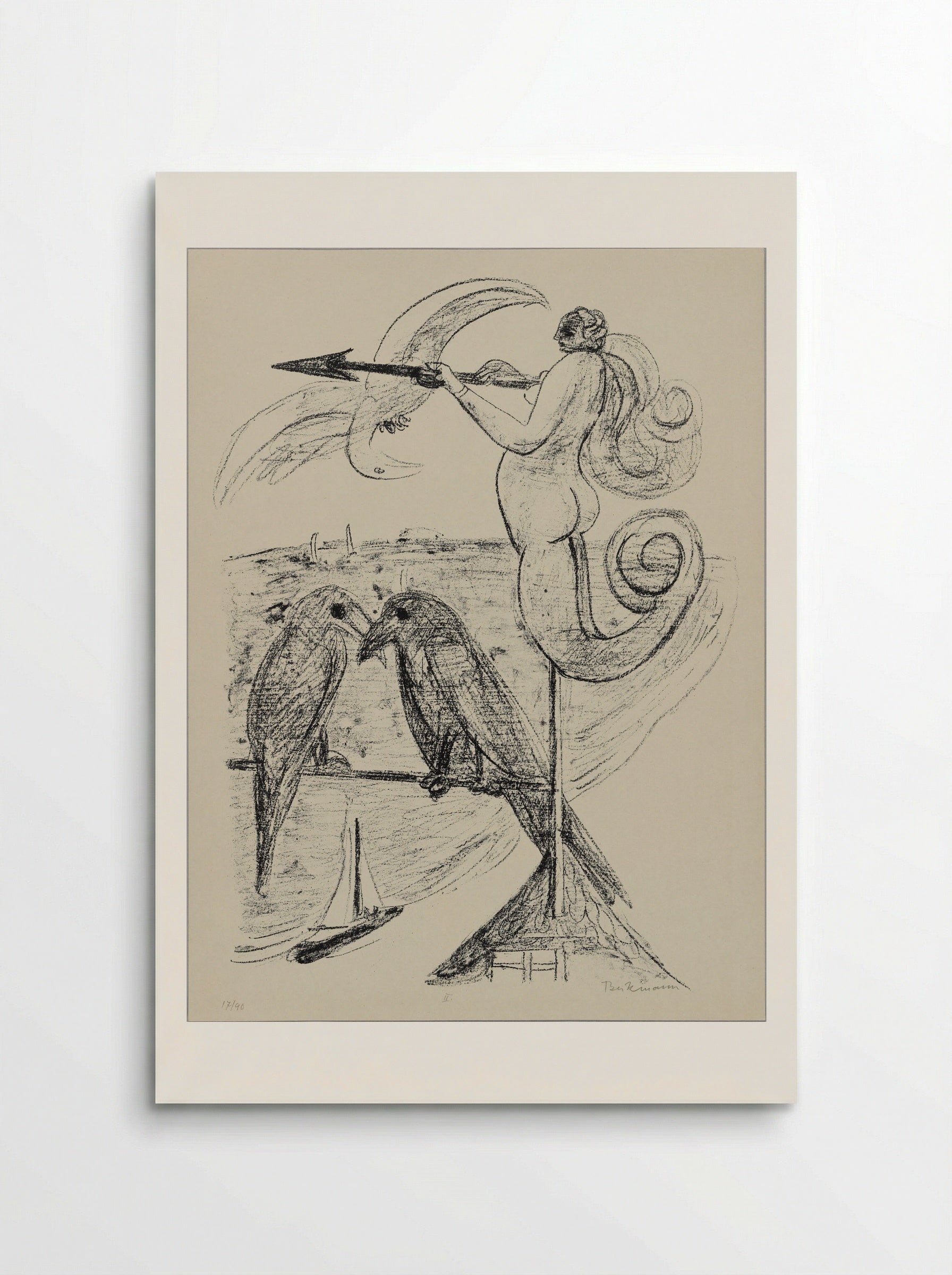
Weather Vane - Max Beckmann
Archival giclée
Frames arrive ready to hang
Secure checkout
Made to order
Description
A 1946 lithograph by Max Beckmann from the Day and Dream portfolio. It features a mermaid weather vane and two large birds rendered in bold, expressive lines.
Max Beckmann produced Weather Vane in 1946 as part of his Day and Dream portfolio. This series consists of fifteen lithographs commissioned by the dealer Curt Valentin in New York. Beckmann was living in Amsterdam at the time, having moved there after his work was labelled degenerate by the German authorities. The portfolio represents a period of transition before his eventual move to the United States in 1947. The composition features a weather vane in the form of a mermaid or siren. She holds a large arrow and sits atop a vertical pole. Her form is defined by heavy, black lithographic crayon marks that create a sense of weight. Below her, two large birds perch on a horizontal bar. These avian figures occupy the middle ground with their dark and textured plumage. In the lower left, a small sailboat moves across a body of water, providing a sense of scale and distance. Beckmann used a transfer lithography technique for this series. He drew directly onto specially prepared paper, which was then transferred to the lithographic stone. This method preserved the immediate and sketch-like quality of his hand. The lines are thick and expressive, which is a hallmark of his late style. He avoided traditional perspective, instead stacking elements vertically to create a compressed space. This lack of depth is common in his work from the 1940s. The imagery in Weather Vane is symbolic but remains open to interpretation. Beckmann often used mythological or circus motifs to comment on the human condition. The siren and the birds suggest themes of direction, fate, or observation. The contrast between the heavy black ink and the cream-coloured paper emphasises the graphic strength of the work. Beckmann used these bold forms to create a narrative that avoids easy explanation.
Return policy
Because every print is made to order, we don't offer change-of-mind returns, refunds or exchanges. If your order arrives faulty, damaged or incorrect, we'll replace it free of charge — just contact us within 48 hours of delivery. See our refunds page for full details.
Shipping
We ship worldwide, printing at the production hub nearest to your delivery address. Delivery times and costs vary by destination — you'll see the options available to you at checkout.
Manufacturing
Each print is produced to order using 12-colour giclée printing on FSC-certified archival paper. Designed in Britain and printed at your nearest production hub to reduce waste and speed up delivery.
Weather Vane - Max Beckmann
Our Features
Designed for Lasting Impact
Specific Features
Every Solis piece is made to order with archival, gallery-quality materials built to last.
- Museum-grade giclée printing for rich, fade-resistant colour
- Archival matte fine-art paper, FSC-certified
- Multiple sizes and framing options available
- Frames in black, natural wood, dark wood or white
- Framed prints arrive ready to hang
Care & Cleaning
To keep your artwork looking its best:
- Dust gently with a soft, dry cloth
- Avoid prolonged direct sunlight
- Never use liquid cleaners on the print or canvas surface
- Keep in a dry, room-temperature space
- Handle prints with clean, dry hands
Materials & Sizing
Museum-grade giclée on FSC-certified archival matte paper, with framed and canvas options.
- Paper sizes: A4, A3, A2, A1, A0 and B2 (50×70 cm)
- Canvas: XS (20×30 cm) to Large (60×90 cm)
- Frames: black, natural wood, dark wood or white
Why Choose Us ?
Damage-free delivery guarantee
Fast Shipping
Museum-Quality Materials

Artist Biography
Max Beckmann
He was born in Leipzig in 1884 and trained at the Weimar Academy. His early work was relatively conventional; the First World War, where he served as a medical orderly, shattered both his style and his psychology. The paintings that followed, dense, allegorical, packed with symbolic figures in compressed, claustrophobic spaces, resist easy classification. His monumental triptychs, painted in exile in Amsterdam and later St Louis, combine mythology, autobiography and contemporary history.
He remains one of the twentieth century's most ambitious figurative painters, comparable in scale and intention to Picasso but less interested in formal innovation than in moral weight. He died in New York in 1950, at sixty-five.
You May Also Like