

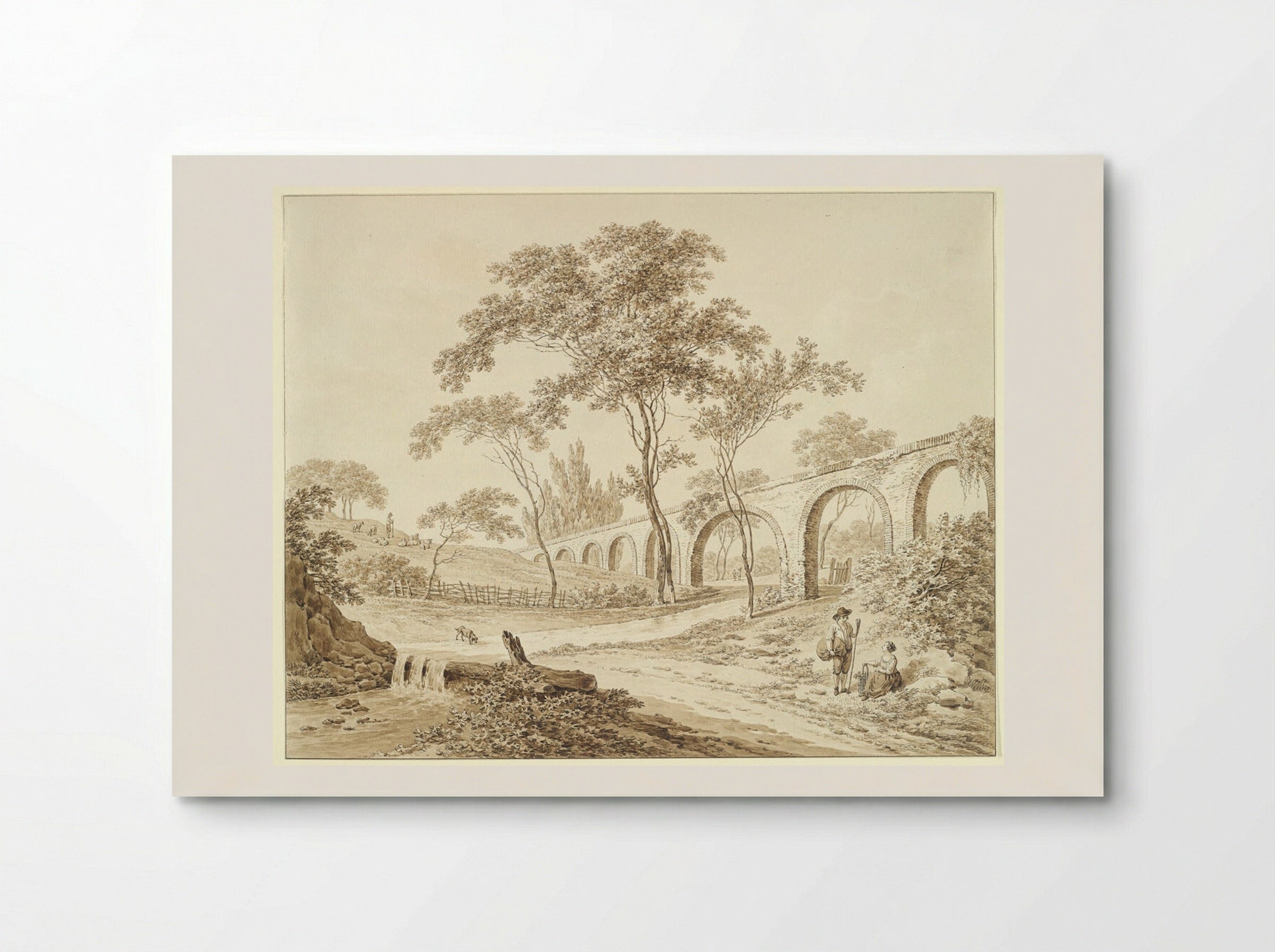
Vue Pres de Sala, dans le Duche de Parme - Daniel Dupré
Archival giclée
Frames arrive ready to hang
Secure checkout
Made to order
Description
A detailed pen and wash drawing by Daniel Dupré, capturing a tranquil rural scene with an aqueduct in the Duchy of Parma.
This work by Daniel Dupré depicts a serene rural scene near Sala, located within the Duchy of Parma. Dupré, a Dutch artist who spent significant time in Italy, was known for his precise topographical studies and his ability to capture the specific character of the Italian countryside. The composition is anchored by a long, multi-arched stone aqueduct that stretches across the middle ground, providing a sense of architectural order against the natural forms of the trees and rolling hills. In the foreground, the artist employs a delicate use of wash to define the textures of the rocky stream and the grassy bank. A small waterfall flows over a fallen log, adding a sense of movement to the quiet scene. Two figures, a man carrying a pack and a seated woman, occupy the lower right, providing a sense of scale and human presence. The use of pen and brown ink allows for fine detail in the foliage and the masonry of the aqueduct, while the grey wash creates soft shadows and depth across the composition. Dupré's approach reflects the 18th-century interest in documenting the classical and rural architecture of Italy. His work avoids excessive ornamentation, focusing instead on the clarity of form and the atmospheric quality of the light. The drawing demonstrates a mastery of perspective, guiding the viewer's eye from the immediate foreground, past the figures, and along the rhythmic repetition of the aqueduct arches towards the distant horizon. This piece is a representative example of the artist's output during his travels, documenting the intersection of human engineering and the natural world.
Return policy
Because every print is made to order, we don't offer change-of-mind returns, refunds or exchanges. If your order arrives faulty, damaged or incorrect, we'll replace it free of charge — just contact us within 48 hours of delivery. See our refunds page for full details.
Shipping
We ship worldwide, printing at the production hub nearest to your delivery address. Delivery times and costs vary by destination — you'll see the options available to you at checkout.
Manufacturing
Each print is produced to order using 12-colour giclée printing on FSC-certified archival paper. Designed in Britain and printed at your nearest production hub to reduce waste and speed up delivery.
Care and materials
Specific Features
Every Solis piece is made to order with archival, gallery-quality materials built to last.
- Museum-grade giclée printing for rich, fade-resistant colour
- Archival matte fine-art paper, FSC-certified
- Multiple sizes and framing options available
- Frames in black, natural wood, dark wood or white
- Framed prints arrive ready to hang
Care & Cleaning
To keep your artwork looking its best:
- Dust gently with a soft, dry cloth
- Avoid prolonged direct sunlight
- Never use liquid cleaners on the print or canvas surface
- Keep in a dry, room-temperature space
- Handle prints with clean, dry hands
Materials & Sizing
Museum-grade giclée on FSC-certified archival matte paper, with framed and canvas options.
- Paper sizes: A4, A3, A2, A1, A0 and B2 (50×70 cm)
- Canvas: XS (20×30 cm) to Large (60×90 cm)
- Frames: black, natural wood, dark wood or white
Vue Pres de Sala, dans le Duche de Parme - Daniel Dupré
Why Choose Us ?
Damage-free delivery guarantee
Fast Shipping
Museum-Quality Materials
You May Also Like