

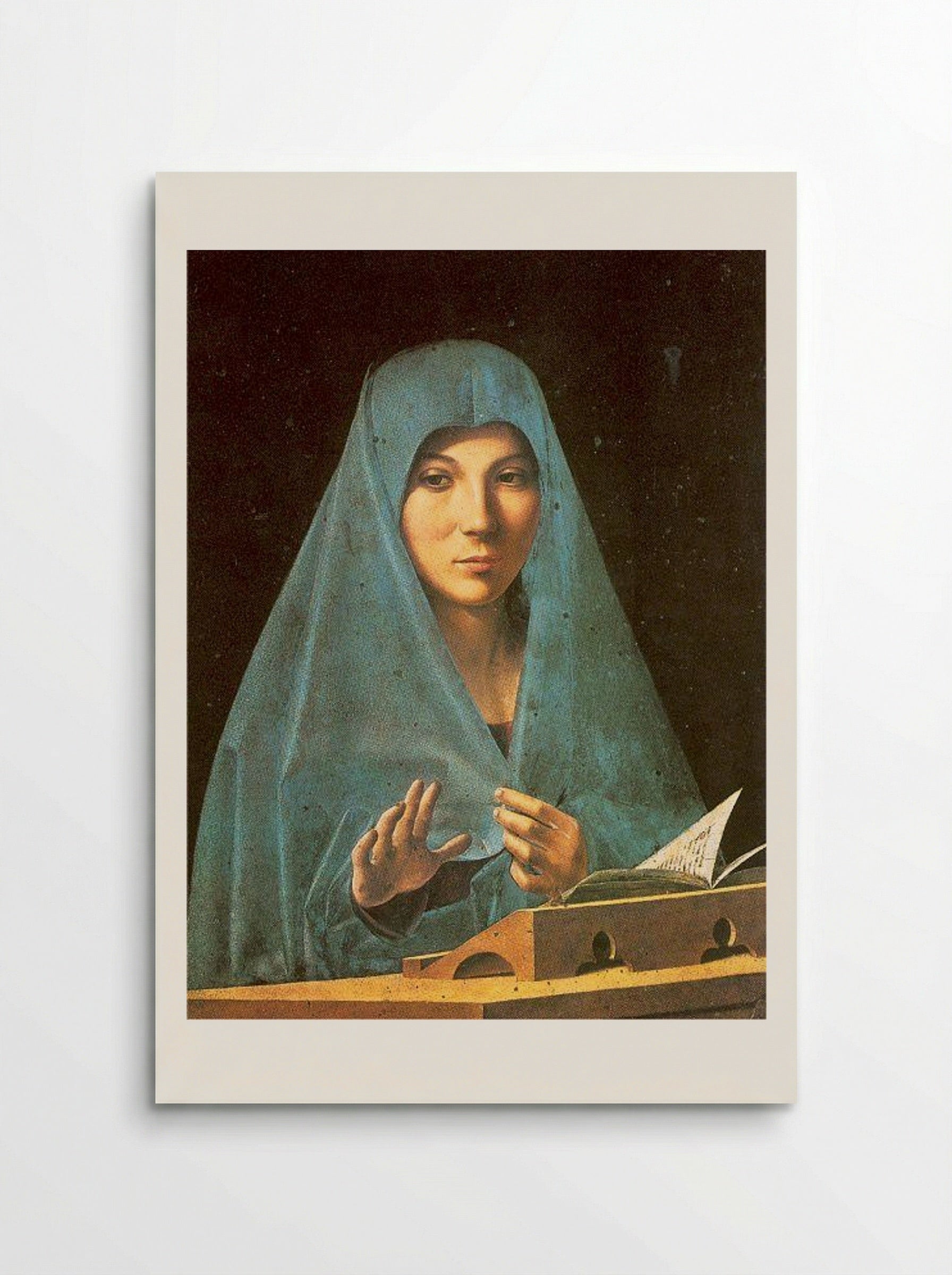
Virgin Annunciate - Antonello da Messina
Archival giclée
Frames arrive ready to hang
Secure checkout
Made to order
Description
A masterful Early Renaissance portrait by Antonello da Messina, depicting the Virgin Mary in a moment of quiet contemplation.
Antonello da Messina, a Sicilian painter active during the fifteenth century, produced this work during a period when he successfully integrated Northern European oil painting techniques with the structural clarity of the Italian Renaissance. The Virgin Annunciate depicts the Virgin Mary at the moment of the Annunciation, captured in a half-length portrait format that focuses entirely on her psychological state rather than a complex narrative setting. Against a dark, neutral background, the figure of Mary emerges with remarkable three-dimensional presence. She is wrapped in a deep blue mantle, which frames her face and creates a sense of volume through carefully rendered folds. Her right hand is raised in a gesture of surprise or acceptance, while her left hand gently holds the edge of her garment. Before her sits a wooden lectern with an open book, providing a horizontal anchor for the composition. The lighting is directional, casting soft shadows that define the contours of her face and the texture of her veil. This use of light, combined with the precise application of oil paint, allows for a level of realism that was highly advanced for the time. The painting is notable for its economy of means. By stripping away extraneous detail, Antonello directs the viewer to the Virgin's expression, which conveys a mixture of humility and awareness. The work demonstrates the artist's ability to synthesise the meticulous detail characteristic of Flemish masters with the monumental form favoured by his Italian contemporaries. It remains a primary example of the portraiture style developed in Sicily during the late fifteenth century, prioritising human emotion and physical presence over elaborate iconography.
Return policy
Because every print is made to order, we don't offer change-of-mind returns, refunds or exchanges. If your order arrives faulty, damaged or incorrect, we'll replace it free of charge — just contact us within 48 hours of delivery. See our refunds page for full details.
Shipping
We ship worldwide, printing at the production hub nearest to your delivery address. Delivery times and costs vary by destination — you'll see the options available to you at checkout.
Manufacturing
Each print is produced to order using 12-colour giclée printing on FSC-certified archival paper. Designed in Britain and printed at your nearest production hub to reduce waste and speed up delivery.
Virgin Annunciate - Antonello da Messina

Artist Biography
Antonello Da Messina
His early St Jerome in His Study (c.1456, 46 x 36 cm, National Gallery, London) shows the synthesis already complete: Flemish precision in the still-life objects and tiled floors, combined with a system of perspective more rigorous than the Netherlandish masters ever attempted. It is a small picture that feels entirely worked out.
The decisive episode came in 1475-76, when he visited Venice and painted the San Cassiano Altarpiece for the church of San Cassiano. The altarpiece was dismembered in the 17th century; only fragments survive in Vienna's Kunsthistorisches Museum. His contact with Giovanni Bellini during this visit generated one of the great productive arguments in art history: scholars still dispute who influenced whom. Either way, Venetian painting was different afterwards.
He returned to Messina and died there in 1479. His late Virgin Annunciate (c.1475, 34.5 x 44.5 cm, Galleria Nazionale, Palermo), showing the Madonna without the angel Gabriel, demonstrates how far he had travelled from his sources: the geometric stillness and internal luminosity are entirely his own.
Our Features
Designed for Lasting Impact
Specific Features
Every Solis piece is made to order with archival, gallery-quality materials built to last.
- Museum-grade giclée printing for rich, fade-resistant colour
- Archival matte fine-art paper, FSC-certified
- Multiple sizes and framing options available
- Frames in black, natural wood, dark wood or white
- Framed prints arrive ready to hang
Care & Cleaning
To keep your artwork looking its best:
- Dust gently with a soft, dry cloth
- Avoid prolonged direct sunlight
- Never use liquid cleaners on the print or canvas surface
- Keep in a dry, room-temperature space
- Handle prints with clean, dry hands
Materials & Sizing
Museum-grade giclée on FSC-certified archival matte paper, with framed and canvas options.
- Paper sizes: A4, A3, A2, A1, A0 and B2 (50×70 cm)
- Canvas: XS (20×30 cm) to Large (60×90 cm)
- Frames: black, natural wood, dark wood or white
Why Choose Us ?
Damage-free delivery guarantee
Fast Shipping
Museum-Quality Materials
Artist Biography
Antonello da Messina
His early St Jerome in His Study (c.1456, 46 x 36 cm, National Gallery, London) shows the synthesis already complete: Flemish precision in the still-life objects and tiled floors, combined with a system of perspective more rigorous than the Netherlandish masters ever attempted. It is a small picture that feels entirely worked out.
The decisive episode came in 1475-76, when he visited Venice and painted the San Cassiano Altarpiece for the church of San Cassiano. The altarpiece was dismembered in the 17th century; only fragments survive in Vienna's Kunsthistorisches Museum. His contact with Giovanni Bellini during this visit generated one of the great productive arguments in art history: scholars still dispute who influenced whom. Either way, Venetian painting was different afterwards.
He returned to Messina and died there in 1479. His late Virgin Annunciate (c.1475, 34.5 x 44.5 cm, Galleria Nazionale, Palermo), showing the Madonna without the angel Gabriel, demonstrates how far he had travelled from his sources: the geometric stillness and internal luminosity are entirely his own.
You May Also Like