

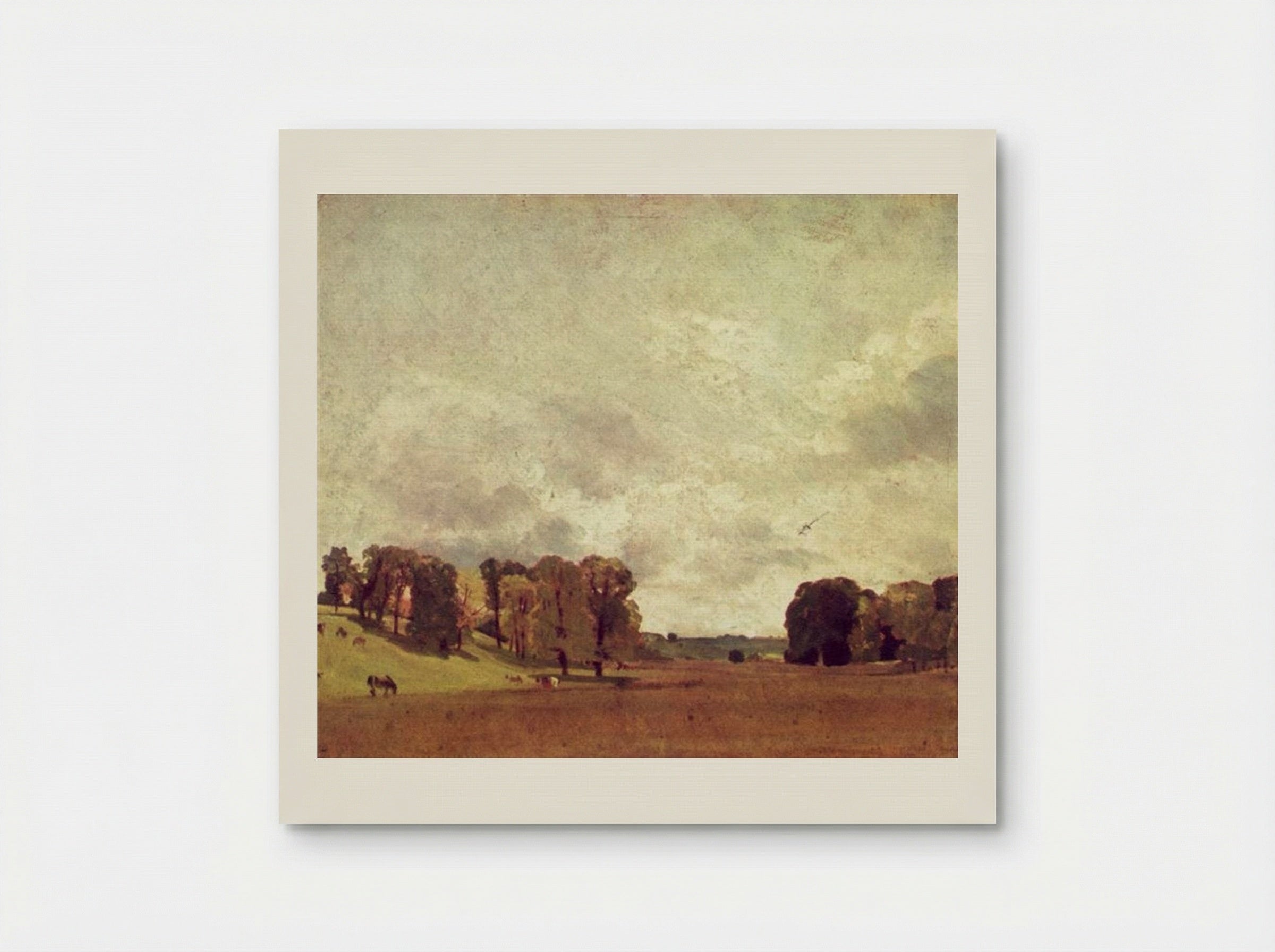
View at Epsom - John Constable
Archival giclée
Frames arrive ready to hang
Secure checkout
Made to order
Description
A tranquil landscape by John Constable, 'View at Epsom' captures the essence of the English countryside with its broad vista, expressive brushwork, and earthy tones.
John Constable, a leading figure in British Romantic painting, is celebrated for his depictions of the English countryside. Born in Suffolk, he developed a deep connection with the natural world, which became the central theme of his art. Constable's approach involved close observation of nature, capturing the changing effects of light and weather. He sought to convey the emotional and atmospheric qualities of the landscape, rather than simply creating topographical records. His innovative techniques, including the use of broken colour and impasto, added a sense of immediacy and vitality to his paintings. 'View at Epsom' exemplifies Constable's skill in capturing the essence of the English countryside. The painting presents a broad, open vista, with a focus on the sky and its effects on the land below. Trees punctuate the horizon, while grazing animals dot the fields. Constable's brushwork is loose and expressive, conveying the textures of the grass and foliage. The colour palette is dominated by earthy tones, with touches of green and blue adding depth and interest. The overall effect is one of tranquility and harmony, inviting the viewer to immerse themselves in the scene.
Return policy
Because every print is made to order, we don't offer change-of-mind returns, refunds or exchanges. If your order arrives faulty, damaged or incorrect, we'll replace it free of charge — just contact us within 48 hours of delivery. See our refunds page for full details.
Shipping
We ship worldwide, printing at the production hub nearest to your delivery address. Delivery times and costs vary by destination — you'll see the options available to you at checkout.
Manufacturing
Each print is produced to order using 12-colour giclée printing on FSC-certified archival paper. Designed in Britain and printed at your nearest production hub to reduce waste and speed up delivery.
Care and materials
Specific Features
Every Solis piece is made to order with archival, gallery-quality materials built to last.
- Museum-grade giclée printing for rich, fade-resistant colour
- Archival matte fine-art paper, FSC-certified
- Multiple sizes and framing options available
- Frames in black, natural wood, dark wood or white
- Framed prints arrive ready to hang
Care & Cleaning
To keep your artwork looking its best:
- Dust gently with a soft, dry cloth
- Avoid prolonged direct sunlight
- Never use liquid cleaners on the print or canvas surface
- Keep in a dry, room-temperature space
- Handle prints with clean, dry hands
Materials & Sizing
Museum-grade giclée on FSC-certified archival matte paper, with framed and canvas options.
- Paper sizes: A4, A3, A2, A1, A0 and B2 (50×70 cm)
- Canvas: XS (20×30 cm) to Large (60×90 cm)
- Frames: black, natural wood, dark wood or white
View at Epsom - John Constable

Artist Biography
John Constable
He was not fashionable. The Royal Academy made him wait until he was fifty-two for full membership, which was unusually late and deliberately insulting. He never went abroad. He never painted Italy or Greece or the grand historical subjects that the Academy valued. He painted English fields, English weather, and English elms, and he did it with a physical urgency that his contemporaries found uncomfortable.
His technique was more radical than his subjects. The six-foot canvases (The Hay Wain, The Leaping Horse, Salisbury Cathedral from the Meadows) were painted with visible, broken brushwork and flecked with white highlights that he called 'snow': tiny dabs of pure white that made the surface glitter like wet leaves. Other painters complained about the white. French painters, particularly Delacroix, paid closer attention.
The Hay Wain was shown at the Paris Salon in 1824 and won a gold medal. Delacroix saw it and repainted parts of The Massacre at Chios before the exhibition opened, loosening his brushwork in response. Constable influenced the Barbizon School and, through them, the Impressionists. He did not live to see any of this. He died in 1837, at sixty, still painting Dedham Vale.
Why Choose Us ?
Damage-free delivery guarantee
Fast Shipping
Museum-Quality Materials
You May Also Like