

Fine Art Poster
From £28
A giclée print on 200gsm matte fine art paper, using a twelve-colour process for accurate, fade-resistant colour. Supplied unframed, delivered flat or rolled.



Archival giclée
Frames arrive ready to hang
Secure checkout
Made to order
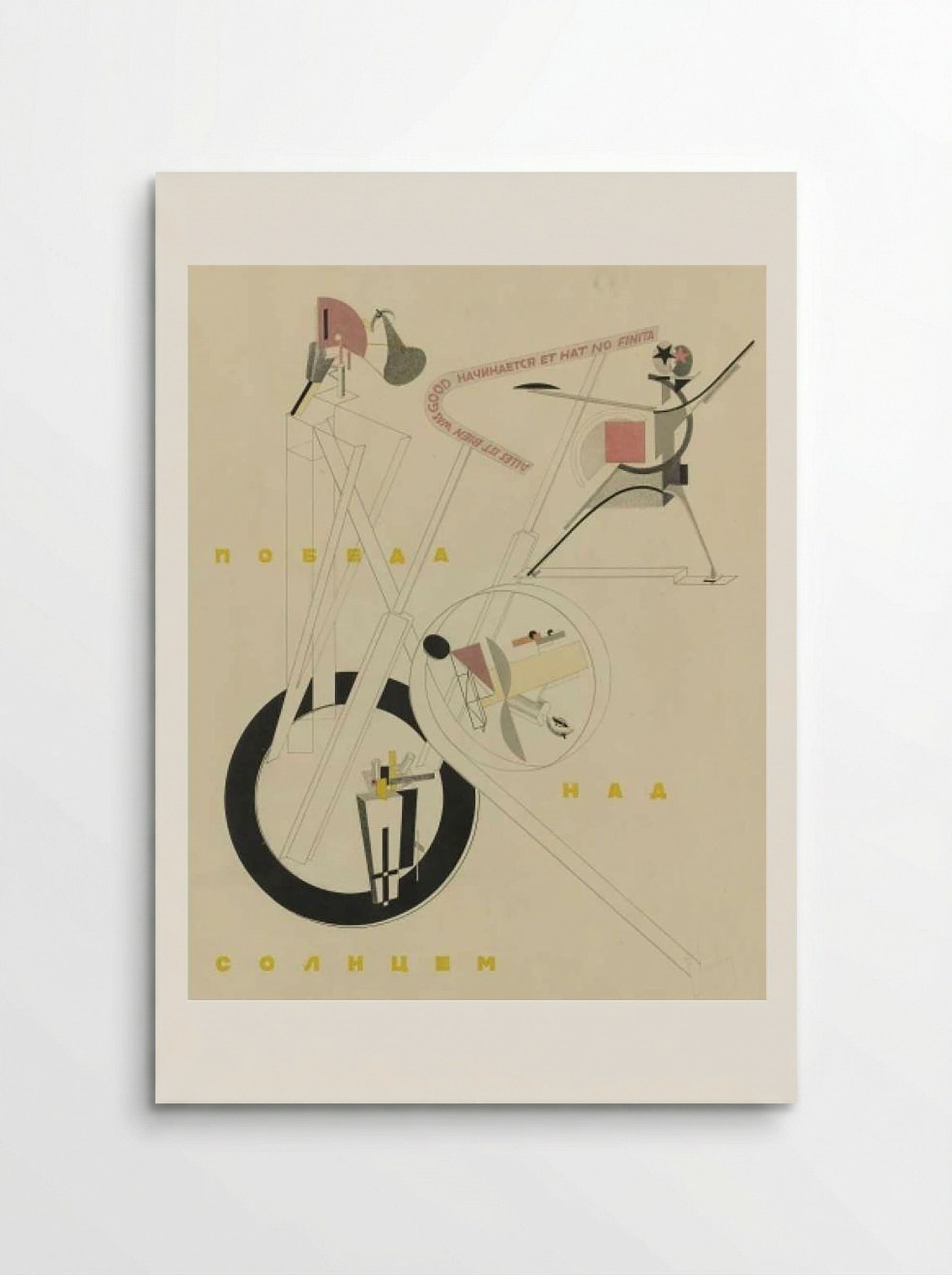
A lithograph by El Lissitzky, 'Victory over the Sun: All is well that begins well and has no end' showcases the artist's Suprematist style through geometric forms, linear elements, and a restrained colour palette.
This lithograph by El Lissitzky (1890-1941), a Russian artist, designer, photographer, typographer, polemicist, and architect, exemplifies the Suprematist movement. Lissitzky was a significant figure in the Russian avant-garde, helping to develop Suprematism with his mentor, Kazimir Malevich. He also promoted the ideas of the Constructivist movement and significantly influenced the Bauhaus and De Stijl movements. 'Victory over the Sun: All is well that begins well and has no end' presents a composition of geometric forms and linear elements. The artwork features a figure constructed from simplified shapes, positioned within a framework of lines and circles. The colour palette is restrained, with muted tones of black, grey, pink, and yellow, contributing to the work's abstract and somewhat austere character. The text, rendered in Cyrillic and other languages, adds another layer to the composition, integrating linguistic elements into the visual arrangement. Lissitzky's work reflects the utopian ideals and revolutionary spirit of the early 20th century, aiming to create a new visual language that transcended traditional artistic conventions.
Because every print is made to order, we don't offer change-of-mind returns, refunds or exchanges. If your order arrives faulty, damaged or incorrect, we'll replace it free of charge — just contact us within 48 hours of delivery. See our refunds page for full details.
We ship worldwide, printing at the production hub nearest to your delivery address. Delivery times and costs vary by destination — you'll see the options available to you at checkout.
Each print is produced to order using 12-colour giclée printing on FSC-certified archival paper. Designed in Britain and printed at your nearest production hub to reduce waste and speed up delivery.
Specific Features
Every Solis piece is made to order with archival, gallery-quality materials built to last.
Care & Cleaning
To keep your artwork looking its best:
Materials & Sizing
Museum-grade giclée on FSC-certified archival matte paper, with framed and canvas options.

Artist Biography
Made to order
Every piece is printed to order. These are the five finishes, and what makes each one different.
From £28
A giclée print on 200gsm matte fine art paper, using a twelve-colour process for accurate, fade-resistant colour. Supplied unframed, delivered flat or rolled.

From £45
The same fine art print in a solid wood frame with UV-protective acrylic glaze and rigid backing. Five frame colours. Arrives ready to hang.
Why Choose Us ?
Damage-free delivery guarantee
Fast Shipping
Museum-Quality Materials
You May Also Like
We use cookies to measure our marketing and see which prints people love.We use cookies to measure our marketing.
By continuing to browse, you agree · Privacy Policy