

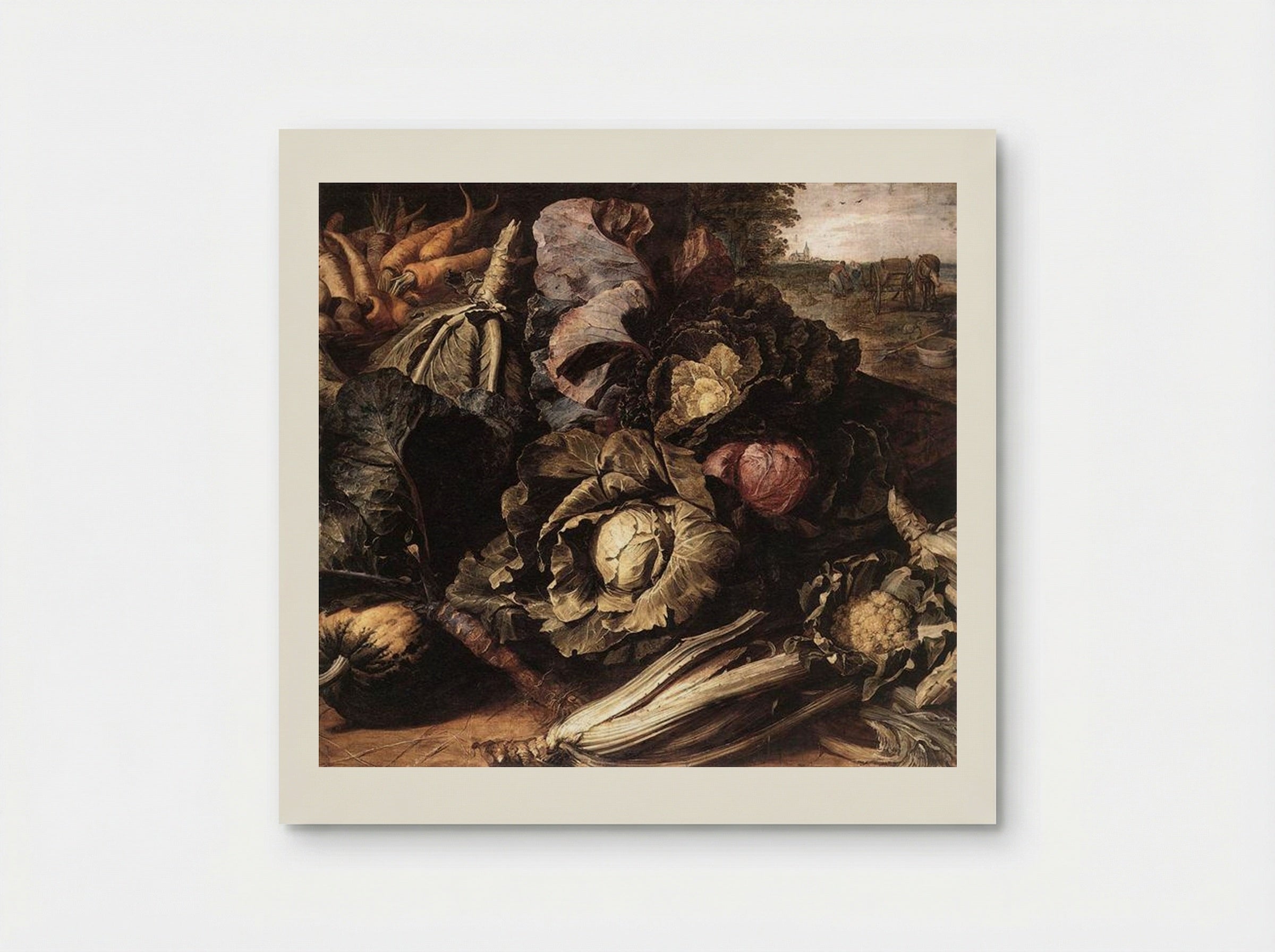
Vegetable Still Life - Frans Snyders
Archival giclée
Frames arrive ready to hang
Secure checkout
Made to order
Description
A still life by Frans Snyders, "Vegetable Still Life" showcases the artist's skill in rendering textures and creating dynamic compositions with everyday objects. The painting features an assortment of vegetables arranged in a visually appealing manner.
Frans Snyders, a Flemish painter of the Baroque period, was a master of still life and animal painting. He frequently collaborated with Peter Paul Rubens and other artists, adding elements of still life or animals to their compositions. Snyders's work is characterised by its energy, opulence, and realistic detail. His still lifes are not mere arrangements of objects; they are dynamic displays of texture, colour, and form. In "Vegetable Still Life", Snyders presents an abundant assortment of freshly harvested vegetables. Cabbages, carrots, and other produce are piled high, creating a sense of overflowing bounty. The composition is carefully arranged to guide the viewer's eye through the scene, from the foreground vegetables to the background figures working in the fields. The muted colour palette and dramatic lighting enhance the painting's realism and create a sense of depth. Snyders's skill in rendering the textures of the vegetables, from the rough leaves of the cabbages to the smooth skin of the carrots, is particularly noteworthy.
Return policy
Because every print is made to order, we don't offer change-of-mind returns, refunds or exchanges. If your order arrives faulty, damaged or incorrect, we'll replace it free of charge — just contact us within 48 hours of delivery. See our refunds page for full details.
Shipping
We ship worldwide, printing at the production hub nearest to your delivery address. Delivery times and costs vary by destination — you'll see the options available to you at checkout.
Manufacturing
Each print is produced to order using 12-colour giclée printing on FSC-certified archival paper. Designed in Britain and printed at your nearest production hub to reduce waste and speed up delivery.
Care and materials
Specific Features
Every Solis piece is made to order with archival, gallery-quality materials built to last.
- Museum-grade giclée printing for rich, fade-resistant colour
- Archival matte fine-art paper, FSC-certified
- Multiple sizes and framing options available
- Frames in black, natural wood, dark wood or white
- Framed prints arrive ready to hang
Care & Cleaning
To keep your artwork looking its best:
- Dust gently with a soft, dry cloth
- Avoid prolonged direct sunlight
- Never use liquid cleaners on the print or canvas surface
- Keep in a dry, room-temperature space
- Handle prints with clean, dry hands
Materials & Sizing
Museum-grade giclée on FSC-certified archival matte paper, with framed and canvas options.
- Paper sizes: A4, A3, A2, A1, A0 and B2 (50×70 cm)
- Canvas: XS (20×30 cm) to Large (60×90 cm)
- Frames: black, natural wood, dark wood or white
Vegetable Still Life - Frans Snyders

Artist Biography
Frans Snyders
He was born in Antwerp in 1579 and studied under Pieter Brueghel the Younger, though his painting style owed more to Brueghel's brother Jan ("Velvet Brueghel"), whose talent for rendering textures left a permanent mark. He may also have trained under Hendrik van Balen, who later taught Anthony van Dyck. A trip to Italy in 1608 to 1609 took him to Rome and Milan, where Cardinal Federico Borromeo became his patron.
Back in Antwerp, Snyders began collaborating with Peter Paul Rubens, a partnership that lasted from the 1610s until Rubens's death in 1640. Their brushwork was so close that contemporaries struggled to distinguish their contributions in shared canvases. Snyders painted roughly sixty hunting scenes and animal pieces after Rubens's designs, and added animal and still-life passages to Rubens's figure compositions. After Rubens died, Snyders served as one of the appraisers of his estate.
In 1611 he married Margaretha de Vos, sister of the painters Cornelis and Paul de Vos. He became dean of the Guild of Saint Luke in 1628 and bought a house on the fashionable Keizerstraat. His market scenes, hunt paintings and kitchen still lifes were compositions of Baroque excess: heaped game, overflowing fruit, dogs lunging at boar and deer. He died childless in 1657, at seventy-seven, leaving his fortune to his sister, a beguine.
Why Choose Us ?
Damage-free delivery guarantee
Fast Shipping
Museum-Quality Materials
You May Also Like