

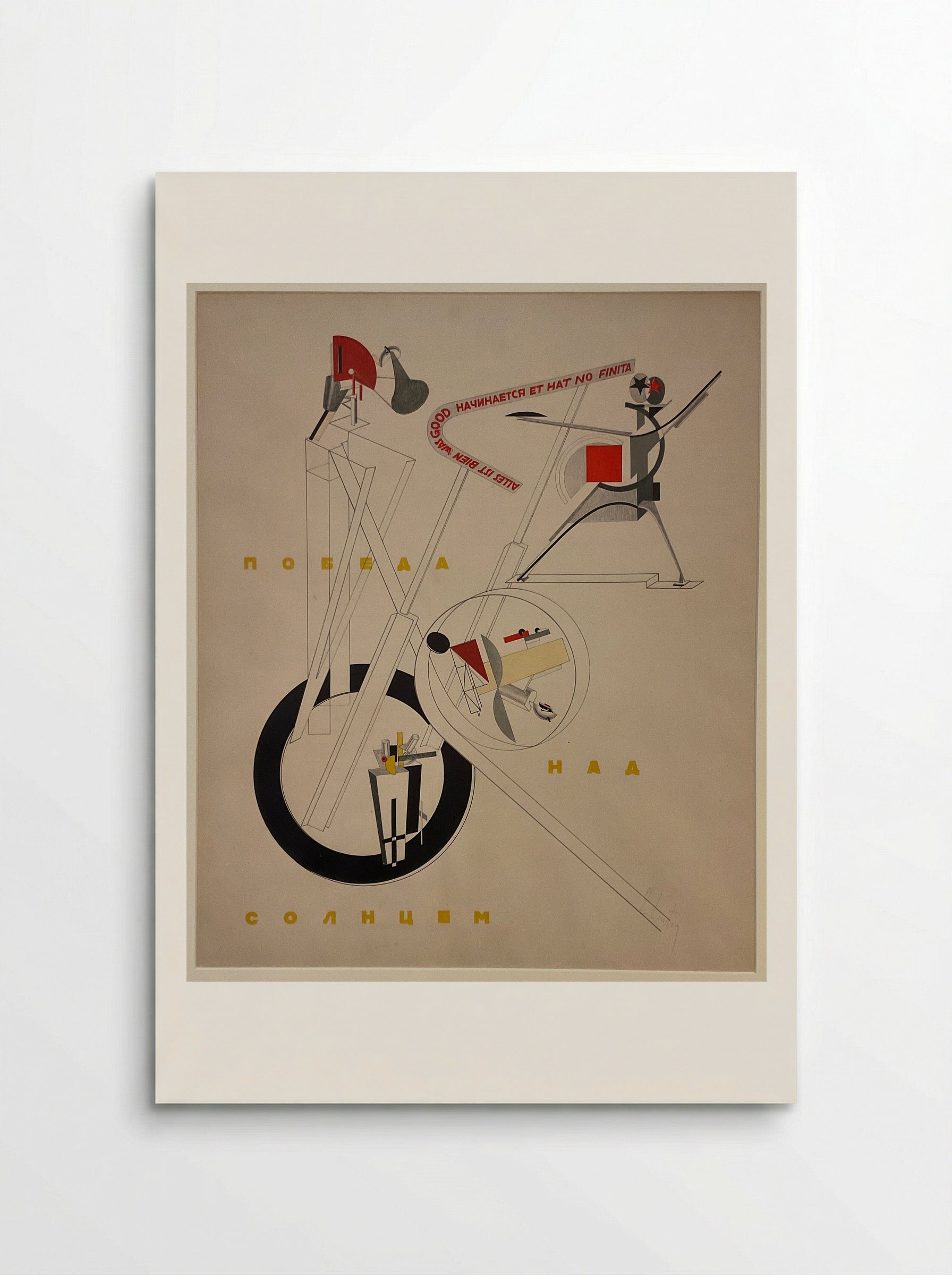
Title Sheet: Part of the Show Machinery - El Lissitzky
Archival giclée
Frames arrive ready to hang
Secure checkout
Made to order
Description
A 1923 lithograph by El Lissitzky, representing the mechanical stage designs for the futuristic opera Victory Over the Sun.
This lithograph serves as the title sheet for El Lissitzky's 1923 portfolio, 'Figurines. The Three-Dimensional Design of the Electro-Mechanical Spectacle: Victory Over the Sun'. The work relates to the artist's conceptualisation of a futuristic opera, originally staged in 1913, which he reimagined through the lens of Constructivist theatre. Lissitzky envisioned the characters as mechanical puppets, or 'electromechanical' figures, that would move across a stage through automated systems rather than human performance. The composition displays the geometric rigour characteristic of Lissitzky's output. It features a series of abstract forms, including circles, squares, and linear structures, which suggest the skeletal framework of stage machinery. The inclusion of Cyrillic text, specifically the title 'Victory Over the Sun' (Pobeda nad solntsem), anchors the work in its Russian Futurist origins. The colour palette is restricted to black, white, red, and yellow, a choice that emphasises the clarity of the forms and the industrial aesthetic of the period. The figures appear weightless, suspended in a non-representational space that rejects traditional perspective in favour of a dynamic, architectural arrangement. Lissitzky's approach to this project reflects his interest in the synthesis of art, technology, and performance. By stripping away the organic nature of the human form and replacing it with geometric components, he sought to create a universal language of design. This print captures the essence of his vision for a new type of theatre, one where the boundaries between the performer and the machine are dissolved. The work remains a significant example of the graphic experimentation that defined the early twentieth-century European avant-garde, demonstrating the application of Suprematist principles to the practical demands of stage design and typography.
You might also like
Return policy
Because every print is made to order, we don't offer change-of-mind returns, refunds or exchanges. If your order arrives faulty, damaged or incorrect, we'll replace it free of charge — just contact us within 48 hours of delivery. See our refunds page for full details.
Shipping
We ship worldwide, printing at the production hub nearest to your delivery address. Delivery times and costs vary by destination — you'll see the options available to you at checkout.
Manufacturing
Each print is produced to order using 12-colour giclée printing on FSC-certified archival paper. Designed in Britain and printed at your nearest production hub to reduce waste and speed up delivery.
Care and materials
Specific Features
Every Solis piece is made to order with archival, gallery-quality materials built to last.
- Museum-grade giclée printing for rich, fade-resistant colour
- Archival matte fine-art paper, FSC-certified
- Multiple sizes and framing options available
- Frames in black, natural wood, dark wood or white
- Framed prints arrive ready to hang
Care & Cleaning
To keep your artwork looking its best:
- Dust gently with a soft, dry cloth
- Avoid prolonged direct sunlight
- Never use liquid cleaners on the print or canvas surface
- Keep in a dry, room-temperature space
- Handle prints with clean, dry hands
Materials & Sizing
Museum-grade giclée on FSC-certified archival matte paper, with framed and canvas options.
- Paper sizes: A4, A3, A2, A1, A0 and B2 (50×70 cm)
- Canvas: XS (20×30 cm) to Large (60×90 cm)
- Frames: black, natural wood, dark wood or white
Title Sheet: Part of the Show Machinery - El Lissitzky

Artist Biography
El Lissitzky
He was born Lazar Markovich Lissitzky in 1890. After returning to Russia, he worked alongside Malevich at the UNOVIS art school in Vitebsk, where Suprematism and the revolution were supposed to be the same thing. He became one of the most influential graphic designers of the twentieth century, his poster designs, book layouts, and exhibition installations connecting Russian avant-garde art to the Bauhaus and De Stijl in western Europe.
He contracted pulmonary tuberculosis and continued working as a book artist and photomonteur because he could do it lying down. His sister Jenta committed suicide in Vitebsk in 1925 while he was hospitalised in Switzerland. He married Sophie Kuppers, a German woman whose family disapproved of the match; she had to leave her sons behind to move to Moscow. He died in Moscow in 1941, the year Germany invaded Russia.
Why Choose Us ?
Damage-free delivery guarantee
Fast Shipping
Museum-Quality Materials
You May Also Like