

Fine Art Poster
From £28
A giclée print on 200gsm matte fine art paper, using a twelve-colour process for accurate, fade-resistant colour. Supplied unframed, delivered flat or rolled.



Archival giclée
Frames arrive ready to hang
Secure checkout
Made to order
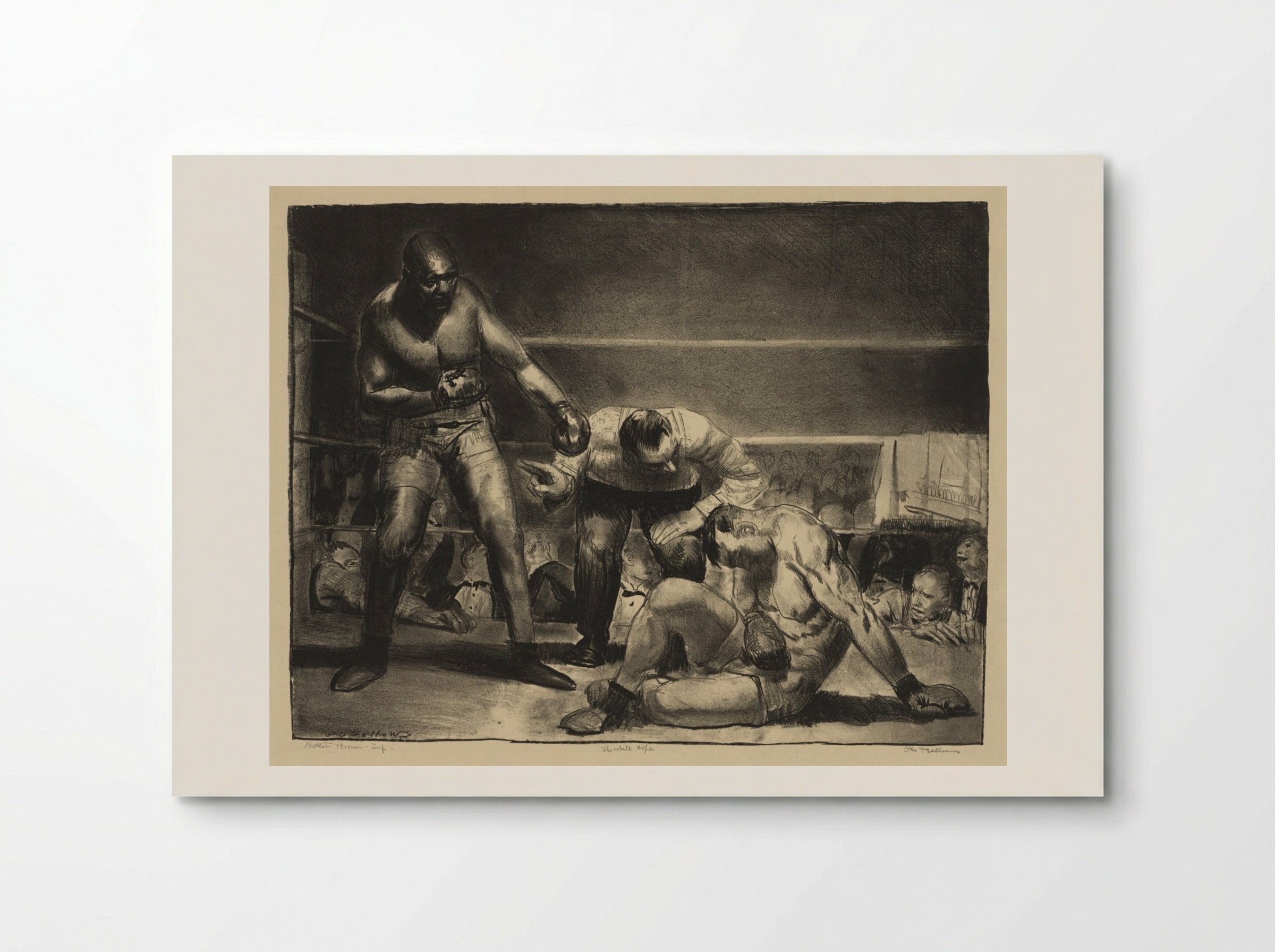
A powerful 1921 lithograph by George Bellows depicting a boxing match, reflecting the racial tensions and social realities of early twentieth-century America.
George Bellows produced this lithograph in 1921, capturing a moment of intense physical conflict within the boxing ring. The composition focuses on the disparity between the two fighters: the standing figure, representing the heavyweight champion Jack Johnson, and his fallen opponent. Bellows utilised the medium of lithography to explore the stark contrasts of light and shadow, creating a sense of drama that mirrors the atmosphere of the underground boxing clubs he frequented in New York City. The work addresses the racial tensions prevalent in early twentieth-century American sports. The title refers to the search for a white challenger capable of defeating Johnson, who was the first African American world heavyweight boxing champion. Bellows depicts the scene with a raw, unvarnished approach, typical of the Ashcan School, which sought to document the realities of urban life. The figures are rendered with muscular tension, while the surrounding crowd is suggested through loose, gestural marks that recede into the darkness of the arena. Technically, the print demonstrates Bellows's mastery of tone. He employs deep blacks and soft greys to define the anatomy of the boxers and the texture of the canvas. The referee, positioned between the two men, acts as a visual anchor, drawing the eye toward the defeated fighter. This print is a significant example of Bellows's interest in the human form in motion and his willingness to engage with the social issues of his time. The work remains a direct observation of a specific cultural moment, presented without sentimentality or moralising commentary. It provides a window into the visceral nature of the sport and the societal pressures that surrounded it during the era.
Because every print is made to order, we don't offer change-of-mind returns, refunds or exchanges. If your order arrives faulty, damaged or incorrect, we'll replace it free of charge — just contact us within 48 hours of delivery. See our refunds page for full details.
We ship worldwide, printing at the production hub nearest to your delivery address. Delivery times and costs vary by destination — you'll see the options available to you at checkout.
Each print is produced to order using 12-colour giclée printing on FSC-certified archival paper. Designed in Britain and printed at your nearest production hub to reduce waste and speed up delivery.

Artist Biography
Our Features
Designed for Lasting Impact
Every Solis piece is made to order with archival, gallery-quality materials built to last.
To keep your artwork looking its best:
Museum-grade giclée on FSC-certified archival matte paper, with framed and canvas options.
Made to order
Every piece is printed to order. These are the five finishes, and what makes each one different.
From £28
A giclée print on 200gsm matte fine art paper, using a twelve-colour process for accurate, fade-resistant colour. Supplied unframed, delivered flat or rolled.

From £45
The same fine art print in a solid wood frame with UV-protective acrylic glaze and rigid backing. Five frame colours. Arrives ready to hang.

From £85
A deeper solid wood frame: 33mm deep with a 20mm face and Perspex glaze. The print sits unmounted for a clean gallery presentation. Black, white or natural.

From £30
Hand-stretched canvas with neat gallery-wrapped edges, giving the artwork surface texture and depth. Arrives ready to hang.

From £135
Stretched canvas set in a floating wood frame, our most substantial finish. Arrives ready to hang.
Why Choose Us ?
Damage-free delivery guarantee
Fast Shipping
Museum-Quality Materials
Artist Biography
George Bellows
You May Also Like
Cookies show us which prints people love, so we hang the right art. Help us fill it?
Essential cookies only if you prefer · Privacy Policy