

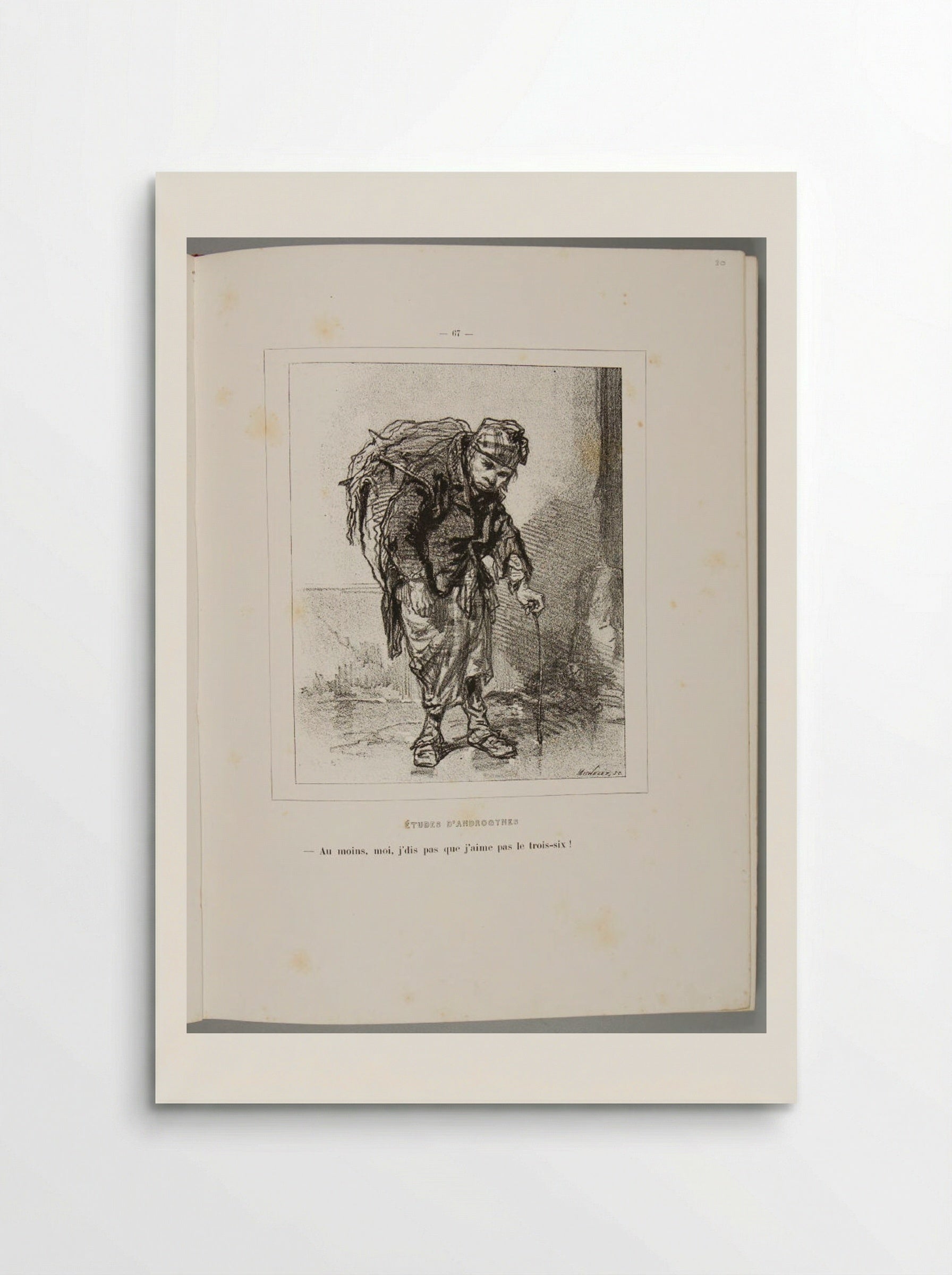
As for me, at least I don't say that I don't like proof spirits - Paul Gavarni
Archival giclée
Frames arrive ready to hang
Secure checkout
Made to order
Description
A lithograph by Paul Gavarni, titled 'As for me, at least I don't say that I don't like proof spirits', depicts a weary figure with a heavy pack, capturing a moment of everyday life in 19th-century Paris.
This lithograph by Paul Gavarni (1804-1866), a French artist celebrated for his satirical and humorous depictions of Parisian life, captures a scene from the series 'Études d'Androgyne'. Gavarni, born Hippolyte Guillaume Sulpice Chevalier, initially trained as a land surveyor before pursuing his artistic inclinations. His work frequently appeared in periodicals such as 'Le Charivari', offering social commentary through caricature. The image presents a figure burdened with a large pack, leaning on a walking stick. The subject's clothing suggests a working-class individual, perhaps a peddler or labourer. Gavarni's skill in capturing the nuances of human expression and social dynamics is evident in the character's weary posture and facial expression. The lithographic technique, with its fine lines and tonal variations, adds depth and texture to the composition. The surrounding text, in French, adds context to the image, hinting at themes of resilience and perhaps a wry acceptance of life's hardships. Gavarni's work provides a glimpse into the social fabric of 19th-century Paris, offering both amusement and insight.
Return policy
Because every print is made to order, we don't offer change-of-mind returns, refunds or exchanges. If your order arrives faulty, damaged or incorrect, we'll replace it free of charge — just contact us within 48 hours of delivery. See our refunds page for full details.
Shipping
We ship worldwide, printing at the production hub nearest to your delivery address. Delivery times and costs vary by destination — you'll see the options available to you at checkout.
Manufacturing
Each print is produced to order using 12-colour giclée printing on FSC-certified archival paper. Designed in Britain and printed at your nearest production hub to reduce waste and speed up delivery.
Care and materials
Specific Features
Every Solis piece is made to order with archival, gallery-quality materials built to last.
- Museum-grade giclée printing for rich, fade-resistant colour
- Archival matte fine-art paper, FSC-certified
- Multiple sizes and framing options available
- Frames in black, natural wood, dark wood or white
- Framed prints arrive ready to hang
Care & Cleaning
To keep your artwork looking its best:
- Dust gently with a soft, dry cloth
- Avoid prolonged direct sunlight
- Never use liquid cleaners on the print or canvas surface
- Keep in a dry, room-temperature space
- Handle prints with clean, dry hands
Materials & Sizing
Museum-grade giclée on FSC-certified archival matte paper, with framed and canvas options.
- Paper sizes: A4, A3, A2, A1, A0 and B2 (50×70 cm)
- Canvas: XS (20×30 cm) to Large (60×90 cm)
- Frames: black, natural wood, dark wood or white
As for me, at least I don't say that I don't like proof spirits - Paul Gavarni

Artist Biography
Paul Gavarni
His real name was Sulpice Guillaume Chevalier. He adopted "Gavarni" from the town of Gavarnie in the Pyrenees after a journey there. He was born in Paris in 1804, worked as a machinist in a factory, and taught himself to draw in evening classes. By the 1830s he was the leading illustrator of Parisian social life: fashionable women, carnival scenes, lorettes and debardeurs, all rendered with a wit and polish that Balzac praised publicly and that helped establish Gavarni's reputation.
After the deaths of his mother and the collapse of his marriage around 1845, his style shifted. He spent time in London documenting the lives of the poor, producing work that was bleaker and more compassionate than his Paris satire. His catalogue raisonne lists approximately eight thousand works. He is often compared with his contemporary Daumier, though Gavarni's satire was more polished and less political. He died in Paris in 1866.
Why Choose Us ?
Damage-free delivery guarantee
Fast Shipping
Museum-Quality Materials
You May Also Like