

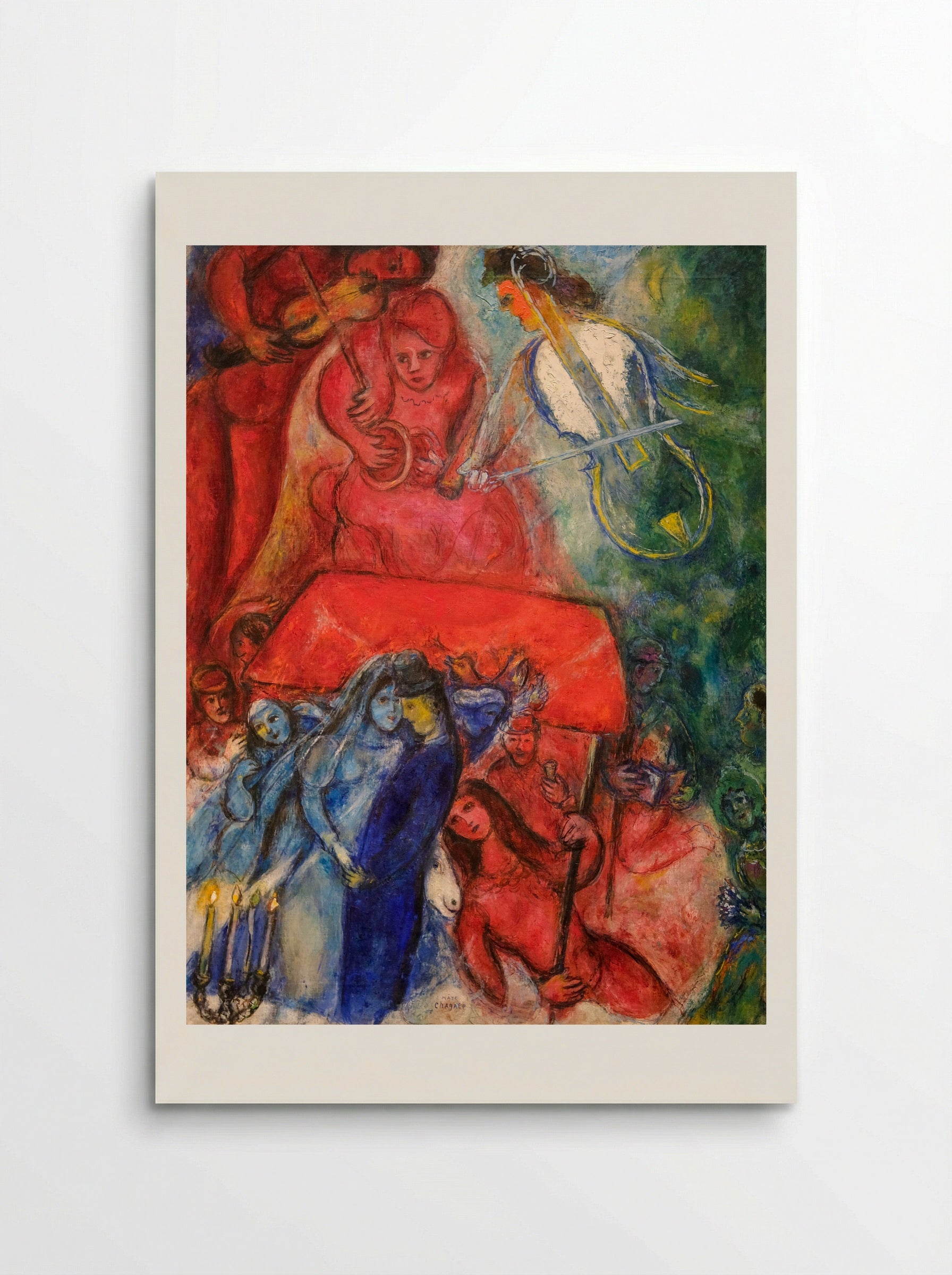
The Wedding - Marc Chagall
Archival giclée
Frames arrive ready to hang
Secure checkout
Made to order
Description
A dreamlike depiction of a wedding ceremony, featuring floating musicians and figures rendered in a signature palette of deep reds and blues.
Marc Chagall often returned to the theme of the wedding, a subject rooted in his memories of Vitebsk and his personal life. In this composition, the artist employs a dreamlike visual language to capture the emotional weight of the ceremony. The figures are arranged in a non-linear fashion, typical of his approach to narrative, where memory and reality merge. At the centre, the bride and groom stand beneath a canopy, their forms rendered in cool blue tones that contrast with the surrounding warmth. Above them, musicians float in the air, a recurring motif in Chagall's work that suggests a sense of weightlessness and joy. The application of paint is layered and textured, with visible brushwork that creates a sense of movement across the canvas. The colour palette is dominated by deep reds, blues, and greens, which help to define the different zones of the scene while maintaining a cohesive, atmospheric quality. Chagall avoids strict perspective, preferring to group figures in a way that prioritises emotional resonance over anatomical accuracy. The presence of candles and the suggestion of a crowd indicate a festive, communal event, yet the isolation of the central couple remains the primary focus. The work reflects the artist's ability to synthesise folklore, personal history, and modernist techniques. By blending these elements, he creates a scene that feels both intimate and universal. The composition invites the viewer to look past the literal representation of a wedding, focusing instead on the symbolic and spiritual aspects of the union. This piece is a clear example of his mature style, where the boundaries between the physical world and the imagination are blurred, allowing for a more subjective interpretation of human experience.
Return policy
Because every print is made to order, we don't offer change-of-mind returns, refunds or exchanges. If your order arrives faulty, damaged or incorrect, we'll replace it free of charge — just contact us within 48 hours of delivery. See our refunds page for full details.
Shipping
We ship worldwide, printing at the production hub nearest to your delivery address. Delivery times and costs vary by destination — you'll see the options available to you at checkout.
Manufacturing
Each print is produced to order using 12-colour giclée printing on FSC-certified archival paper. Designed in Britain and printed at your nearest production hub to reduce waste and speed up delivery.
Care and materials
Specific Features
Every Solis piece is made to order with archival, gallery-quality materials built to last.
- Museum-grade giclée printing for rich, fade-resistant colour
- Archival matte fine-art paper, FSC-certified
- Multiple sizes and framing options available
- Frames in black, natural wood, dark wood or white
- Framed prints arrive ready to hang
Care & Cleaning
To keep your artwork looking its best:
- Dust gently with a soft, dry cloth
- Avoid prolonged direct sunlight
- Never use liquid cleaners on the print or canvas surface
- Keep in a dry, room-temperature space
- Handle prints with clean, dry hands
Materials & Sizing
Museum-grade giclée on FSC-certified archival matte paper, with framed and canvas options.
- Paper sizes: A4, A3, A2, A1, A0 and B2 (50×70 cm)
- Canvas: XS (20×30 cm) to Large (60×90 cm)
- Frames: black, natural wood, dark wood or white
The Wedding - Marc Chagall

Artist Biography
Marc Chagall
He was born Moishe Shagal in 1887, in the Pale of Settlement, the restricted zone where Jews were permitted to live in the Russian Empire. His father worked at a herring warehouse. The family was devout Hasidic. After studying in St Petersburg, he went to Paris in 1911 and immersed himself in the Fauvists and Cubists, absorbing their formal innovations without abandoning the narrative imagery of his childhood. The colour and the dreamlike floating figures were already there in Vitebsk. Paris gave him the structure.
He met Bella Rosenfeld, the daughter of a wealthy Vitebsk jeweller, and married her in 1915. She became his primary subject for the next three decades. The flying lovers that recur across his work, gravity-defying couples suspended above rooftops and villages, began with Bella. When she died of a streptococcal infection in New York in September 1944, penicillin existed but the entire supply was reserved for soldiers. He stopped painting for nine months. He continued to paint her memory for the remaining forty-one years of his life.
Picasso once said that when Matisse dies, Chagall will be the only painter left who understands what colour really is. The friendship ended at a dinner at Chagall's home in 1964. Picasso asked when he was going back to Russia. Chagall replied: after you, I hear you are greatly loved there but not your work. They never spoke again.
His late stained glass commissions are among the strongest work of his final decades: the Peace Window at the United Nations, the twelve windows representing the Tribes of Israel at the Hadassah Medical Centre in Jerusalem, and windows at Metz Cathedral. In 1964, Andre Malraux commissioned him to paint the ceiling of the Paris Opera, a decision that provoked fury from critics who objected to a Russian-born Jewish artist working inside a French Baroque monument. He lived to ninety-seven.
Why Choose Us ?
Damage-free delivery guarantee
Fast Shipping
Museum-Quality Materials
You May Also Like