

The Wanderer - Hans Thoma
Archival giclée
Frames arrive ready to hang
Secure checkout
Made to order
Description
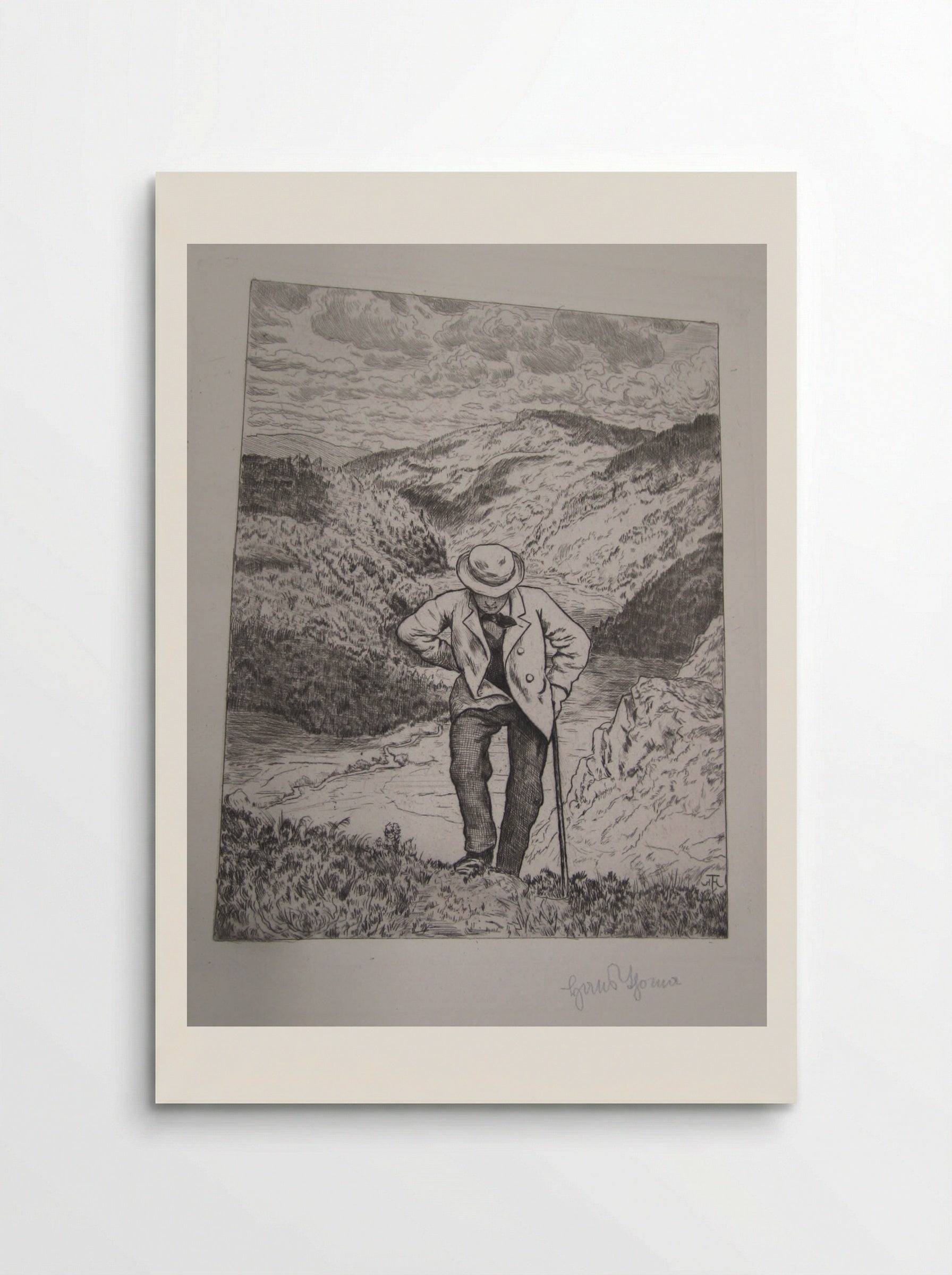
A detailed etching by Hans Thoma depicting a solitary figure observing a mountainous valley, capturing a moment of quiet contemplation.
Hans Thoma, a figure associated with the German Symbolist movement, produced this etching during a period when his work frequently engaged with the relationship between the individual and the natural world. The composition depicts a solitary male figure standing upon a rocky outcrop, his posture slightly hunched as he surveys the valley below. The artist employs a precise, linear technique, using dense cross-hatching to define the textures of the terrain and the heavy fabric of the wanderer's coat. The background reveals a sweeping view of a mountainous region, rendered with meticulous attention to the atmospheric quality of the clouds and the undulating slopes. Thoma avoids excessive ornamentation, choosing instead to focus on the quiet, contemplative mood of the scene. The figure, equipped with a walking stick and a hat, embodies the archetype of the traveller, a common motif in nineteenth-century German art. This print demonstrates Thoma's technical proficiency in the medium of etching. The contrast between the foreground figure and the expansive, detailed background creates a sense of depth, drawing the viewer into the quiet solitude of the moment. The work reflects the artist's deep connection to his native Black Forest region, where he often found inspiration for his subjects. By capturing this singular moment of observation, Thoma invites the viewer to share in the wanderer's quiet reflection. The print is signed by the artist in the lower margin, confirming its status as an authentic impression of his graphic work.
Return policy
Because every print is made to order, we don't offer change-of-mind returns, refunds or exchanges. If your order arrives faulty, damaged or incorrect, we'll replace it free of charge — just contact us within 48 hours of delivery. See our refunds page for full details.
Shipping
We ship worldwide, printing at the production hub nearest to your delivery address. Delivery times and costs vary by destination — you'll see the options available to you at checkout.
Manufacturing
Each print is produced to order using 12-colour giclée printing on FSC-certified archival paper. Designed in Britain and printed at your nearest production hub to reduce waste and speed up delivery.
The Wanderer - Hans Thoma

Artist Biography
Hans Thoma
A trip to Paris in 1868 with his friend Otto Scholderer exposed him to Courbet and the Barbizon painters, whose realism influenced his landscape style. He moved to Munich and spent six years there, then to Frankfurt, where he lived from 1876 to 1899. He also spent extended periods in Italy, becoming one of the "German Romans", artists who found in Renaissance observation a means of contemporary expression that fed into European Symbolism.
His landscapes of the Black Forest, with their deep greens, rounded hills and pastoral stillness, made him the best-known painter of that region. He also painted mythological and Symbolist subjects, self-portraits with allegorical figures, and genre scenes of German rural life. He married his student Cella Berteneder, who became known as a painter of flowers and still lifes.
In 1899 he was appointed director of the Kunsthalle Karlsruhe, a position he held until 1919. After his death in 1924, his work was appropriated by nationalist and Nazi ideology, and several paintings were looted from Jewish collectors during the Third Reich. The association has complicated his posthumous reputation. He remains little known outside Germany, a painter whose Black Forest landscapes speak to regional identity with an honesty that the political appropriation could not quite destroy.
Our Features
Designed for Lasting Impact
Specific Features
Every Solis piece is made to order with archival, gallery-quality materials built to last.
- Museum-grade giclée printing for rich, fade-resistant colour
- Archival matte fine-art paper, FSC-certified
- Multiple sizes and framing options available
- Frames in black, natural wood, dark wood or white
- Framed prints arrive ready to hang
Care & Cleaning
To keep your artwork looking its best:
- Dust gently with a soft, dry cloth
- Avoid prolonged direct sunlight
- Never use liquid cleaners on the print or canvas surface
- Keep in a dry, room-temperature space
- Handle prints with clean, dry hands
Materials & Sizing
Museum-grade giclée on FSC-certified archival matte paper, with framed and canvas options.
- Paper sizes: A4, A3, A2, A1, A0 and B2 (50×70 cm)
- Canvas: XS (20×30 cm) to Large (60×90 cm)
- Frames: black, natural wood, dark wood or white
Why Choose Us ?
Damage-free delivery guarantee
Fast Shipping
Museum-Quality Materials
Artist Biography
Hans Thoma
A trip to Paris in 1868 with his friend Otto Scholderer exposed him to Courbet and the Barbizon painters, whose realism influenced his landscape style. He moved to Munich and spent six years there, then to Frankfurt, where he lived from 1876 to 1899. He also spent extended periods in Italy, becoming one of the "German Romans", artists who found in Renaissance observation a means of contemporary expression that fed into European Symbolism.
His landscapes of the Black Forest, with their deep greens, rounded hills and pastoral stillness, made him the best-known painter of that region. He also painted mythological and Symbolist subjects, self-portraits with allegorical figures, and genre scenes of German rural life. He married his student Cella Berteneder, who became known as a painter of flowers and still lifes.
In 1899 he was appointed director of the Kunsthalle Karlsruhe, a position he held until 1919. After his death in 1924, his work was appropriated by nationalist and Nazi ideology, and several paintings were looted from Jewish collectors during the Third Reich. The association has complicated his posthumous reputation. He remains little known outside Germany, a painter whose Black Forest landscapes speak to regional identity with an honesty that the political appropriation could not quite destroy.
You May Also Like