

Fine Art Poster
From £28
A giclée print on 200gsm matte fine art paper, using a twelve-colour process for accurate, fade-resistant colour. Supplied unframed, delivered flat or rolled.



Archival giclée
Frames arrive ready to hang
Secure checkout
Made to order
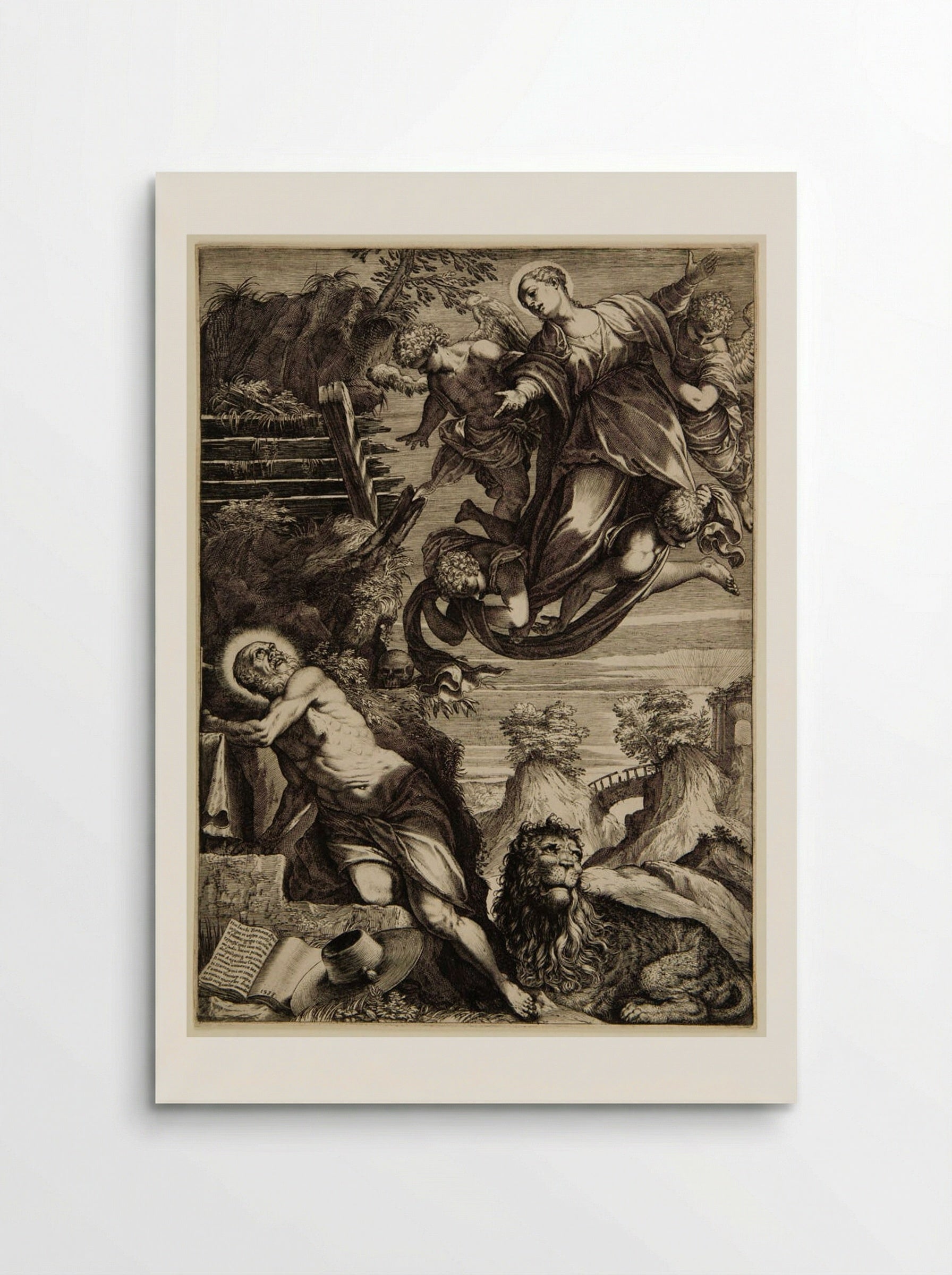
A detailed 1588 engraving by Agostino Carracci depicting Saint Jerome in a wilderness setting, visited by the Virgin Mary and celestial figures.
This engraving by Agostino Carracci depicts a vision of the Virgin Mary appearing to Saint Jerome. The composition is divided into two distinct zones. In the lower portion, Saint Jerome is shown in a rocky wilderness, accompanied by his traditional attribute, the lion. He is depicted in a state of spiritual contemplation, with an open book and a skull nearby, symbols of his scholarly life and his meditation on mortality. The artist employs precise hatching to define the musculature of the saint and the texture of the lion's fur. In the upper portion, the Virgin Mary descends, surrounded by putti. Her figure is rendered with fluid lines, contrasting with the more grounded, rugged appearance of the saint below. The background features a distant landscape with a bridge and architectural elements, which provides a sense of depth to the scene. Carracci, a member of the influential Bolognese family of painters, was highly regarded for his technical skill in printmaking. His work often bridged the gap between the late Renaissance and the emerging Baroque style, focusing on clarity of form and dramatic narrative. The print demonstrates the artist's mastery of the burin. The varying density of the lines creates a range of tones, from the deep shadows of the cave to the luminous quality of the celestial figures. This work reflects the Counter-Reformation emphasis on personal piety and the direct experience of the divine. The inclusion of the date 1588 on the open book provides a clear chronological marker for this piece, placing it within the artist's mature period in Bologna. The balance between the human and the divine, achieved through careful anatomical study and compositional arrangement, is characteristic of the Carracci school's approach to religious iconography.
Because every print is made to order, we don't offer change-of-mind returns, refunds or exchanges. If your order arrives faulty, damaged or incorrect, we'll replace it free of charge — just contact us within 48 hours of delivery. See our refunds page for full details.
We ship worldwide, printing at the production hub nearest to your delivery address. Delivery times and costs vary by destination — you'll see the options available to you at checkout.
Each print is produced to order using 12-colour giclée printing on FSC-certified archival paper. Designed in Britain and printed at your nearest production hub to reduce waste and speed up delivery.
Specific Features
Every Solis piece is made to order with archival, gallery-quality materials built to last.
Care & Cleaning
To keep your artwork looking its best:
Materials & Sizing
Museum-grade giclée on FSC-certified archival matte paper, with framed and canvas options.

Artist Biography
Made to order
Every piece is printed to order. These are the five finishes, and what makes each one different.
From £28
A giclée print on 200gsm matte fine art paper, using a twelve-colour process for accurate, fade-resistant colour. Supplied unframed, delivered flat or rolled.

From £45
The same fine art print in a solid wood frame with UV-protective acrylic glaze and rigid backing. Five frame colours. Arrives ready to hang.

From £85
A deeper solid wood frame: 33mm deep with a 20mm face and Perspex glaze. The print sits unmounted for a clean gallery presentation. Black, white or natural.

From £30
Hand-stretched canvas with neat gallery-wrapped edges, giving the artwork surface texture and depth. Arrives ready to hang.

From £135
Stretched canvas set in a floating wood frame, our most substantial finish. Arrives ready to hang.
Why Choose Us ?
Damage-free delivery guarantee
Fast Shipping
Museum-Quality Materials
You May Also Like
We use cookies to measure our marketing and see which prints people love.We use cookies to measure our marketing.
By continuing to browse, you agree · Privacy Policy