

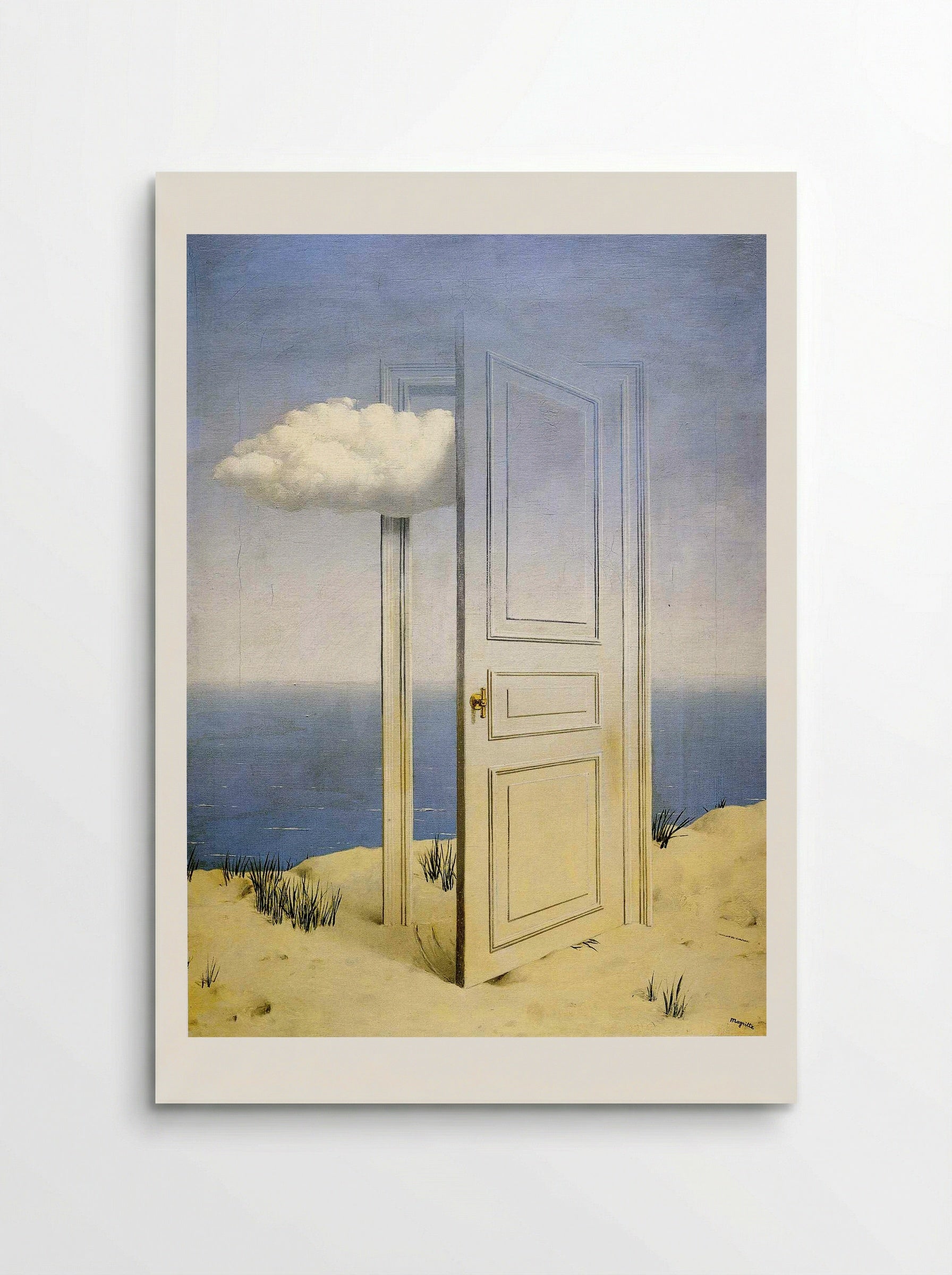
The Victory - René Magritte
Archival giclée
Frames arrive ready to hang
Secure checkout
Made to order
Description
René Magritte's "The Victory" presents an open door on a beach, with a cloud floating within its frame, blurring the lines between reality and the surreal. This oil on canvas painting exemplifies Magritte's signature style of juxtaposing ordinary objects in unexpected contexts.
René Magritte, a Belgian artist (1898-1967), is celebrated for his contributions to Surrealism. His work often features ordinary objects in unexpected contexts, challenging viewers' perceptions of reality. Magritte aimed to disrupt the comfortable assumptions of everyday life, prompting reflection on the relationship between image and object. His paintings are characterised by a clean, precise style that enhances the unsettling nature of his juxtapositions. In "The Victory", Magritte presents a scene that is both familiar and deeply strange. An open door stands on a sandy shore, with tufts of grass emerging from the sand. Beyond the doorframe, the sea meets the sky, rendered in soft blues. A single, fluffy white cloud floats, partially obscuring the door's opening, creating a visual paradox. The door itself is painted in muted tones, its simple design contrasting with the surreal nature of the scene. The composition is carefully balanced, with the door acting as a frame within a frame, inviting the viewer to contemplate the boundary between the interior and exterior, the real and the imagined.
Return policy
Because every print is made to order, we don't offer change-of-mind returns, refunds or exchanges. If your order arrives faulty, damaged or incorrect, we'll replace it free of charge — just contact us within 48 hours of delivery. See our refunds page for full details.
Shipping
We ship worldwide, printing at the production hub nearest to your delivery address. Delivery times and costs vary by destination — you'll see the options available to you at checkout.
Manufacturing
Each print is produced to order using 12-colour giclée printing on FSC-certified archival paper. Designed in Britain and printed at your nearest production hub to reduce waste and speed up delivery.
The Victory - René Magritte

Artist Biography
Rene Magritte
He grew up in Lessines, Belgium. His mother drowned herself in the River Sambre when he was thirteen; her body was found with her nightdress wrapped around her face. Whether this explains the recurring covered faces in his paintings is a question biographers have insisted on and Magritte consistently refused to answer.
He studied at the Academie Royale des Beaux-Arts in Brussels and spent several years working as a commercial artist and wallpaper designer. The commercial work is relevant: his painting technique is deliberately flat, illustrative, and impersonal. There are no visible brushstrokes, no evidence of struggle. The surfaces look like advertisements for impossible things. He painted in a small room in his house, wearing a suit, with his easel next to the living room furniture.
He was a Surrealist but not the Parisian variety. He disliked Breton's intellectualising and preferred to work from home in Brussels. His version of Surrealism was cooler and more logical: ordinary objects placed in wrong contexts, familiar things made strange through simple displacement. A rock floating in the sky. An apple covering a face. A train emerging from a fireplace. Each painting poses a single visual problem and leaves you to solve it.
He made relatively few paintings compared to his contemporaries. Each one is self-contained. He did not develop through phases or wrestle with form. He found his approach early and refined it quietly for decades.
Our Features
Designed for Lasting Impact
Specific Features
Every Solis piece is made to order with archival, gallery-quality materials built to last.
- Museum-grade giclée printing for rich, fade-resistant colour
- Archival matte fine-art paper, FSC-certified
- Multiple sizes and framing options available
- Frames in black, natural wood, dark wood or white
- Framed prints arrive ready to hang
Care & Cleaning
To keep your artwork looking its best:
- Dust gently with a soft, dry cloth
- Avoid prolonged direct sunlight
- Never use liquid cleaners on the print or canvas surface
- Keep in a dry, room-temperature space
- Handle prints with clean, dry hands
Materials & Sizing
Museum-grade giclée on FSC-certified archival matte paper, with framed and canvas options.
- Paper sizes: A4, A3, A2, A1, A0 and B2 (50×70 cm)
- Canvas: XS (20×30 cm) to Large (60×90 cm)
- Frames: black, natural wood, dark wood or white
Why Choose Us ?
Damage-free delivery guarantee
Fast Shipping
Museum-Quality Materials
Artist Biography
René Magritte
He grew up in Lessines, Belgium. His mother drowned herself in the River Sambre when he was thirteen; her body was found with her nightdress wrapped around her face. Whether this explains the recurring covered faces in his paintings is a question biographers have insisted on and Magritte consistently refused to answer.
He studied at the Academie Royale des Beaux-Arts in Brussels and spent several years working as a commercial artist and wallpaper designer. The commercial work is relevant: his painting technique is deliberately flat, illustrative, and impersonal. There are no visible brushstrokes, no evidence of struggle. The surfaces look like advertisements for impossible things. He painted in a small room in his house, wearing a suit, with his easel next to the living room furniture.
He was a Surrealist but not the Parisian variety. He disliked Breton's intellectualising and preferred to work from home in Brussels. His version of Surrealism was cooler and more logical: ordinary objects placed in wrong contexts, familiar things made strange through simple displacement. A rock floating in the sky. An apple covering a face. A train emerging from a fireplace. Each painting poses a single visual problem and leaves you to solve it.
He made relatively few paintings compared to his contemporaries. Each one is self-contained. He did not develop through phases or wrestle with form. He found his approach early and refined it quietly for decades.
You May Also Like