

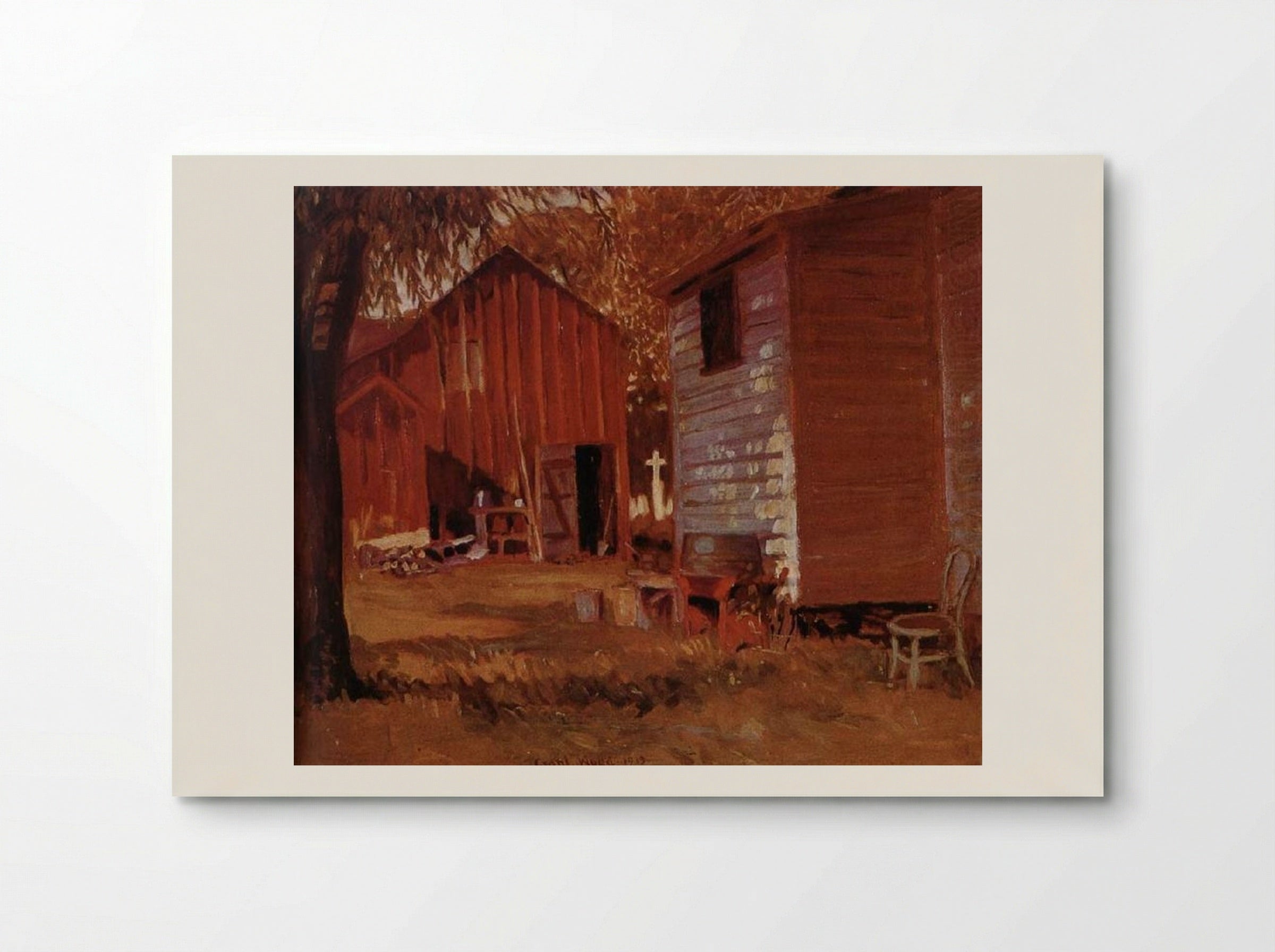
The Usual Place - Grant Wood
Archival giclée
Frames arrive ready to hang
Secure checkout
Made to order
Description
A quiet, atmospheric rural scene by Grant Wood, capturing a weathered farmyard in warm, earthy tones with loose, expressive brushwork.
The Usual Place, painted by Grant Wood in 1919, offers a glimpse into the artist's early stylistic development before he became associated with the precise, clean lines of American Regionalism. This work captures a quiet, rural farmyard scene, rendered with a loose, impressionistic brushwork that contrasts with his later, more controlled output. The composition focuses on two weathered outbuildings, their surfaces textured by time and exposure to the elements. A single chair sits in the foreground, suggesting a human presence that remains unseen. The palette is dominated by warm, earthy tones: deep ochres, burnt siennas, and muted reds. These colours evoke the feeling of a late afternoon in the American Midwest. The light filters through the foliage, casting long shadows across the ground and creating a sense of stillness. Wood employs a painterly approach here, allowing the texture of the paint to define the wooden siding of the barns and the rough grass of the yard. This piece provides insight into Wood's formative years, showing his interest in the vernacular architecture of Iowa. While he is often remembered for his highly polished portraits, this work demonstrates his ability to observe the mundane details of daily life with a quiet, contemplative eye. The scene is devoid of narrative artifice, presenting the farmyard as a self-contained environment. It reflects an era when Wood was still experimenting with European influences, particularly the light-filled canvases of the Impressionists, before he turned his attention to the starker, more graphic style that would define his career in the 1930s. The work remains a study in atmosphere and the quiet dignity of rural life.
Return policy
Because every print is made to order, we don't offer change-of-mind returns, refunds or exchanges. If your order arrives faulty, damaged or incorrect, we'll replace it free of charge — just contact us within 48 hours of delivery. See our refunds page for full details.
Shipping
We ship worldwide, printing at the production hub nearest to your delivery address. Delivery times and costs vary by destination — you'll see the options available to you at checkout.
Manufacturing
Each print is produced to order using 12-colour giclée printing on FSC-certified archival paper. Designed in Britain and printed at your nearest production hub to reduce waste and speed up delivery.
Care and materials
Specific Features
Every Solis piece is made to order with archival, gallery-quality materials built to last.
- Museum-grade giclée printing for rich, fade-resistant colour
- Archival matte fine-art paper, FSC-certified
- Multiple sizes and framing options available
- Frames in black, natural wood, dark wood or white
- Framed prints arrive ready to hang
Care & Cleaning
To keep your artwork looking its best:
- Dust gently with a soft, dry cloth
- Avoid prolonged direct sunlight
- Never use liquid cleaners on the print or canvas surface
- Keep in a dry, room-temperature space
- Handle prints with clean, dry hands
Materials & Sizing
Museum-grade giclée on FSC-certified archival matte paper, with framed and canvas options.
- Paper sizes: A4, A3, A2, A1, A0 and B2 (50×70 cm)
- Canvas: XS (20×30 cm) to Large (60×90 cm)
- Frames: black, natural wood, dark wood or white
The Usual Place - Grant Wood

Artist Biography
Grant Wood
As a key figure in the Regionalism movement, Grant Wood rejected European abstraction in favour of celebrating rural American life. His most famous painting, *American Gothic* (1930), became an iconic, and often parodied, representation of the American character. Other notable works, like *The Midnight Ride of Paul Revere* (1931) and *Stone City, Iowa* (1930), further cemented his reputation as a painter of the American heartland. These paintings weren't simply landscapes; they were imbued with a sense of nostalgia, social commentary, and a deep connection to the land.
Despite his relatively short career, Grant Wood left an indelible mark on American art. His paintings continue to resonate with viewers today, offering a glimpse into a specific time and place, while simultaneously exploring universal themes of identity, community, and the relationship between humanity and nature. His work serves as a reminder of the beauty and complexity that can be found in the everyday, and the enduring power of art to capture the spirit of a nation.
Why Choose Us ?
Damage-free delivery guarantee
Fast Shipping
Museum-Quality Materials
You May Also Like