

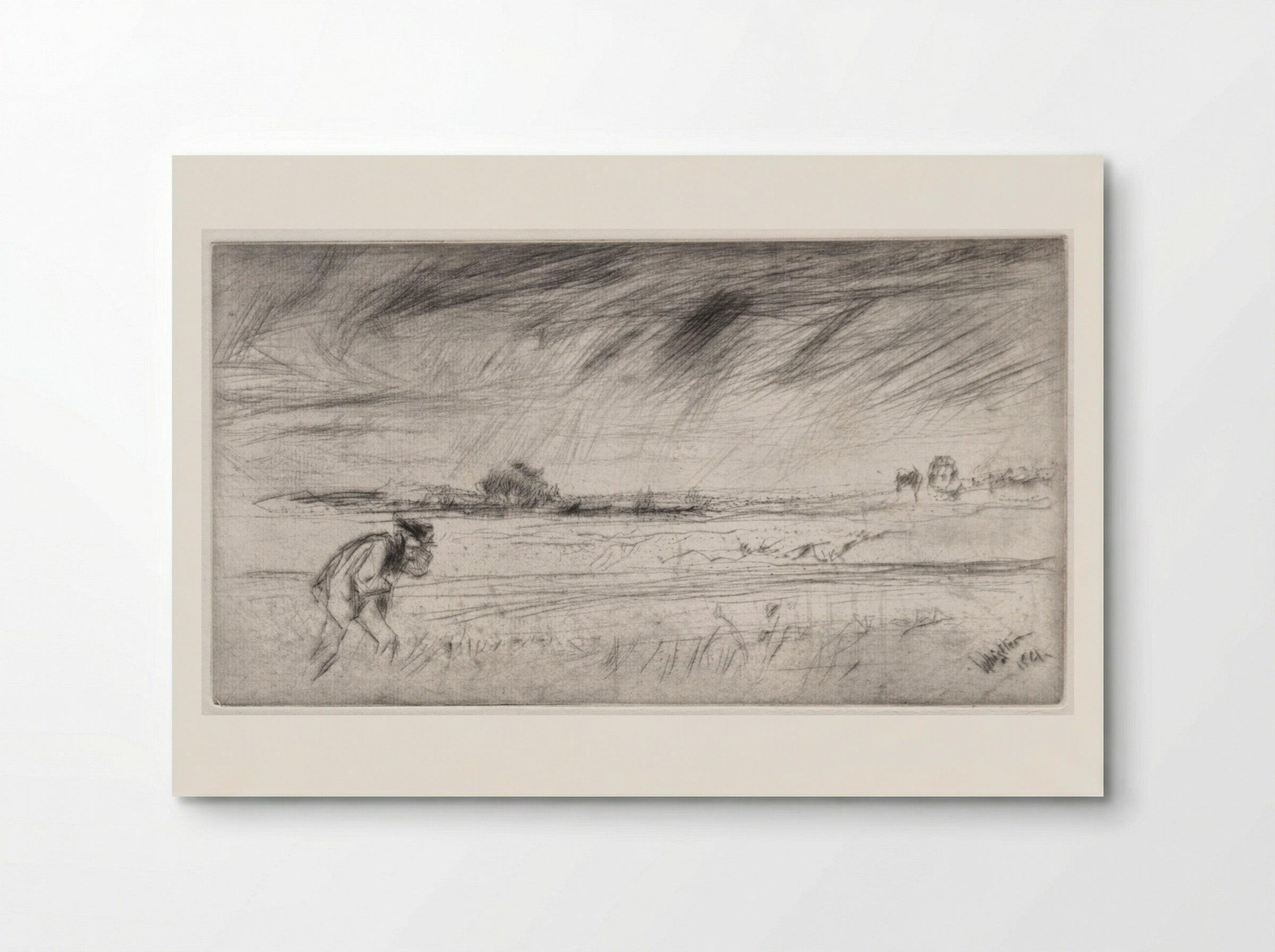
The Storm - James McNeill Whistler
Archival giclée
Frames arrive ready to hang
Secure checkout
Made to order
Description
A 1861 etching by James McNeill Whistler, capturing a solitary figure battling wind and rain through expressive, economical line work.
James McNeill Whistler produced this etching, titled The Storm, in 1861. It captures a fleeting moment of atmospheric tension through sparse, economical mark-making. The composition is dominated by the sky, where diagonal, rapid lines suggest the movement of rain and wind across an open expanse. In the lower left, a solitary figure leans forward against the elements, their posture conveying the physical exertion required to navigate the weather. Whistler utilised the drypoint needle to create the darker, more velvety lines in the sky, contrasting these with the lighter, etched lines that define the horizon and the foreground. This technique allows the paper itself to function as a source of light, creating a sense of space without the need for dense shading. The work reflects his interest in the tonal qualities of printmaking, a medium he mastered alongside painting. Unlike the highly finished academic prints of the period, this work prioritises the immediacy of the artist's hand. The composition is deliberately open, leaving much of the plate surface unworked to emphasise the vastness of the environment. By focusing on the interaction between the human figure and the natural world, Whistler creates a scene that feels both observational and subjective. The signature and date in the lower right corner confirm its place within his early career, during which he spent significant time in London and Paris, refining his approach to graphic art. This print demonstrates his ability to evoke mood through minimal visual information, a characteristic that would define his later work in various media.
Return policy
Because every print is made to order, we don't offer change-of-mind returns, refunds or exchanges. If your order arrives faulty, damaged or incorrect, we'll replace it free of charge — just contact us within 48 hours of delivery. See our refunds page for full details.
Shipping
We ship worldwide, printing at the production hub nearest to your delivery address. Delivery times and costs vary by destination — you'll see the options available to you at checkout.
Manufacturing
Each print is produced to order using 12-colour giclée printing on FSC-certified archival paper. Designed in Britain and printed at your nearest production hub to reduce waste and speed up delivery.
Care and materials
Specific Features
Every Solis piece is made to order with archival, gallery-quality materials built to last.
- Museum-grade giclée printing for rich, fade-resistant colour
- Archival matte fine-art paper, FSC-certified
- Multiple sizes and framing options available
- Frames in black, natural wood, dark wood or white
- Framed prints arrive ready to hang
Care & Cleaning
To keep your artwork looking its best:
- Dust gently with a soft, dry cloth
- Avoid prolonged direct sunlight
- Never use liquid cleaners on the print or canvas surface
- Keep in a dry, room-temperature space
- Handle prints with clean, dry hands
Materials & Sizing
Museum-grade giclée on FSC-certified archival matte paper, with framed and canvas options.
- Paper sizes: A4, A3, A2, A1, A0 and B2 (50×70 cm)
- Canvas: XS (20×30 cm) to Large (60×90 cm)
- Frames: black, natural wood, dark wood or white
The Storm - James McNeill Whistler

Artist Biography
James Mcneill Whistler
He was born in 1834 in Lowell, Massachusetts. His father, a civil engineer, took the family to St Petersburg to advise on the railroad to Moscow. The young Whistler took drawing classes at the Imperial Academy of Sciences. After the West Point disaster, he briefly worked for the US Coast and Geodetic Survey, learning the etching techniques he would use for the rest of his career, then left for Paris. He never lived in America again.
The painting everyone knows as Whistler's Mother is actually called Arrangement in Grey and Black No. 1. He named his works with musical terms (Nocturnes, Arrangements, Harmonies, Symphonies) to insist that painting was about tonal composition, not subject matter. The painting of his mother was about grey and black. That it also depicted his mother was, in principle, secondary.
In 1877, John Ruskin reviewed his Nocturne in Black and Gold: The Falling Rocket and wrote that he never expected to hear a coxcomb ask two hundred guineas for flinging a pot of paint in the public's face. Whistler sued for libel. The case was heard over two days in November 1878. He won, and was awarded damages of one farthing, the least valuable coin in the realm. The legal costs bankrupted him.
He signed his work with a butterfly. It started as a monogram inspired by the potter's marks on Chinese ceramics he collected, gradually evolving into an abstract butterfly shape. Around 1880, he added a stinger to it, representing both the delicate and the combative sides of his personality. The Peacock Room, his masterpiece of decorative art, extended his obsession with total harmony from a single painting to an entire architectural space.
Why Choose Us ?
Damage-free delivery guarantee
Fast Shipping
Museum-Quality Materials
You May Also Like