

Fine Art Poster
From £28
A giclée print on 200gsm matte fine art paper, using a twelve-colour process for accurate, fade-resistant colour. Supplied unframed, delivered flat or rolled.



Archival giclée
Frames arrive ready to hang
Secure checkout
Made to order
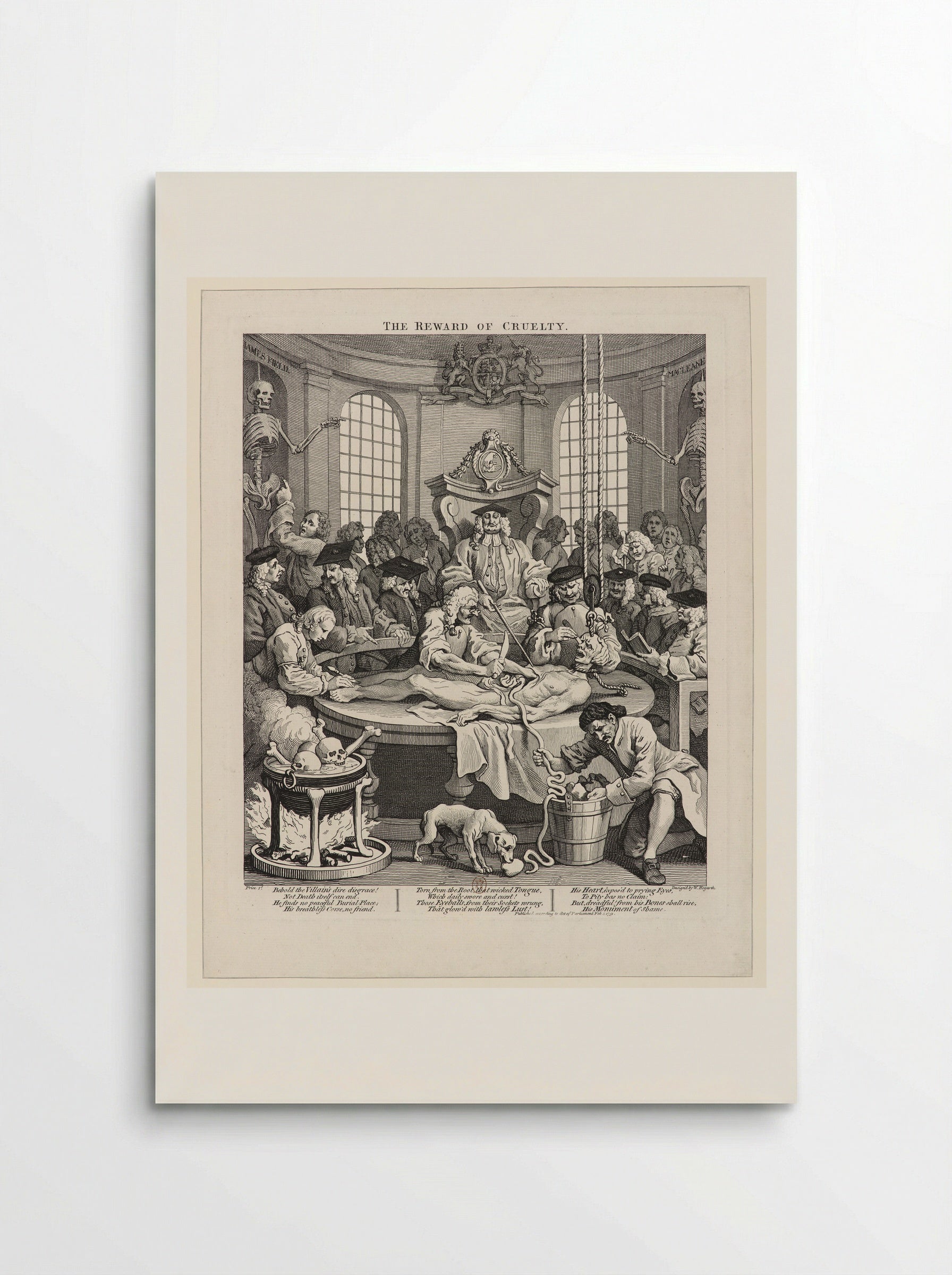
The final plate of William Hogarth's The Four Stages of Cruelty, this 1751 engraving depicts the grim anatomical dissection of the criminal Tom Nero.
The Reward of Cruelty is the final plate in William Hogarth's series, The Four Stages of Cruelty, published in 1751. This work depicts the post-mortem dissection of Tom Nero, a character who progresses from torturing animals to committing murder. Hogarth intended this series to serve as a moral warning against the brutal treatment of animals and the subsequent descent into human violence. The scene takes place in a lecture theatre at the Surgeons' Hall. A surgeon presides over the dissection, while other figures observe the procedure with varying degrees of interest or indifference. The composition is dense with macabre detail: a dog gnaws on a human heart in the foreground, while the intestines of the deceased are being removed and placed into a bucket. Skeletons of previous criminals, identified as James Field and Macleane, loom in the background, reinforcing the theme of inevitable retribution. Hogarth employs a sharp, linear style characteristic of his printmaking. The etching captures the clinical yet grotesque atmosphere of the anatomical theatre. The figures are rendered with exaggerated features, a common device in Hogarth's social commentary to convey character flaws or moral decay. The inclusion of text at the bottom of the print provides a didactic summary of the narrative, warning the viewer of the consequences of a life devoid of empathy. This print reflects the mid-eighteenth-century public fascination with anatomy and the legal reality that the bodies of executed criminals were often surrendered to surgeons for dissection. By linking the act of cruelty to this final, public humiliation, Hogarth creates a narrative arc that concludes with the total degradation of the protagonist. The work remains a significant example of British satirical art, demonstrating Hogarth's ability to combine social critique with detailed, narrative-driven imagery.
Because every print is made to order, we don't offer change-of-mind returns, refunds or exchanges. If your order arrives faulty, damaged or incorrect, we'll replace it free of charge — just contact us within 48 hours of delivery. See our refunds page for full details.
We ship worldwide, printing at the production hub nearest to your delivery address. Delivery times and costs vary by destination — you'll see the options available to you at checkout.
Each print is produced to order using 12-colour giclée printing on FSC-certified archival paper. Designed in Britain and printed at your nearest production hub to reduce waste and speed up delivery.
Specific Features
Every Solis piece is made to order with archival, gallery-quality materials built to last.
Care & Cleaning
To keep your artwork looking its best:
Materials & Sizing
Museum-grade giclée on FSC-certified archival matte paper, with framed and canvas options.

Artist Biography
Made to order
Every piece is printed to order. These are the five finishes, and what makes each one different.
From £28
A giclée print on 200gsm matte fine art paper, using a twelve-colour process for accurate, fade-resistant colour. Supplied unframed, delivered flat or rolled.

From £45
The same fine art print in a solid wood frame with UV-protective acrylic glaze and rigid backing. Five frame colours. Arrives ready to hang.

From £85
A deeper solid wood frame: 33mm deep with a 20mm face and Perspex glaze. The print sits unmounted for a clean gallery presentation. Black, white or natural.

From £30
Hand-stretched canvas with neat gallery-wrapped edges, giving the artwork surface texture and depth. Arrives ready to hang.

From £135
Stretched canvas set in a floating wood frame, our most substantial finish. Arrives ready to hang.
Why Choose Us ?
Damage-free delivery guarantee
Fast Shipping
Museum-Quality Materials
You May Also Like
We use cookies to measure our marketing and see which prints people love.We use cookies to measure our marketing.
By continuing to browse, you agree · Privacy Policy