

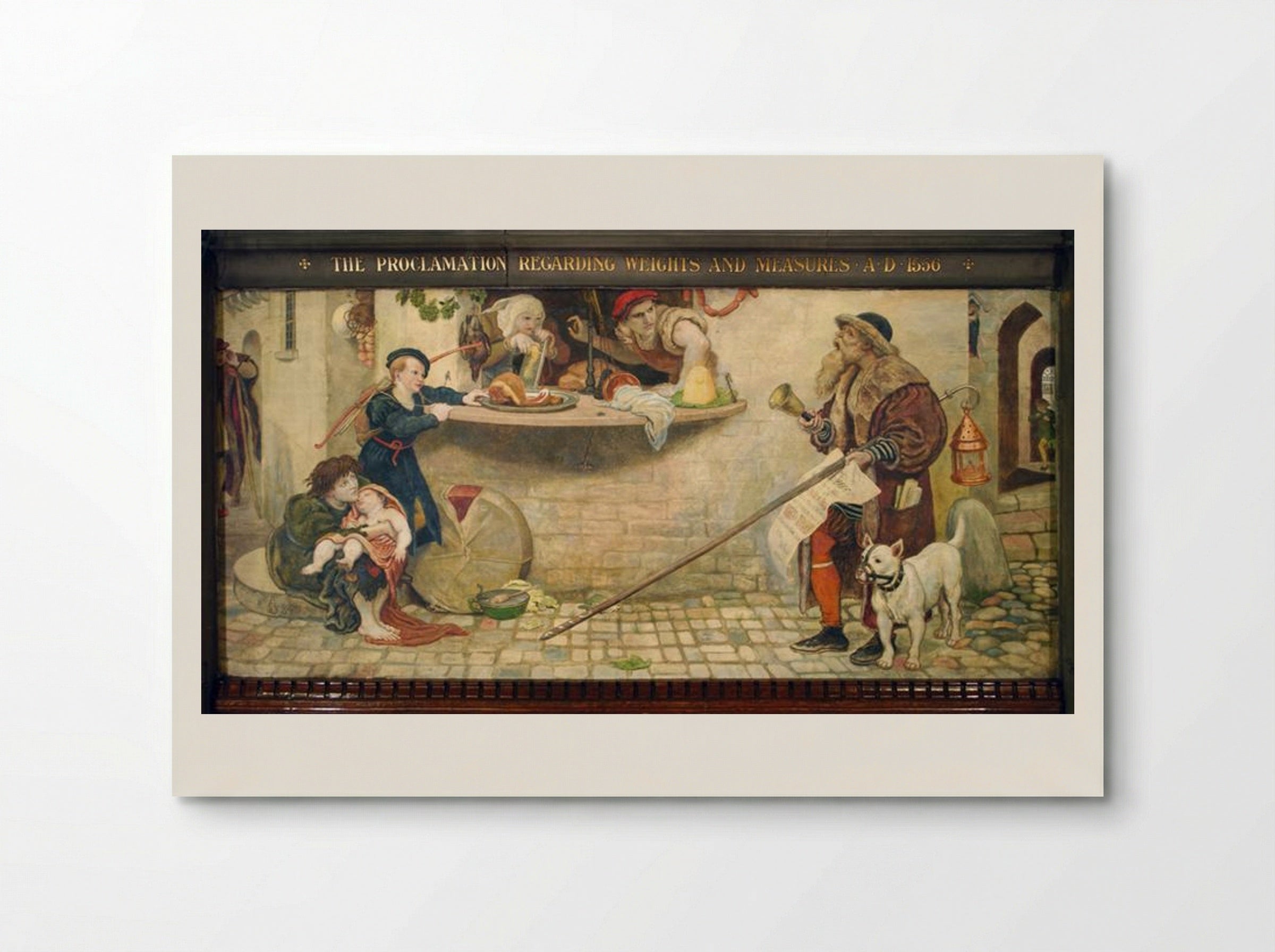
The Proclamation Regarding Weights and Measures, A.D. 1556 - Ford Madox Brown
Archival giclée
Frames arrive ready to hang
Secure checkout
Made to order
Description
A historical scene by Ford Madox Brown depicting a town crier announcing new trade regulations in 1556 Manchester. Part of the Manchester Murals series, this work captures Tudor life with naturalistic detail.
Ford Madox Brown produced this work as part of a series of twelve murals for the Great Hall of Manchester Town Hall. The cycle depicts the history of Manchester from Roman times to the nineteenth century. This specific scene illustrates a decree from 1556 during the reign of Queen Mary I. It focuses on the standardisation of weights and measures to prevent fraud in local trade. The composition features a town crier in the foreground. He holds a bell and a long staff while reading the official proclamation from a parchment. Beside him stands a white dog with a spiked collar. To the left, a butcher and a woman are visible behind a shop counter. They appear to be adjusting their scales or inspecting meat in response to the new regulations. A young boy with a bow and arrow leans against the counter. A woman sits on the ground nearby holding a small child. The butcher's stall contains various cuts of meat and a large cheese. A set of scales hangs from the ceiling of the booth. In the background, the architecture of the town is visible through narrow doorways and windows. The figures are arranged in a shallow space, which is typical of mural design intended to respect the flat surface of the wall. Brown included small details like the texture of the cobblestones and the grain of the wooden counter to ground the scene in reality. Brown used the Gambier Parry process for the original mural. This technique involved applying pigments mixed with wax and resin to a dry surface to mimic the appearance of traditional fresco. The style is characteristic of the Pre-Raphaelite circle. It avoids idealised figures in favour of naturalistic detail and historical accuracy. The artist researched sixteenth-century costume and architecture to ensure the scene appeared authentic to the Tudor period. The colour palette uses earthy tones such as ochre and terracotta.
Return policy
Because every print is made to order, we don't offer change-of-mind returns, refunds or exchanges. If your order arrives faulty, damaged or incorrect, we'll replace it free of charge — just contact us within 48 hours of delivery. See our refunds page for full details.
Shipping
We ship worldwide, printing at the production hub nearest to your delivery address. Delivery times and costs vary by destination — you'll see the options available to you at checkout.
Manufacturing
Each print is produced to order using 12-colour giclée printing on FSC-certified archival paper. Designed in Britain and printed at your nearest production hub to reduce waste and speed up delivery.
The Proclamation Regarding Weights and Measures, A.D. 1556 - Ford Madox Brown

Artist Biography
Ford Madox Brown
He was born in Calais in 1821, trained across Europe, and settled in London. Though never an official member of the Pre-Raphaelite Brotherhood, he was their most important older ally and the teacher who most shaped their ambitions. His insistence on painting outdoors in natural light, often to the point of physical discomfort, and his dense, moralising compositions made him a bridge between the Nazarenes he had studied with in Rome and the young English radicals who followed.
He also designed stained glass and furniture for Morris and Co. He died in 1893, at seventy-two.
Our Features
Designed for Lasting Impact
Specific Features
Every Solis piece is made to order with archival, gallery-quality materials built to last.
- Museum-grade giclée printing for rich, fade-resistant colour
- Archival matte fine-art paper, FSC-certified
- Multiple sizes and framing options available
- Frames in black, natural wood, dark wood or white
- Framed prints arrive ready to hang
Care & Cleaning
To keep your artwork looking its best:
- Dust gently with a soft, dry cloth
- Avoid prolonged direct sunlight
- Never use liquid cleaners on the print or canvas surface
- Keep in a dry, room-temperature space
- Handle prints with clean, dry hands
Materials & Sizing
Museum-grade giclée on FSC-certified archival matte paper, with framed and canvas options.
- Paper sizes: A4, A3, A2, A1, A0 and B2 (50×70 cm)
- Canvas: XS (20×30 cm) to Large (60×90 cm)
- Frames: black, natural wood, dark wood or white
Why Choose Us ?
Damage-free delivery guarantee
Fast Shipping
Museum-Quality Materials
Artist Biography
Ford Madox Brown
He was born in Calais in 1821, trained across Europe, and settled in London. Though never an official member of the Pre-Raphaelite Brotherhood, he was their most important older ally and the teacher who most shaped their ambitions. His insistence on painting outdoors in natural light, often to the point of physical discomfort, and his dense, moralising compositions made him a bridge between the Nazarenes he had studied with in Rome and the young English radicals who followed.
He also designed stained glass and furniture for Morris and Co. He died in 1893, at seventy-two.
You May Also Like