

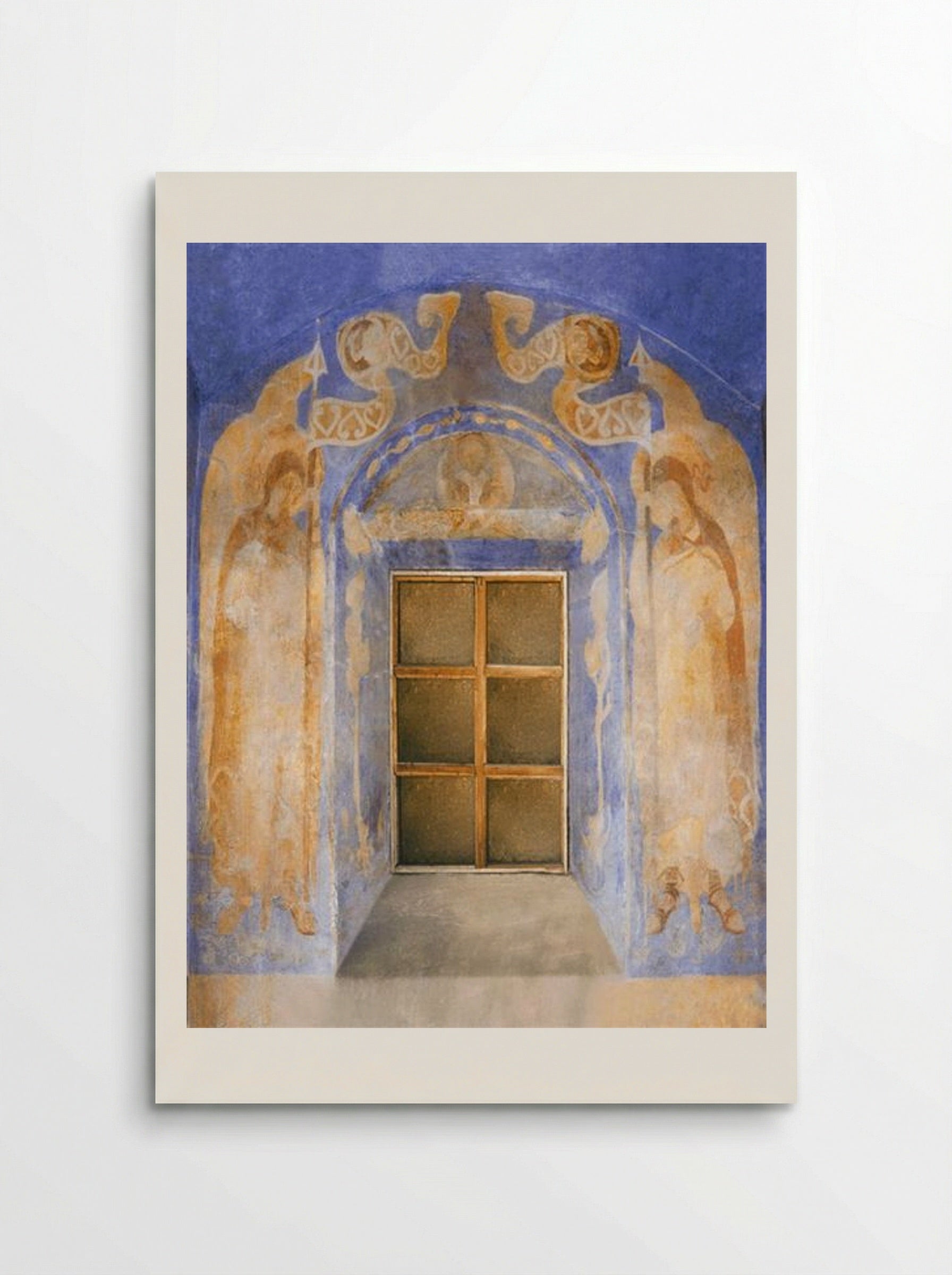
The Painting of the Western Wall of the Chapel of St. Anastasia - Nicholas Roerich
Archival giclée
Frames arrive ready to hang
Secure checkout
Made to order
Description
A fine art print of Nicholas Roerich's mural work for the Chapel of St. Anastasia, featuring ethereal figures and a striking blue colour palette.
This work depicts the mural decoration executed by Nicholas Roerich for the Chapel of St. Anastasia in Pskov. Roerich, a polymath with a deep interest in ancient Russian history and spiritual traditions, was commissioned to restore and decorate the interior of this historic structure. The composition reflects his engagement with the aesthetic principles of early Russian icon painting, adapted through a modernist lens. The image shows a central doorway flanked by two standing figures, likely angelic or saintly forms, rendered in a muted, ethereal palette. The figures are integrated into the architectural frame, their elongated silhouettes echoing the verticality of the archway. Above the door, a circular motif sits within the curve of the vault, surrounded by decorative scrolls that mirror the rhythmic lines of the figures below. The use of a dominant, cool blue tone provides a stark contrast to the warm, ochre-toned figures, creating a sense of quietude and sacred space. Roerich often sought to bridge the gap between contemporary art and the archaic roots of Russian culture. In this chapel, he avoided the heavy ornamentation of later periods, opting instead for a simplified, monumental style that prioritises clarity and spiritual resonance. The application of paint suggests a weathered, aged surface, consistent with the historical context of the chapel. This print captures the interplay between the structural elements of the building and the painted surfaces, offering a view into Roerich's approach to monumental art. His work here demonstrates a careful balance between historical reverence and his own stylistic interpretation, resulting in a composition that feels both ancient and distinctly personal to the artist's vision.
Return policy
Because every print is made to order, we don't offer change-of-mind returns, refunds or exchanges. If your order arrives faulty, damaged or incorrect, we'll replace it free of charge — just contact us within 48 hours of delivery. See our refunds page for full details.
Shipping
We ship worldwide, printing at the production hub nearest to your delivery address. Delivery times and costs vary by destination — you'll see the options available to you at checkout.
Manufacturing
Each print is produced to order using 12-colour giclée printing on FSC-certified archival paper. Designed in Britain and printed at your nearest production hub to reduce waste and speed up delivery.
The Painting of the Western Wall of the Chapel of St. Anastasia - Nicholas Roerich

Artist Biography
Nicholas Roerich
He was born in St Petersburg in 1874 and studied law and art simultaneously before choosing art. After the Revolution, he left Russia and eventually settled in the Kullu Valley of India, where he established a research institute. His paintings of Central Asian mountains, produced in enormous quantities, glow with a flat, saturated colour that reflects his interest in theosophy and Eastern spiritual traditions.
The Roerich Pact, his treaty for protecting cultural sites during wartime, was the precursor to the 1954 Hague Convention. He died in Naggar, Himachal Pradesh, in 1947, at seventy-three.
Our Features
Designed for Lasting Impact
Specific Features
Every Solis piece is made to order with archival, gallery-quality materials built to last.
- Museum-grade giclée printing for rich, fade-resistant colour
- Archival matte fine-art paper, FSC-certified
- Multiple sizes and framing options available
- Frames in black, natural wood, dark wood or white
- Framed prints arrive ready to hang
Care & Cleaning
To keep your artwork looking its best:
- Dust gently with a soft, dry cloth
- Avoid prolonged direct sunlight
- Never use liquid cleaners on the print or canvas surface
- Keep in a dry, room-temperature space
- Handle prints with clean, dry hands
Materials & Sizing
Museum-grade giclée on FSC-certified archival matte paper, with framed and canvas options.
- Paper sizes: A4, A3, A2, A1, A0 and B2 (50×70 cm)
- Canvas: XS (20×30 cm) to Large (60×90 cm)
- Frames: black, natural wood, dark wood or white
Why Choose Us ?
Damage-free delivery guarantee
Fast Shipping
Museum-Quality Materials
Artist Biography
Nicholas Roerich
He was born in St Petersburg in 1874 and studied law and art simultaneously before choosing art. After the Revolution, he left Russia and eventually settled in the Kullu Valley of India, where he established a research institute. His paintings of Central Asian mountains, produced in enormous quantities, glow with a flat, saturated colour that reflects his interest in theosophy and Eastern spiritual traditions.
The Roerich Pact, his treaty for protecting cultural sites during wartime, was the precursor to the 1954 Hague Convention. He died in Naggar, Himachal Pradesh, in 1947, at seventy-three.
You May Also Like