

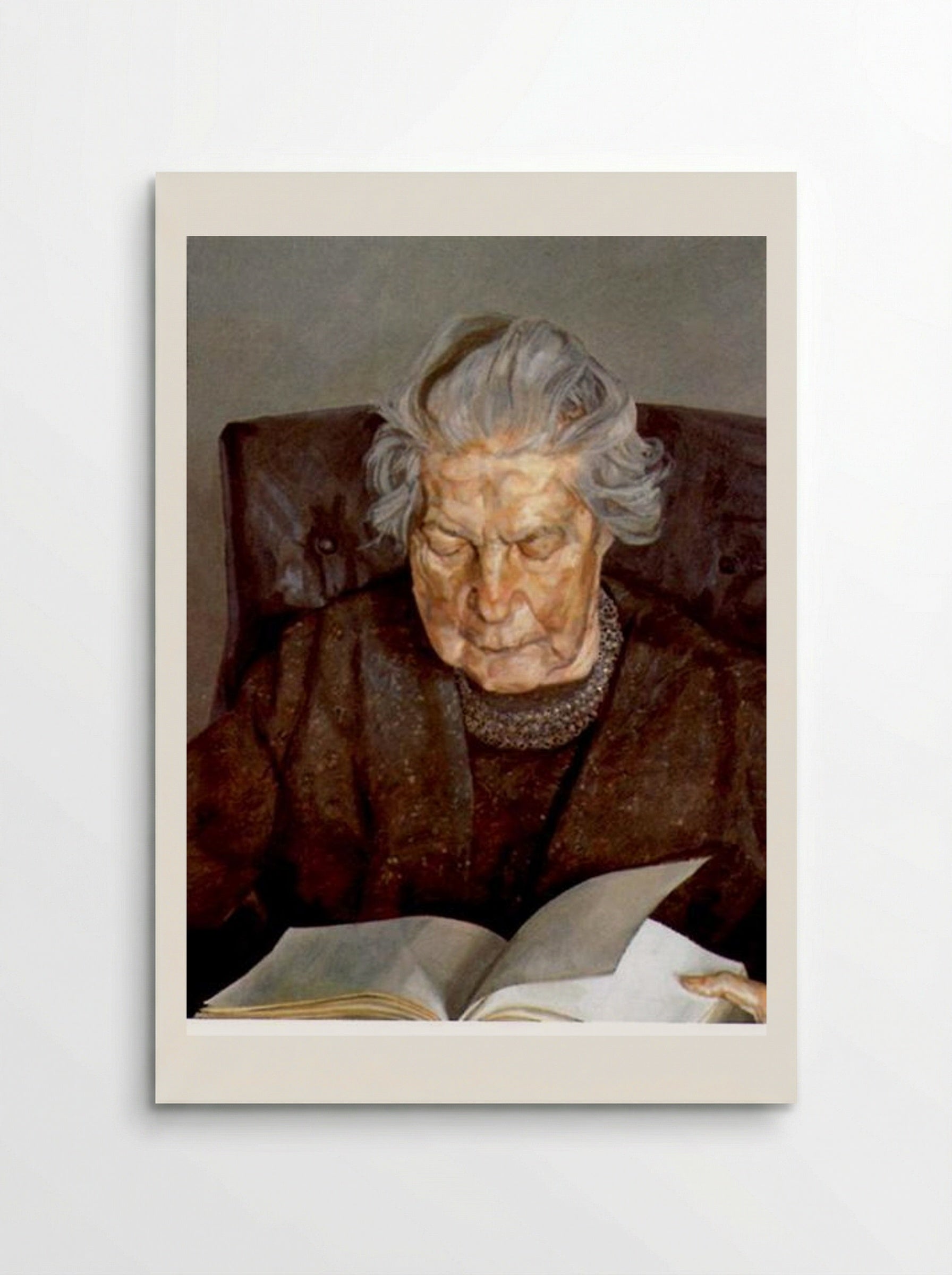
The Painter's Mother Reading - Lucian Freud
Archival giclée
Frames arrive ready to hang
Secure checkout
Made to order
Description
A striking portrait by Lucian Freud, depicting his mother in a moment of quiet concentration, rendered with the artist's signature attention to texture and form.
Lucian Freud, a central figure in twentieth-century British painting, produced a series of portraits depicting his mother, Lucie Freud, following the death of his father in 1970. This specific work captures her in a moment of quiet absorption, her gaze directed downward at a book. Freud employs a rigorous approach to the human form, focusing on the textures of skin, the weight of fabric, and the specific geometry of the sitter's posture. The painting demonstrates the artist's characteristic method of building up paint in layers, creating a surface that possesses a tangible, physical presence. The palette is restrained, dominated by earthy browns, muted greys, and flesh tones that reveal the artist's close observation of his subject. Unlike the idealised portraits common in earlier centuries, Freud presents his mother with an unflinching honesty. Every wrinkle and shadow is rendered with precision, reflecting his interest in the psychological state of the sitter as much as their physical appearance. Lucie Freud appears here in a dark garment, seated in a chair that provides a solid, grounding backdrop for her figure. The lighting is focused, drawing attention to the contours of her face and the hands holding the open volume. This work is representative of the artist's mature style, where the act of painting becomes a prolonged engagement with the subject. By choosing his mother as a frequent model, Freud explored themes of familiarity and distance, documenting the ageing process with clinical detachment. The composition is tight, forcing the viewer to confront the subject directly, without the distraction of a complex environment. It is a study of stillness and concentration, executed with the technical control that defined Freud's career.
Return policy
Because every print is made to order, we don't offer change-of-mind returns, refunds or exchanges. If your order arrives faulty, damaged or incorrect, we'll replace it free of charge — just contact us within 48 hours of delivery. See our refunds page for full details.
Shipping
We ship worldwide, printing at the production hub nearest to your delivery address. Delivery times and costs vary by destination — you'll see the options available to you at checkout.
Manufacturing
Each print is produced to order using 12-colour giclée printing on FSC-certified archival paper. Designed in Britain and printed at your nearest production hub to reduce waste and speed up delivery.
Care and materials
Specific Features
Every Solis piece is made to order with archival, gallery-quality materials built to last.
- Museum-grade giclée printing for rich, fade-resistant colour
- Archival matte fine-art paper, FSC-certified
- Multiple sizes and framing options available
- Frames in black, natural wood, dark wood or white
- Framed prints arrive ready to hang
Care & Cleaning
To keep your artwork looking its best:
- Dust gently with a soft, dry cloth
- Avoid prolonged direct sunlight
- Never use liquid cleaners on the print or canvas surface
- Keep in a dry, room-temperature space
- Handle prints with clean, dry hands
Materials & Sizing
Museum-grade giclée on FSC-certified archival matte paper, with framed and canvas options.
- Paper sizes: A4, A3, A2, A1, A0 and B2 (50×70 cm)
- Canvas: XS (20×30 cm) to Large (60×90 cm)
- Frames: black, natural wood, dark wood or white
The Painter's Mother Reading - Lucian Freud

Artist Biography
Lucian Freud
He was Sigmund Freud's grandson. The family left Berlin for London in 1933, when Lucian was ten. He became a British citizen in 1939. The biographical connection to psychoanalysis is unavoidable and he resisted it throughout his career, though his paintings of naked bodies on beds and sofas, viewed from above in harsh overhead light, invite exactly the clinical reading he rejected.
His early work is tight, linear, almost Pre-Raphaelite in its precision: the portrait of Francis Bacon from 1952, Girl with a White Dog, Hotel Bedroom. The shift came in the late 1950s when he switched from sable brushes to hog-hair, thickened the paint, and began working on a larger scale. The flesh became heavier, more present, more uncomfortable to look at.
He painted everyone the same way. The Queen sat for him (the result was controversial). His studio assistant and bookmaker 'Big Sue' Tilley posed naked on a sofa; the painting sold for GBP33.6 million. His whippets appear repeatedly. He insisted on working from life, never photographs, and never took commissions. People came to him.
He worked every day until a few weeks before his death in 2011, at eighty-eight. His last painting was unfinished on the easel.
Why Choose Us ?
Damage-free delivery guarantee
Fast Shipping
Museum-Quality Materials
You May Also Like