

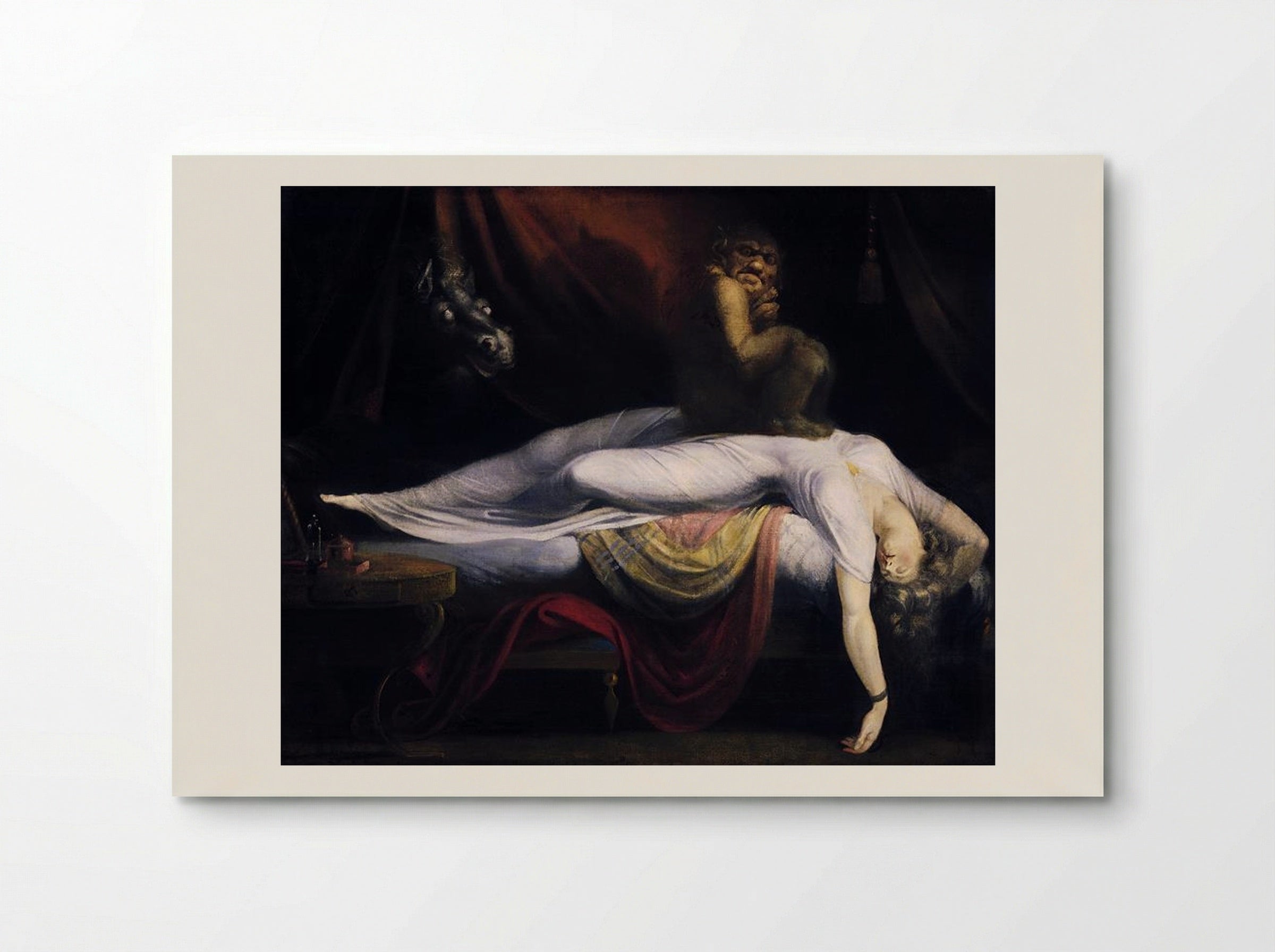
The Nightmare - Henry Fuseli
Archival giclée
Frames arrive ready to hang
Secure checkout
Made to order
Description
A seminal work of Romanticism, Henry Fuseli's 1781 painting depicts a sleeping woman haunted by a grotesque incubus and a spectral horse.
Henry Fuseli, a Swiss-born painter active in London, completed The Nightmare in 1781. It remains one of the most recognisable images from the late eighteenth century. The composition depicts a woman in a deep, troubled sleep, her body draped across a bed with her head hanging over the edge. A small, grotesque creature, known as an incubus, squats upon her chest. This figure represents the physical manifestation of a nightmare, a concept that fascinated the artist and his contemporaries. To the left, a spectral horse with glowing eyes emerges from the shadows, its head peering through the heavy curtains. This inclusion draws upon folklore, specifically the association between horses and nocturnal visitations. Fuseli employs a dramatic use of chiaroscuro, with deep shadows contrasting against the pale, luminous form of the sleeping woman. The lighting directs the viewer's focus to the central figures, while the surrounding darkness creates a sense of claustrophobia and unease. Fuseli was deeply interested in the psychological aspects of human experience, particularly the irrational and the subconscious. By visualising the internal state of a dream, he moved away from the rationalism of the Enlightenment. The painting does not rely on classical mythology or historical narrative, but instead explores the subjective realm of fear and desire. The theatrical staging and the exaggerated posture of the woman contribute to the overall sense of drama. This work was first exhibited at the Royal Academy in 1782, where it caused a sensation among the public and critics alike. It continues to be studied for its early exploration of themes that would later occupy the field of psychoanalysis.
Return policy
Because every print is made to order, we don't offer change-of-mind returns, refunds or exchanges. If your order arrives faulty, damaged or incorrect, we'll replace it free of charge — just contact us within 48 hours of delivery. See our refunds page for full details.
Shipping
We ship worldwide, printing at the production hub nearest to your delivery address. Delivery times and costs vary by destination — you'll see the options available to you at checkout.
Manufacturing
Each print is produced to order using 12-colour giclée printing on FSC-certified archival paper. Designed in Britain and printed at your nearest production hub to reduce waste and speed up delivery.
Care and materials
Specific Features
Every Solis piece is made to order with archival, gallery-quality materials built to last.
- Museum-grade giclée printing for rich, fade-resistant colour
- Archival matte fine-art paper, FSC-certified
- Multiple sizes and framing options available
- Frames in black, natural wood, dark wood or white
- Framed prints arrive ready to hang
Care & Cleaning
To keep your artwork looking its best:
- Dust gently with a soft, dry cloth
- Avoid prolonged direct sunlight
- Never use liquid cleaners on the print or canvas surface
- Keep in a dry, room-temperature space
- Handle prints with clean, dry hands
Materials & Sizing
Museum-grade giclée on FSC-certified archival matte paper, with framed and canvas options.
- Paper sizes: A4, A3, A2, A1, A0 and B2 (50×70 cm)
- Canvas: XS (20×30 cm) to Large (60×90 cm)
- Frames: black, natural wood, dark wood or white
The Nightmare - Henry Fuseli

Artist Biography
Henry Fuseli
He was born Johann Heinrich Fussli in Zurich in 1741, the second of eighteen children. He was ordained as a minister in 1761 but forced to leave Switzerland after helping expose a corrupt magistrate. He spent eight years in Rome, changed his name from Fussli to the Italianate Fuseli, and arrived in London with a taste for the violent, the erotic, and the supernatural.
William Blake, not easily impressed, said of him: the only man that e'er I knew who did not make me almost spew. This was a compliment. Blake meant Fuseli was the only person who did not disgust him. Their friendship lasted decades. Fuseli married his model Sophia Rawlins in 1788. He became Keeper of the Royal Academy and grew increasingly conservative in his politics despite having started as a radical. He died in 1825, aged eighty-four, and was buried in St Paul's Cathedral.
Why Choose Us ?
Damage-free delivery guarantee
Fast Shipping
Museum-Quality Materials
You May Also Like