

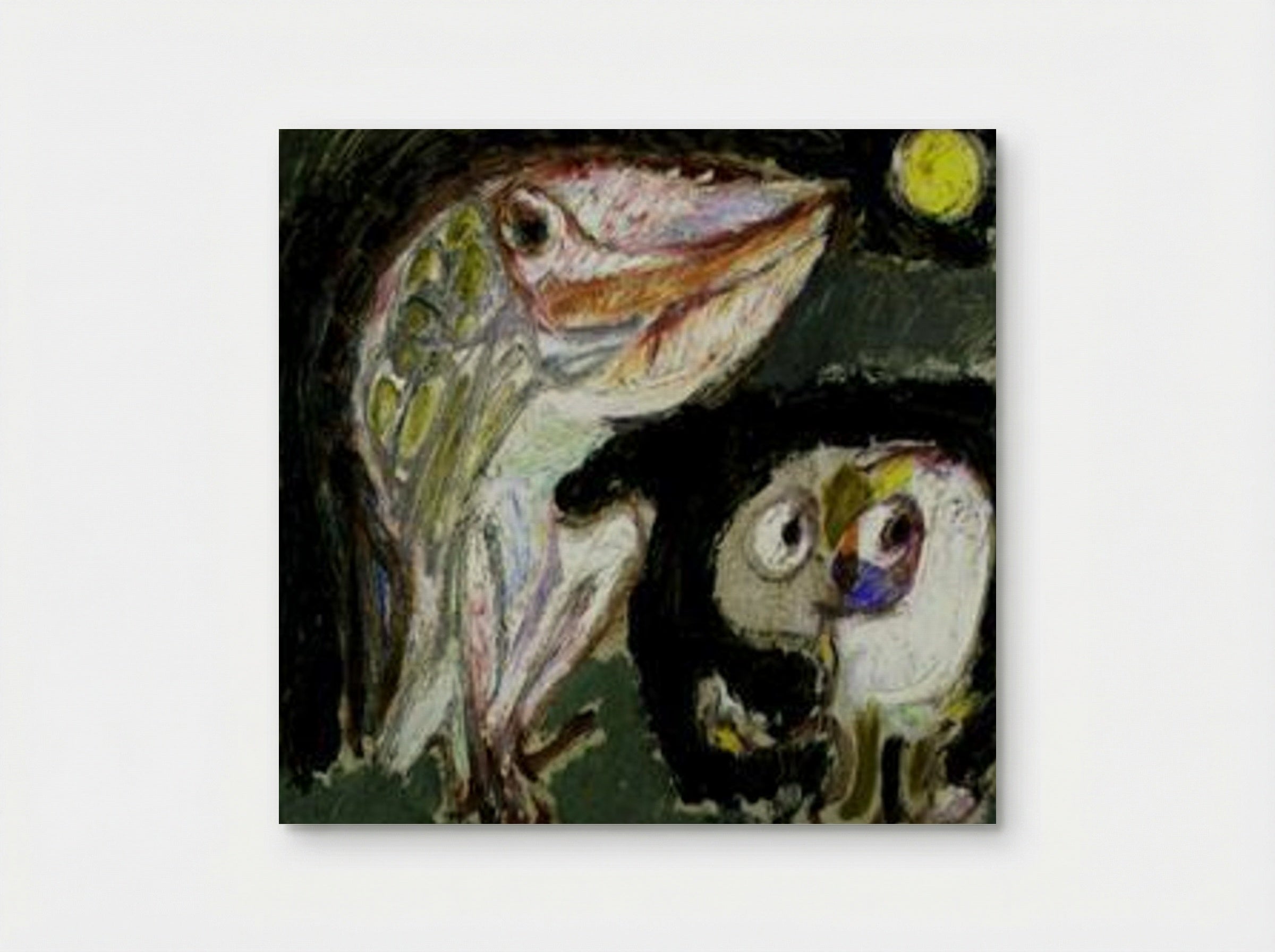
The Moon and the Animals - Asger Jorn
Archival giclée
Frames arrive ready to hang
Secure checkout
Made to order
Description
Asger Jorn's "The Moon and the Animals" is an abstract expressionist painting featuring a fish and an owl under a yellow moon, rendered with bold brushstrokes and muted colours.
Asger Jorn (1914-1973) was a Danish artist known for his contributions to the abstract expressionist movement. He co-founded the CoBrA group in 1948, which sought to break away from traditional artistic conventions and embrace spontaneity and experimentation. Jorn's work often incorporates mythological and folkloric themes, reflecting his interest in exploring the human condition through art. His style is characterised by bold brushstrokes, distorted figures, and a distinctive use of colour. In "The Moon and the Animals", Jorn presents a composition featuring a fish-like creature and an owl-like figure set against a dark background with a yellow moon. The painting is executed with loose, expressive brushwork, giving the figures a sense of movement and energy. The colours are muted, with shades of white, black, and green dominating the palette. The overall effect is one of mystery and intrigue, inviting viewers to interpret the symbolic meaning of the animals and their relationship to the moon.
Return policy
Because every print is made to order, we don't offer change-of-mind returns, refunds or exchanges. If your order arrives faulty, damaged or incorrect, we'll replace it free of charge — just contact us within 48 hours of delivery. See our refunds page for full details.
Shipping
We ship worldwide, printing at the production hub nearest to your delivery address. Delivery times and costs vary by destination — you'll see the options available to you at checkout.
Manufacturing
Each print is produced to order using 12-colour giclée printing on FSC-certified archival paper. Designed in Britain and printed at your nearest production hub to reduce waste and speed up delivery.
The Moon and the Animals - Asger Jorn
Artist Biography
Asger Jorn
Born in Vejrum, Jutland in 1914, Jorn studied briefly in Paris in the late 1930s, where he attended Léger's atelier and worked with Le Corbusier on a pavilion project. During the Nazi occupation of Denmark he co-founded Helhesten, an underground cultural journal that kept experimental art alive through the war years. In 1948 he was a founding member of CoBrA, the international group that brought together artists from Copenhagen, Brussels, and Amsterdam in a loose avant-garde coalition emphasising raw expressiveness and collective mythology.
After CoBrA dissolved in 1951 he aligned briefly with the Situationist International, contributing theoretical writing alongside Guy Debord before a clean break in 1961. Over his lifetime he produced more than 2,500 works in paint, print, ceramics, and collage, and wrote over twenty books on aesthetics and political theory. He was also, incidentally, the first person to translate Franz Kafka into Danish. The major collection of his work is held at Museum Jorn in Silkeborg, which he helped establish. He died in Aarhus in May 1973.
Our Features
Designed for Lasting Impact
Specific Features
Every Solis piece is made to order with archival, gallery-quality materials built to last.
- Museum-grade giclée printing for rich, fade-resistant colour
- Archival matte fine-art paper, FSC-certified
- Multiple sizes and framing options available
- Frames in black, natural wood, dark wood or white
- Framed prints arrive ready to hang
Care & Cleaning
To keep your artwork looking its best:
- Dust gently with a soft, dry cloth
- Avoid prolonged direct sunlight
- Never use liquid cleaners on the print or canvas surface
- Keep in a dry, room-temperature space
- Handle prints with clean, dry hands
Materials & Sizing
Museum-grade giclée on FSC-certified archival matte paper, with framed and canvas options.
- Paper sizes: A4, A3, A2, A1, A0 and B2 (50×70 cm)
- Canvas: XS (20×30 cm) to Large (60×90 cm)
- Frames: black, natural wood, dark wood or white
Why Choose Us ?
Damage-free delivery guarantee
Fast Shipping
Museum-Quality Materials
Artist Biography
Asger Jorn
Born in Vejrum, Jutland in 1914, Jorn studied briefly in Paris in the late 1930s, where he attended Léger's atelier and worked with Le Corbusier on a pavilion project. During the Nazi occupation of Denmark he co-founded Helhesten, an underground cultural journal that kept experimental art alive through the war years. In 1948 he was a founding member of CoBrA, the international group that brought together artists from Copenhagen, Brussels, and Amsterdam in a loose avant-garde coalition emphasising raw expressiveness and collective mythology.
After CoBrA dissolved in 1951 he aligned briefly with the Situationist International, contributing theoretical writing alongside Guy Debord before a clean break in 1961. Over his lifetime he produced more than 2,500 works in paint, print, ceramics, and collage, and wrote over twenty books on aesthetics and political theory. He was also, incidentally, the first person to translate Franz Kafka into Danish. The major collection of his work is held at Museum Jorn in Silkeborg, which he helped establish. He died in Aarhus in May 1973.
You May Also Like