

Fine Art Poster
From £28
A giclée print on 200gsm matte fine art paper, using a twelve-colour process for accurate, fade-resistant colour. Supplied unframed, delivered flat or rolled.



Archival giclée
Frames arrive ready to hang
Secure checkout
Made to order
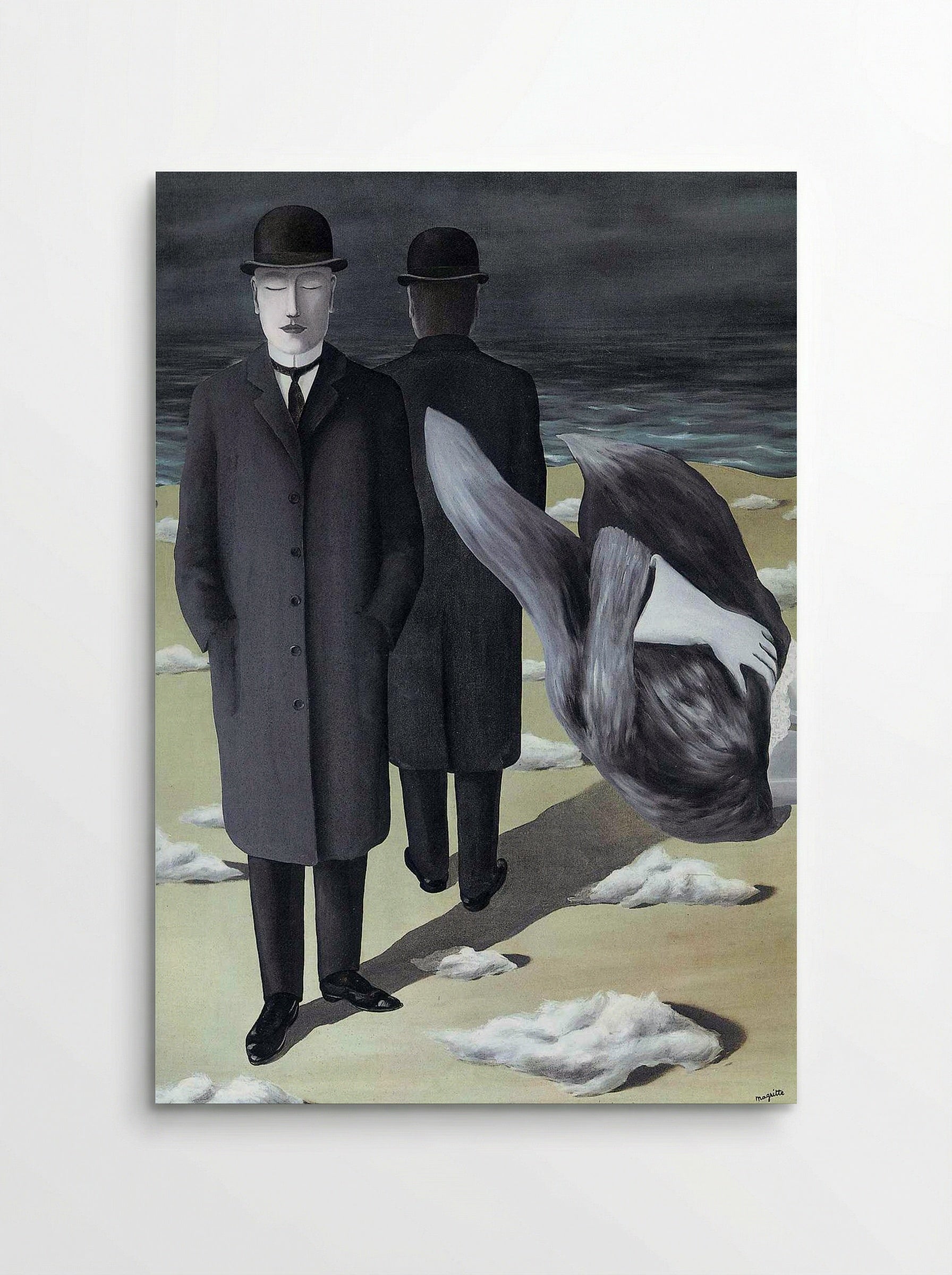
A surreal scene by René Magritte depicts two men on a beach with a reclining woman, rendered in a muted palette of greys and blacks, evoking a sense of mystery.
René Magritte (1898-1967) was a Belgian artist associated with the Surrealist movement. His work is characterised by the juxtaposition of ordinary objects in unexpected contexts, challenging viewers' perceptions of reality. Magritte's paintings often feature a sense of mystery and ambiguity, inviting contemplation and interpretation. He explored themes of identity, representation, and the nature of seeing. His influence extends to contemporary art and popular culture. 'The Meaning of Night' presents a dreamlike scene on a beach. Two men in dark overcoats and bowler hats stand facing different directions. One faces the viewer, his eyes closed, while the other faces the sea. A woman lies on the sand, her head and torso obscured by a dark, wing-like shape. The beach is covered in small, puffy clouds, and the sea is a dark, turbulent expanse. The colour palette is muted, with shades of grey, black, and beige dominating the composition. The painting evokes a sense of unease and invites speculation about the relationships between the figures and the meaning of the scene.
Because every print is made to order, we don't offer change-of-mind returns, refunds or exchanges. If your order arrives faulty, damaged or incorrect, we'll replace it free of charge — just contact us within 48 hours of delivery. See our refunds page for full details.
We ship worldwide, printing at the production hub nearest to your delivery address. Delivery times and costs vary by destination — you'll see the options available to you at checkout.
Each print is produced to order using 12-colour giclée printing on FSC-certified archival paper. Designed in Britain and printed at your nearest production hub to reduce waste and speed up delivery.

Artist Biography
Our Features
Designed for Lasting Impact
Every Solis piece is made to order with archival, gallery-quality materials built to last.
To keep your artwork looking its best:
Museum-grade giclée on FSC-certified archival matte paper, with framed and canvas options.
Made to order
Every piece is printed to order. These are the five finishes, and what makes each one different.
From £28
A giclée print on 200gsm matte fine art paper, using a twelve-colour process for accurate, fade-resistant colour. Supplied unframed, delivered flat or rolled.

From £45
The same fine art print in a solid wood frame with UV-protective acrylic glaze and rigid backing. Five frame colours. Arrives ready to hang.
Why Choose Us ?
Damage-free delivery guarantee
Fast Shipping
Museum-Quality Materials
Artist Biography
René Magritte
You May Also Like
We use cookies to measure our marketing and see which prints people love.We use cookies to measure our marketing.
By continuing to browse, you agree · Privacy Policy