

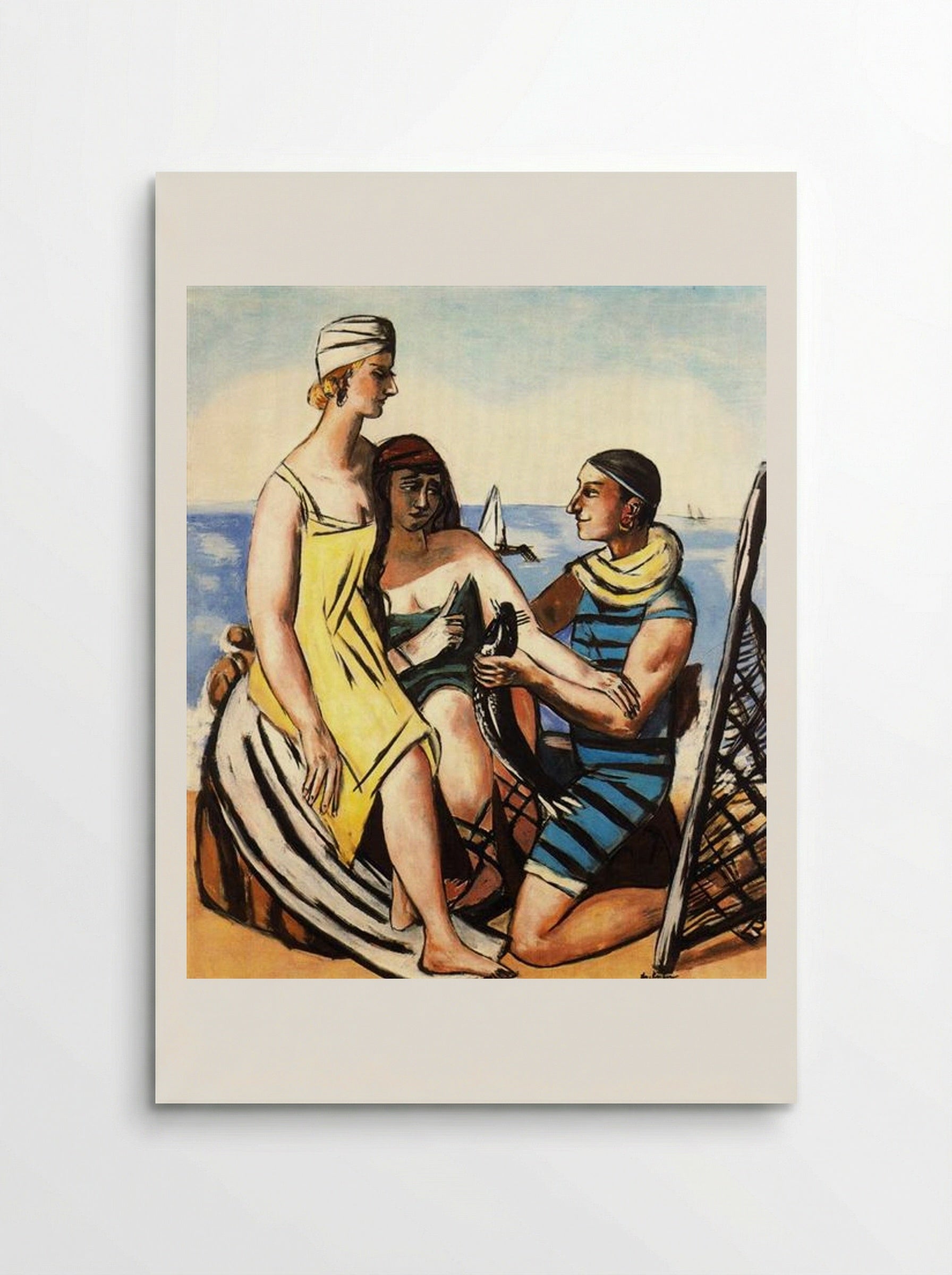
The Little Fish - Max Beckmann
Archival giclée
Frames arrive ready to hang
Secure checkout
Made to order
Description
A 1933 oil painting by Max Beckmann featuring three figures on a beach with a large black fish. This Expressionist work uses bold outlines and a primary colour palette.
Max Beckmann painted The Little Fish in 1933, a year of significant personal and political change for the artist in Germany. The composition features three figures situated on a beach against a background of the sea and a distant sailboat. A man in a blue and black striped swimsuit kneels on the right, holding a large black fish. To the left, two women are seated; one wears a yellow dress and a white turban, while the other is partially obscured behind her. The year 1933 marked Beckmann's dismissal from his teaching position at the Städelschule in Frankfurt by the National Socialist government. This context of displacement often informs the psychological tension found in his work from this period. The figures in The Little Fish appear physically close yet emotionally distant from one another. The woman in the yellow dress gazes past the man, while the central figure looks down with a sombre expression. The painting demonstrates Beckmann's use of heavy black outlines to define forms and create a sense of physical weight. The space is compressed, pushing the figures toward the front of the picture plane. This technique creates an immediate, almost claustrophobic atmosphere despite the outdoor setting. The colour palette relies on primary tones, specifically the yellow of the dress and the blue of the sea. Beckmann often used fish as symbolic objects in his paintings, frequently relating to themes of sexuality and the unconscious. In this specific work, the interaction between the figures and the fish remains ambiguous. The man presents the creature to the women, yet their expressions are detached and contemplative. The heavy application of paint and the bold, simplified shapes are typical of his mature style, which moved away from the more detailed realism of his earlier career toward a more personal, symbolic language.
Return policy
Because every print is made to order, we don't offer change-of-mind returns, refunds or exchanges. If your order arrives faulty, damaged or incorrect, we'll replace it free of charge — just contact us within 48 hours of delivery. See our refunds page for full details.
Shipping
We ship worldwide, printing at the production hub nearest to your delivery address. Delivery times and costs vary by destination — you'll see the options available to you at checkout.
Manufacturing
Each print is produced to order using 12-colour giclée printing on FSC-certified archival paper. Designed in Britain and printed at your nearest production hub to reduce waste and speed up delivery.
The Little Fish - Max Beckmann

Artist Biography
Max Beckmann
He was born in Leipzig in 1884 and trained at the Weimar Academy. His early work was relatively conventional; the First World War, where he served as a medical orderly, shattered both his style and his psychology. The paintings that followed, dense, allegorical, packed with symbolic figures in compressed, claustrophobic spaces, resist easy classification. His monumental triptychs, painted in exile in Amsterdam and later St Louis, combine mythology, autobiography and contemporary history.
He remains one of the twentieth century's most ambitious figurative painters, comparable in scale and intention to Picasso but less interested in formal innovation than in moral weight. He died in New York in 1950, at sixty-five.
Our Features
Designed for Lasting Impact
Specific Features
Every Solis piece is made to order with archival, gallery-quality materials built to last.
- Museum-grade giclée printing for rich, fade-resistant colour
- Archival matte fine-art paper, FSC-certified
- Multiple sizes and framing options available
- Frames in black, natural wood, dark wood or white
- Framed prints arrive ready to hang
Care & Cleaning
To keep your artwork looking its best:
- Dust gently with a soft, dry cloth
- Avoid prolonged direct sunlight
- Never use liquid cleaners on the print or canvas surface
- Keep in a dry, room-temperature space
- Handle prints with clean, dry hands
Materials & Sizing
Museum-grade giclée on FSC-certified archival matte paper, with framed and canvas options.
- Paper sizes: A4, A3, A2, A1, A0 and B2 (50×70 cm)
- Canvas: XS (20×30 cm) to Large (60×90 cm)
- Frames: black, natural wood, dark wood or white
Why Choose Us ?
Damage-free delivery guarantee
Fast Shipping
Museum-Quality Materials
Artist Biography
Max Beckmann
He was born in Leipzig in 1884 and trained at the Weimar Academy. His early work was relatively conventional; the First World War, where he served as a medical orderly, shattered both his style and his psychology. The paintings that followed, dense, allegorical, packed with symbolic figures in compressed, claustrophobic spaces, resist easy classification. His monumental triptychs, painted in exile in Amsterdam and later St Louis, combine mythology, autobiography and contemporary history.
He remains one of the twentieth century's most ambitious figurative painters, comparable in scale and intention to Picasso but less interested in formal innovation than in moral weight. He died in New York in 1950, at sixty-five.
You May Also Like