

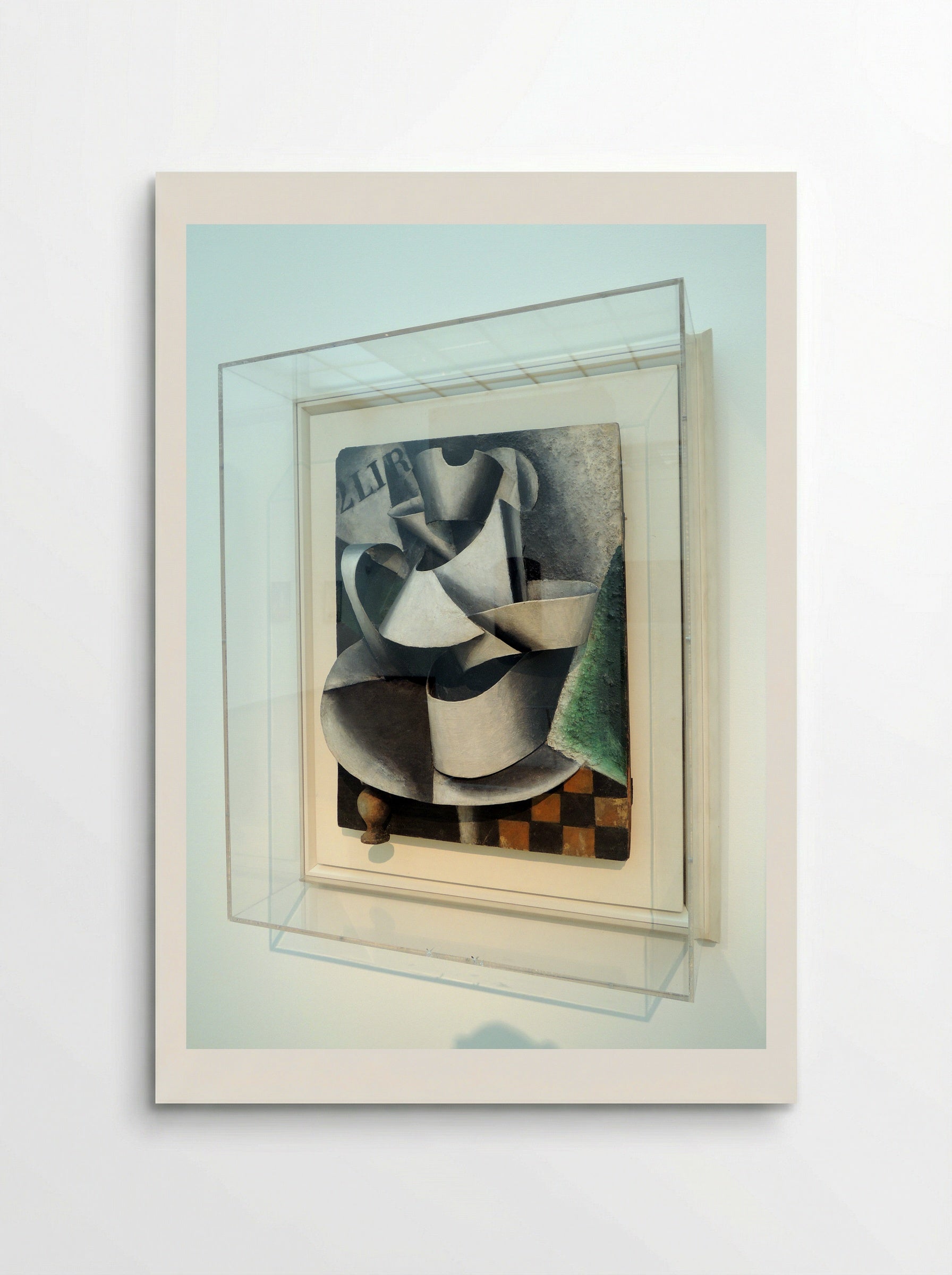
The Jug on the Table - Lyubov Popova
Archival giclée
Frames arrive ready to hang
Secure checkout
Made to order
Description
A 1915 Cubo-Futurist relief by Lyubov Popova, featuring a fragmented jug and table constructed with oil, wood, and plaster.
Lyubov Popova painted The Jug on the Table in 1915 during a period of intense experimentation within the Russian Avant-Garde. This work belongs to her Cubo-Futurist phase, where she combined the fragmented perspective of French Cubism with the dynamism of Italian Futurism. The composition is a relief, meaning it uses physical depth rather than just the illusion of space. Popova attached curved elements to the surface to represent the volume of the jug and the table. The colour palette is restrained, using greys, blacks, and ochres. A section of green adds a point of contrast on the right side. The artist used stencilled lettering in the upper left corner, a common technique in Cubist works to ground the abstract forms in reality. Below the central forms, a chequered pattern suggests a tablecloth or floor, while a turned wooden leg extends from the bottom of the frame. This physical object bridges the gap between the painted surface and the three-dimensional world. Popova studied in Paris under Henri Le Fauconnier and Jean Metzinger before returning to Moscow. Her work from this time focuses on the structural properties of objects. She broke down the jug into its constituent geometric parts: cylinders, cones, and planes. By using actual materials like wood and plaster, she moved away from traditional representation toward architectonic construction. This approach preceded her later transition into Constructivism and industrial design.
Return policy
Because every print is made to order, we don't offer change-of-mind returns, refunds or exchanges. If your order arrives faulty, damaged or incorrect, we'll replace it free of charge — just contact us within 48 hours of delivery. See our refunds page for full details.
Shipping
We ship worldwide, printing at the production hub nearest to your delivery address. Delivery times and costs vary by destination — you'll see the options available to you at checkout.
Manufacturing
Each print is produced to order using 12-colour giclée printing on FSC-certified archival paper. Designed in Britain and printed at your nearest production hub to reduce waste and speed up delivery.
The Jug on the Table - Lyubov Popova
Our Features
Designed for Lasting Impact
Specific Features
Every Solis piece is made to order with archival, gallery-quality materials built to last.
- Museum-grade giclée printing for rich, fade-resistant colour
- Archival matte fine-art paper, FSC-certified
- Multiple sizes and framing options available
- Frames in black, natural wood, dark wood or white
- Framed prints arrive ready to hang
Care & Cleaning
To keep your artwork looking its best:
- Dust gently with a soft, dry cloth
- Avoid prolonged direct sunlight
- Never use liquid cleaners on the print or canvas surface
- Keep in a dry, room-temperature space
- Handle prints with clean, dry hands
Materials & Sizing
Museum-grade giclée on FSC-certified archival matte paper, with framed and canvas options.
- Paper sizes: A4, A3, A2, A1, A0 and B2 (50×70 cm)
- Canvas: XS (20×30 cm) to Large (60×90 cm)
- Frames: black, natural wood, dark wood or white
Why Choose Us ?
Damage-free delivery guarantee
Fast Shipping
Museum-Quality Materials
Artist Biography
Lyubov Popova
You May Also Like