

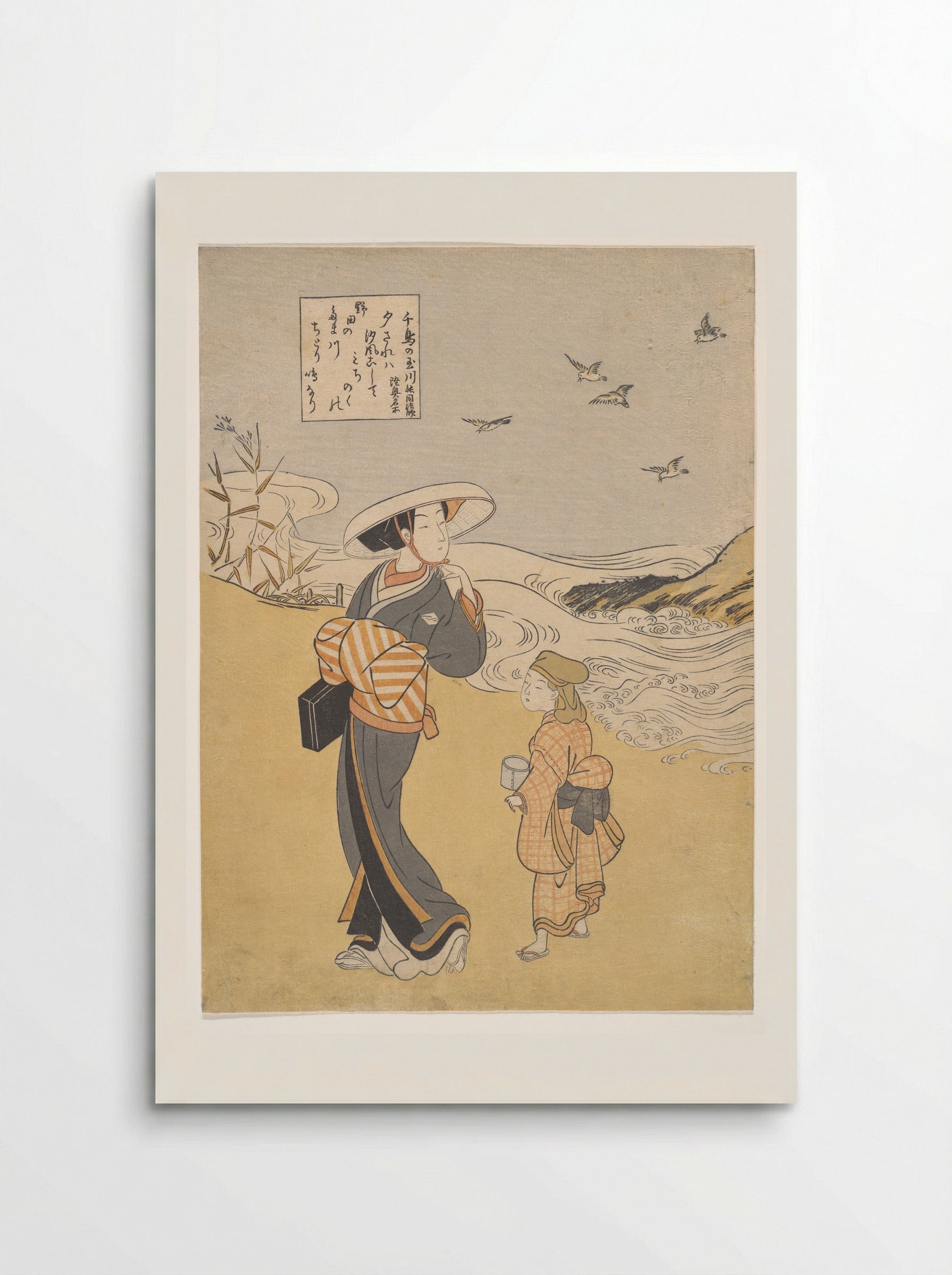
The Jewel River of Plovers, a Famous Place in Mutsu Province - Suzuki Harunobu
Archival giclée
Frames arrive ready to hang
Secure checkout
Made to order
Description
A refined ukiyo-e woodblock print by Suzuki Harunobu, depicting a woman and attendant by the Jewel River of Plovers.
Suzuki Harunobu produced this woodblock print as part of his series, Six Jewel Rivers. The series draws upon the classical Japanese literary tradition of the Six Jewel Rivers, which were celebrated in poetry for their beauty and specific associations. In this composition, Harunobu depicts a woman and a young attendant walking along the shore of the Chidori no Tamagawa, or the Jewel River of Plovers, located in Mutsu Province. The figures are rendered in the slender, graceful style characteristic of Harunobu's mature period. The woman wears a dark kimono with a bold, striped obi, while the attendant carries a small bucket, suggesting a domestic or travel-related task. Above them, plovers fly across the sky, providing a visual link to the river's name. The background features stylised, rhythmic lines representing the water, which contrast with the solid, flat areas of the figures' clothing. A cartouche in the upper left corner contains the title and a poem, a common feature in ukiyo-e prints that integrated text with visual imagery. Harunobu is credited with the development of nishiki-e, or brocade prints, which allowed for the use of multiple colours in a single image. This print demonstrates his mastery of the medium, utilising a refined palette of soft ochres, greys, and muted tones. The composition relies on a balance between the negative space of the sky and the patterned details of the figures. By placing the figures in a setting associated with classical poetry, Harunobu elevates the everyday scene into a reflection of cultural history. The print remains a representative example of the aesthetic values of the Edo period, where the intersection of literature, nature, and human activity formed the basis of artistic expression.
Return policy
Because every print is made to order, we don't offer change-of-mind returns, refunds or exchanges. If your order arrives faulty, damaged or incorrect, we'll replace it free of charge — just contact us within 48 hours of delivery. See our refunds page for full details.
Shipping
We ship worldwide, printing at the production hub nearest to your delivery address. Delivery times and costs vary by destination — you'll see the options available to you at checkout.
Manufacturing
Each print is produced to order using 12-colour giclée printing on FSC-certified archival paper. Designed in Britain and printed at your nearest production hub to reduce waste and speed up delivery.
The Jewel River of Plovers, a Famous Place in Mutsu Province - Suzuki Harunobu
Artist Biography
Suzuki Harunobu
Harunobu moved away from the stiff portraits of kabuki actors common in his era. He preferred to depict young women in their daily lives, often using an elevated viewpoint to look into private spaces. His series Zashiki hakkei, or Eight Parlour Views, provides a clear example of his method. He took classical Chinese themes and reimagined them as domestic scenes. A temple bell might become a chiming clock. A distant storm is represented by a woman drying herself after a bath.
Modern collectors value these prints for their quiet atmosphere and precise compositions. Harunobu avoided the aggressive energy of later ukiyo-e artists. He chose instead to focus on slender figures and soft colour harmonies. His work captures specific moments of leisure, such as playing cat's cradle or walking by the shore. These scenes offer a calm window into eighteenth-century Japan. They remain popular because they balance historical detail with a clean, graphic sensibility that suits contemporary interiors.
Our Features
Designed for Lasting Impact
Specific Features
Every Solis piece is made to order with archival, gallery-quality materials built to last.
- Museum-grade giclée printing for rich, fade-resistant colour
- Archival matte fine-art paper, FSC-certified
- Multiple sizes and framing options available
- Frames in black, natural wood, dark wood or white
- Framed prints arrive ready to hang
Care & Cleaning
To keep your artwork looking its best:
- Dust gently with a soft, dry cloth
- Avoid prolonged direct sunlight
- Never use liquid cleaners on the print or canvas surface
- Keep in a dry, room-temperature space
- Handle prints with clean, dry hands
Materials & Sizing
Museum-grade giclée on FSC-certified archival matte paper, with framed and canvas options.
- Paper sizes: A4, A3, A2, A1, A0 and B2 (50×70 cm)
- Canvas: XS (20×30 cm) to Large (60×90 cm)
- Frames: black, natural wood, dark wood or white
Why Choose Us ?
Damage-free delivery guarantee
Fast Shipping
Museum-Quality Materials
Artist Biography
Suzuki Harunobu
Harunobu moved away from the stiff portraits of kabuki actors common in his era. He preferred to depict young women in their daily lives, often using an elevated viewpoint to look into private spaces. His series Zashiki hakkei, or Eight Parlour Views, provides a clear example of his method. He took classical Chinese themes and reimagined them as domestic scenes. A temple bell might become a chiming clock. A distant storm is represented by a woman drying herself after a bath.
Modern collectors value these prints for their quiet atmosphere and precise compositions. Harunobu avoided the aggressive energy of later ukiyo-e artists. He chose instead to focus on slender figures and soft colour harmonies. His work captures specific moments of leisure, such as playing cat's cradle or walking by the shore. These scenes offer a calm window into eighteenth-century Japan. They remain popular because they balance historical detail with a clean, graphic sensibility that suits contemporary interiors.
You May Also Like