

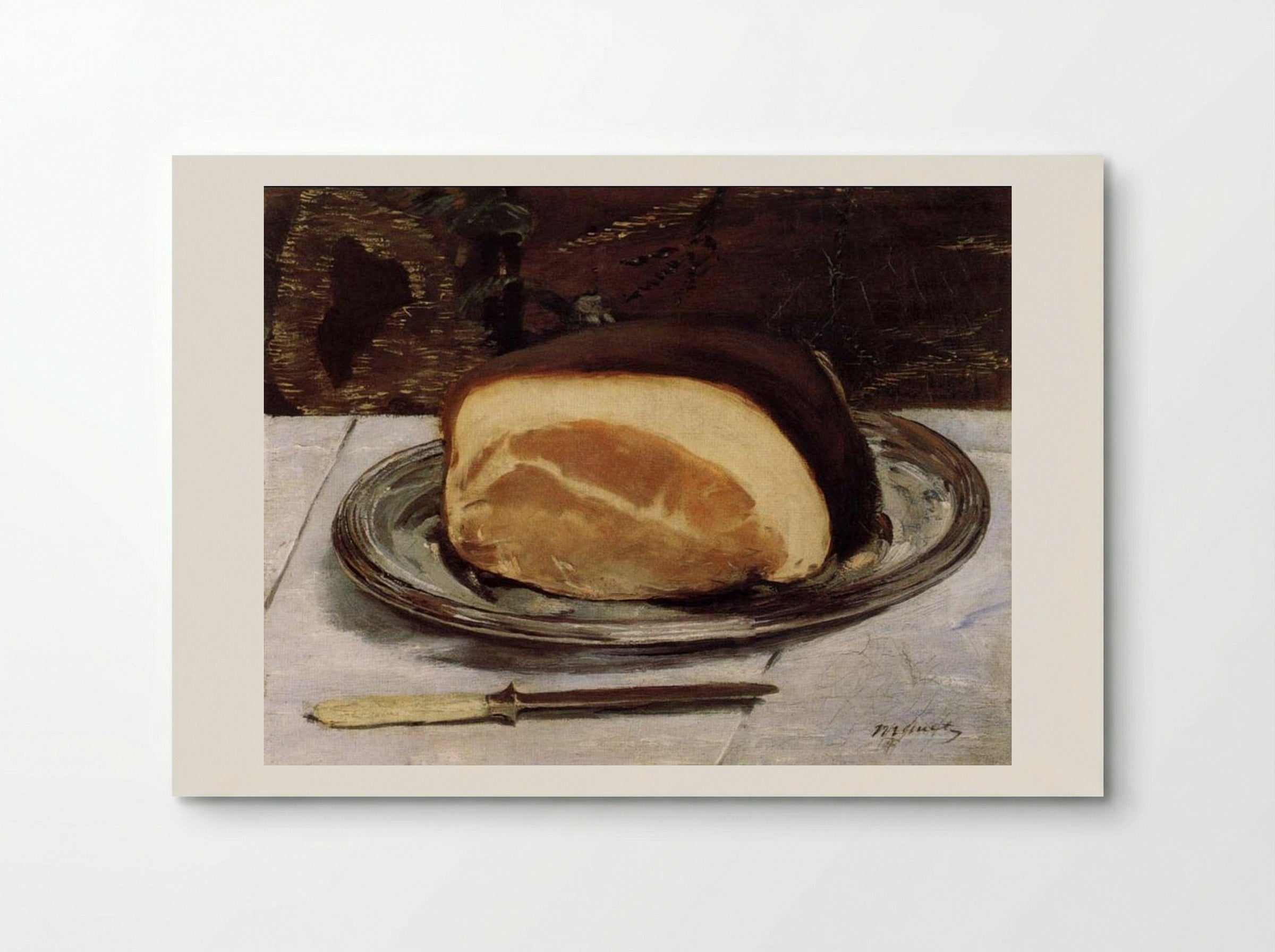
The Ham - Edouard Manet
Archival giclée
Frames arrive ready to hang
Secure checkout
Made to order
Description
A direct and painterly still life study by Edouard Manet, focusing on the simple form and texture of a ham on a platter.
Edouard Manet, a central figure in the transition from Realism to Impressionism, produced this still life study during the mid-1870s. The composition focuses on a single, substantial cut of ham resting upon a simple metal platter. Manet employs a restrained palette, relying on the contrast between the pale, fleshy tones of the meat and the dark, moody background to define the form. The white tablecloth provides a neutral base, allowing the textures of the food and the metallic sheen of the plate to occupy the viewer's attention. Unlike the highly polished still lifes of the Dutch Golden Age, Manet approaches this subject with a direct, painterly technique. His brushwork is confident and economical, prioritising the immediate visual impression over minute detail. The inclusion of a simple knife in the foreground adds a sense of domestic utility to the scene. This work reflects the artist's interest in elevating everyday objects to the status of fine art, a practice that defined much of his career in Paris. The background remains largely indistinct, suggesting a shallow space that keeps the focus firmly on the central subject. By stripping away unnecessary narrative elements, Manet invites an objective observation of light, colour, and material presence. This print captures the tonal nuances of the original oil painting, preserving the artist's characteristic approach to form and shadow.
Return policy
Because every print is made to order, we don't offer change-of-mind returns, refunds or exchanges. If your order arrives faulty, damaged or incorrect, we'll replace it free of charge — just contact us within 48 hours of delivery. See our refunds page for full details.
Shipping
We ship worldwide, printing at the production hub nearest to your delivery address. Delivery times and costs vary by destination — you'll see the options available to you at checkout.
Manufacturing
Each print is produced to order using 12-colour giclée printing on FSC-certified archival paper. Designed in Britain and printed at your nearest production hub to reduce waste and speed up delivery.
The Ham - Edouard Manet
Our Features
Designed for Lasting Impact
Specific Features
Every Solis piece is made to order with archival, gallery-quality materials built to last.
- Museum-grade giclée printing for rich, fade-resistant colour
- Archival matte fine-art paper, FSC-certified
- Multiple sizes and framing options available
- Frames in black, natural wood, dark wood or white
- Framed prints arrive ready to hang
Care & Cleaning
To keep your artwork looking its best:
- Dust gently with a soft, dry cloth
- Avoid prolonged direct sunlight
- Never use liquid cleaners on the print or canvas surface
- Keep in a dry, room-temperature space
- Handle prints with clean, dry hands
Materials & Sizing
Museum-grade giclée on FSC-certified archival matte paper, with framed and canvas options.
- Paper sizes: A4, A3, A2, A1, A0 and B2 (50×70 cm)
- Canvas: XS (20×30 cm) to Large (60×90 cm)
- Frames: black, natural wood, dark wood or white
Why Choose Us ?
Damage-free delivery guarantee
Fast Shipping
Museum-Quality Materials
Artist Biography
Edouard Manet
You May Also Like