

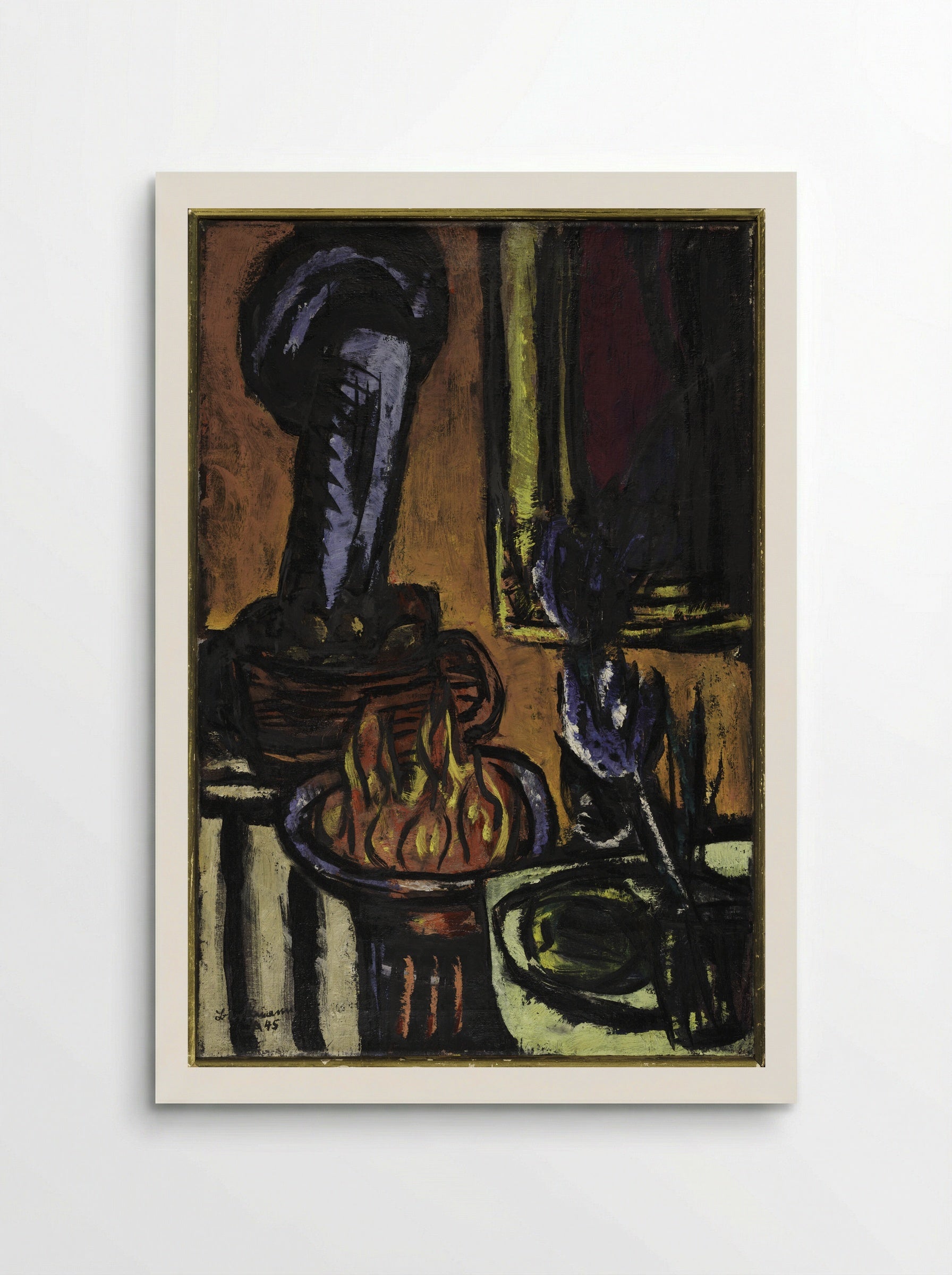
The Fire (Small Still Life) - Max Beckmann
Archival giclée
Frames arrive ready to hang
Secure checkout
Made to order
Description
A 1945 still life by Max Beckmann, featuring a flickering flame and dark, expressive forms painted during his exile in Amsterdam.
Max Beckmann painted The Fire (Small Still Life) in 1945, a period defined by his exile in Amsterdam during the final stages of the Second World War. This work captures the claustrophobic and tense atmosphere of his surroundings. The composition features a small, flickering flame contained within a vessel, positioned alongside a dark, sculptural form and a solitary flower. Beckmann employs his characteristic heavy black outlines to define these objects, creating a sense of weight and physical presence that borders on the monumental despite the modest scale of the subject matter. The palette is dominated by deep ochres, burnt umbers, and stark blacks, which serve to compress the pictorial space. The flame itself provides a sharp contrast, rendered in warmer yellows and oranges that puncture the gloom of the interior. This use of colour is not merely decorative; it functions as a psychological anchor within the frame. The brushwork is deliberate and assertive, reflecting the artist's rejection of traditional academic finish in favour of a more direct, emotive application of paint. Beckmann often utilised the still life genre to explore themes of isolation and existential anxiety. In this piece, the objects appear as actors on a stage, caught in a moment of quiet intensity. The lack of traditional perspective and the flattened depth contribute to a sense of unease, forcing the viewer to engage with the objects as symbolic entities rather than mere domestic items. This print reproduces the texture of the original oil paint, allowing for an appreciation of the artist's tactile approach to the canvas. It remains a representative example of Beckmann's late style, where the personal and the political converge through the lens of everyday objects.
Return policy
Because every print is made to order, we don't offer change-of-mind returns, refunds or exchanges. If your order arrives faulty, damaged or incorrect, we'll replace it free of charge — just contact us within 48 hours of delivery. See our refunds page for full details.
Shipping
We ship worldwide, printing at the production hub nearest to your delivery address. Delivery times and costs vary by destination — you'll see the options available to you at checkout.
Manufacturing
Each print is produced to order using 12-colour giclée printing on FSC-certified archival paper. Designed in Britain and printed at your nearest production hub to reduce waste and speed up delivery.
Care and materials
Specific Features
Every Solis piece is made to order with archival, gallery-quality materials built to last.
- Museum-grade giclée printing for rich, fade-resistant colour
- Archival matte fine-art paper, FSC-certified
- Multiple sizes and framing options available
- Frames in black, natural wood, dark wood or white
- Framed prints arrive ready to hang
Care & Cleaning
To keep your artwork looking its best:
- Dust gently with a soft, dry cloth
- Avoid prolonged direct sunlight
- Never use liquid cleaners on the print or canvas surface
- Keep in a dry, room-temperature space
- Handle prints with clean, dry hands
Materials & Sizing
Museum-grade giclée on FSC-certified archival matte paper, with framed and canvas options.
- Paper sizes: A4, A3, A2, A1, A0 and B2 (50×70 cm)
- Canvas: XS (20×30 cm) to Large (60×90 cm)
- Frames: black, natural wood, dark wood or white
The Fire (Small Still Life) - Max Beckmann

Artist Biography
Max Beckmann
He was born in Leipzig in 1884 and trained at the Weimar Academy. His early work was relatively conventional; the First World War, where he served as a medical orderly, shattered both his style and his psychology. The paintings that followed, dense, allegorical, packed with symbolic figures in compressed, claustrophobic spaces, resist easy classification. His monumental triptychs, painted in exile in Amsterdam and later St Louis, combine mythology, autobiography and contemporary history.
He remains one of the twentieth century's most ambitious figurative painters, comparable in scale and intention to Picasso but less interested in formal innovation than in moral weight. He died in New York in 1950, at sixty-five.
Why Choose Us ?
Damage-free delivery guarantee
Fast Shipping
Museum-Quality Materials
You May Also Like