

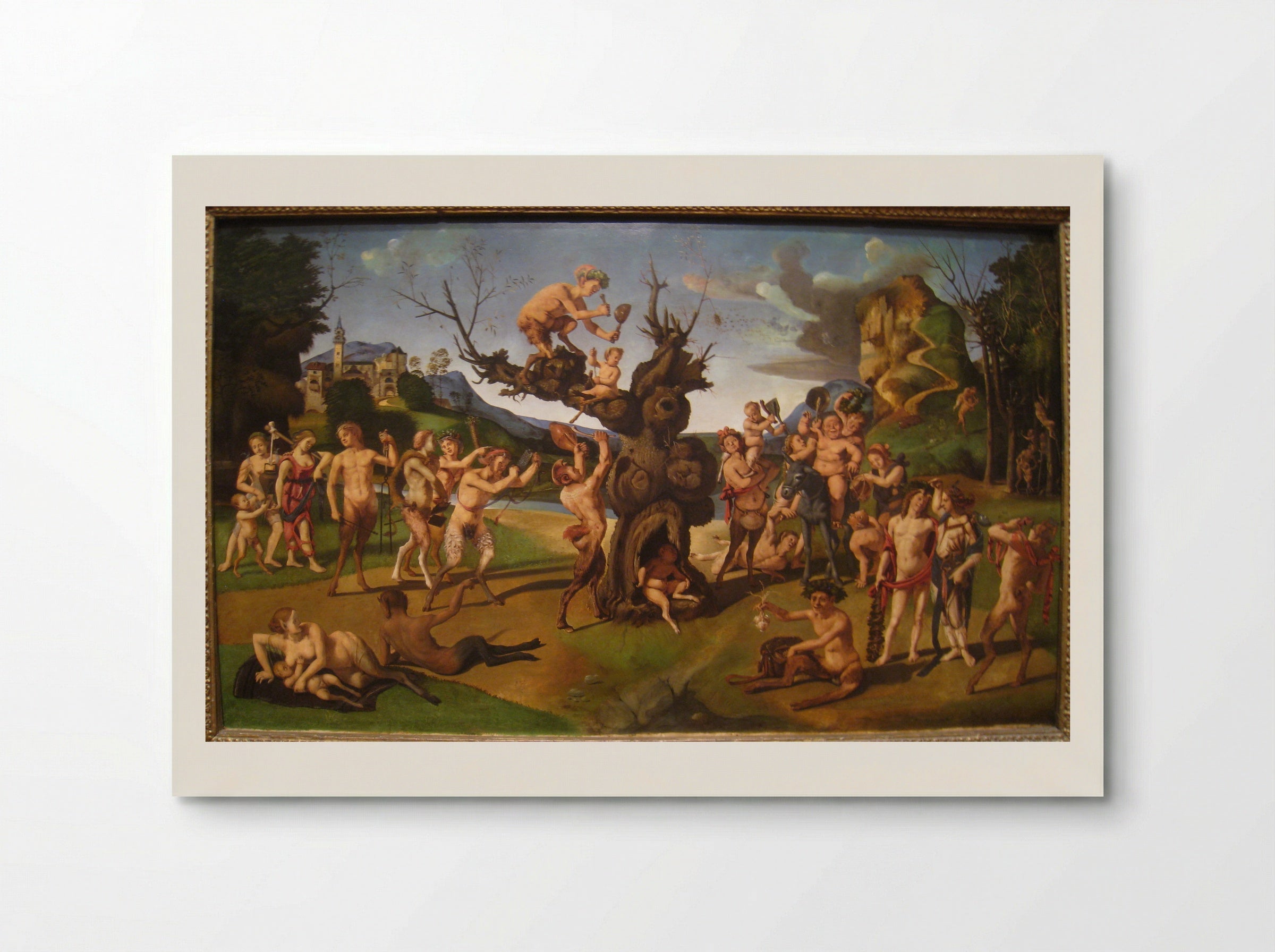
The Discovery of Honey by Bacchus - Piero di Cosimo
Archival giclée
Frames arrive ready to hang
Secure checkout
Made to order
Description
A mythological scene by Piero di Cosimo depicting Bacchus and his retinue discovering honey in a hollow tree, rendered with characteristic Renaissance detail.
Piero di Cosimo, a Florentine painter known for his eccentric approach to mythological subjects, created this work as part of a series commissioned for the Palazzo Vespucci. The painting depicts a scene from Ovid, where Bacchus and his retinue of satyrs and nymphs discover honey within a hollow tree. The composition is populated by numerous figures engaged in various activities, ranging from the central act of harvesting the honeycomb to more relaxed, pastoral interactions among the satyrs. The artist employs a distinct narrative style, placing these mythological beings in a setting that blends classical antiquity with the natural world. The figures exhibit a range of anatomical poses, reflecting the artist's interest in human and hybrid forms. The central tree, gnarled and ancient, acts as the anchor for the chaotic energy surrounding the discovery. The background features a distant, serene townscape and rolling hills, which contrast with the lively, somewhat frenetic activity occurring in the foreground. Technically, the work displays the smooth transitions and attention to detail characteristic of the period. The palette is balanced, utilising natural earth tones for the figures and the environment, punctuated by the blue of the sky and water. Piero di Cosimo avoids the rigid symmetry often found in contemporary works, opting instead for a more fluid, episodic arrangement of figures. This approach allows the viewer to scan the scene, observing the individual reactions of the satyrs as they gather around the source of the honey. The painting remains a curious example of the artist's imaginative interpretation of classical literature, demonstrating his ability to weave complex, multi-figure narratives into a cohesive visual field.
Return policy
Because every print is made to order, we don't offer change-of-mind returns, refunds or exchanges. If your order arrives faulty, damaged or incorrect, we'll replace it free of charge — just contact us within 48 hours of delivery. See our refunds page for full details.
Shipping
We ship worldwide, printing at the production hub nearest to your delivery address. Delivery times and costs vary by destination — you'll see the options available to you at checkout.
Manufacturing
Each print is produced to order using 12-colour giclée printing on FSC-certified archival paper. Designed in Britain and printed at your nearest production hub to reduce waste and speed up delivery.
Care and materials
Specific Features
Every Solis piece is made to order with archival, gallery-quality materials built to last.
- Museum-grade giclée printing for rich, fade-resistant colour
- Archival matte fine-art paper, FSC-certified
- Multiple sizes and framing options available
- Frames in black, natural wood, dark wood or white
- Framed prints arrive ready to hang
Care & Cleaning
To keep your artwork looking its best:
- Dust gently with a soft, dry cloth
- Avoid prolonged direct sunlight
- Never use liquid cleaners on the print or canvas surface
- Keep in a dry, room-temperature space
- Handle prints with clean, dry hands
Materials & Sizing
Museum-grade giclée on FSC-certified archival matte paper, with framed and canvas options.
- Paper sizes: A4, A3, A2, A1, A0 and B2 (50×70 cm)
- Canvas: XS (20×30 cm) to Large (60×90 cm)
- Frames: black, natural wood, dark wood or white
The Discovery of Honey by Bacchus - Piero di Cosimo

Artist Biography
Piero Di Cosimo
He was born in Florence around 1462, took the name di Cosimo from his master Cosimo Rosselli, and by 1480 was working as an unpaid apprentice in Rosselli's workshop. He operated outside the official artistic circles of Florentine Renaissance painting, borrowing freely from Leonardo, Signorelli and Netherlandish artists without belonging to any school.
His mythological paintings, many based on Vitruvius's account of human evolution, are filled with hybrid creatures, fantastic landscapes and strange revels. He also painted portraits, including the posthumous bust of Simonetta Vespucci (c. 1480), and excelled at designing pageants and triumphal processions for Florentine festivals. He could discern equestrian battles and urban scenes in the stains on a wall, a habit Leonardo also described. He died in Florence in 1521.
Why Choose Us ?
Damage-free delivery guarantee
Fast Shipping
Museum-Quality Materials
You May Also Like