

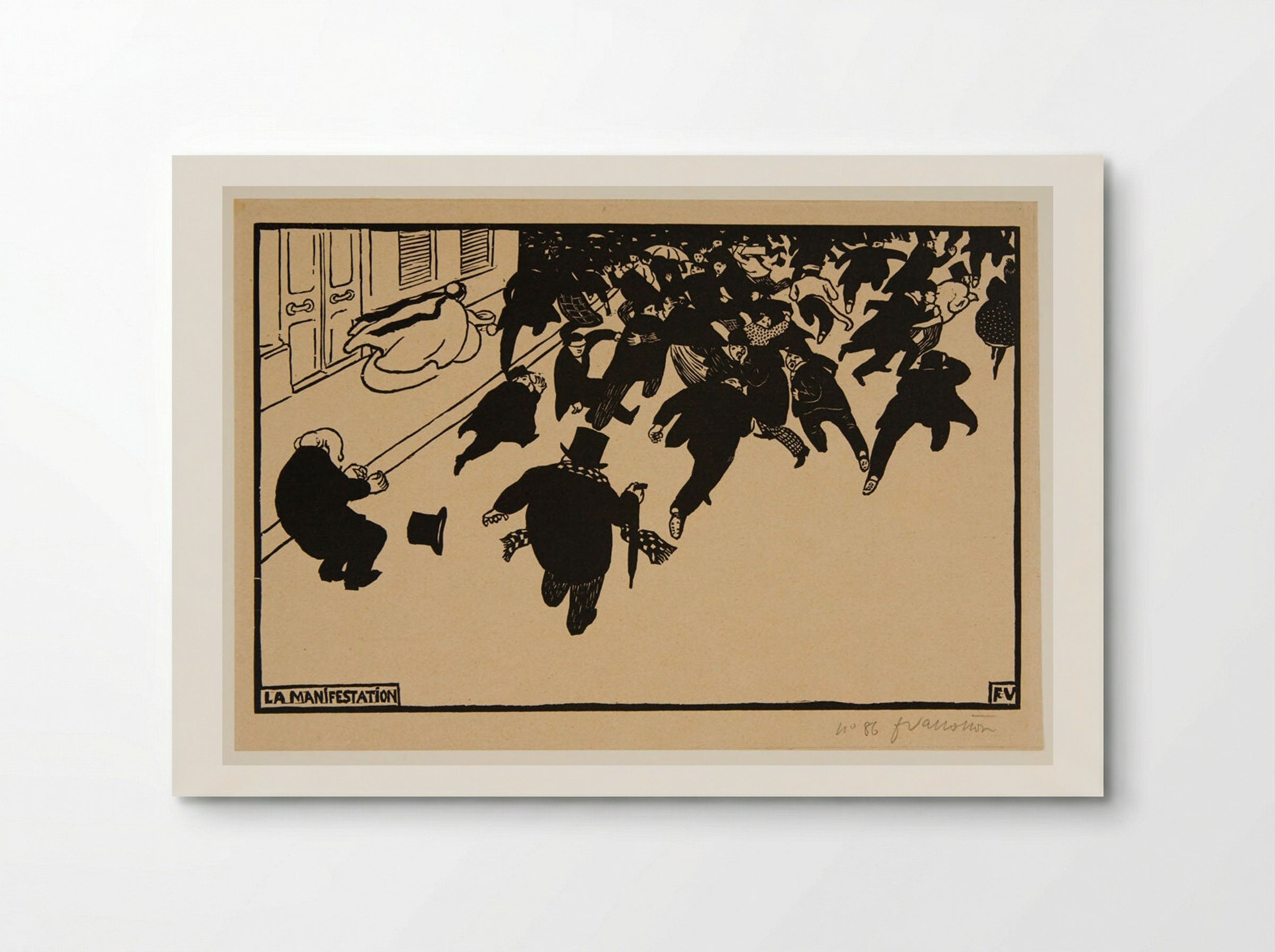
The Demonstration - Félix Vallotton
Archival giclée
Frames arrive ready to hang
Secure checkout
Made to order
Description
A striking 1893 woodcut by Félix Vallotton, capturing a chaotic street scene through bold, minimalist silhouettes and high-contrast graphic design.
Félix Vallotton produced this woodcut in 1893, a period during which he revitalised the medium of wood engraving through a stark, modern aesthetic. The work depicts a chaotic street scene, capturing the sudden dispersal of a crowd. Vallotton employs a radical simplification of form, using solid blocks of black ink against the negative space of the paper to define figures and movement. This technique, often referred to as his black-and-white style, owes a debt to Japanese ukiyo-e prints, which were widely collected by artists in Paris at the time. The composition is dynamic, with figures caught in various stages of flight or agitation. A man in a top hat occupies the foreground, his back to the viewer, while others scatter in different directions. The lack of mid-tones or shading forces the viewer to focus on the silhouettes and the rhythm of the shapes. Vallotton avoids traditional perspective, opting instead for a flattened, graphic arrangement that emphasises the tension of the moment. The inclusion of the title in a small box at the bottom left and his monogram at the bottom right are characteristic of his printmaking practice. This print belongs to a series of works that examine contemporary urban life in Paris. Vallotton observed the social and political atmosphere of the city with a detached, analytical eye. By stripping away unnecessary detail, he creates a visual shorthand for human behaviour under pressure. The work remains a clear example of his ability to convey complex narratives through minimal means, demonstrating his mastery of the woodcut as a tool for social commentary. The stark contrast between the ink and the paper creates a sense of urgency that is both immediate and timeless.
Return policy
Because every print is made to order, we don't offer change-of-mind returns, refunds or exchanges. If your order arrives faulty, damaged or incorrect, we'll replace it free of charge — just contact us within 48 hours of delivery. See our refunds page for full details.
Shipping
We ship worldwide, printing at the production hub nearest to your delivery address. Delivery times and costs vary by destination — you'll see the options available to you at checkout.
Manufacturing
Each print is produced to order using 12-colour giclée printing on FSC-certified archival paper. Designed in Britain and printed at your nearest production hub to reduce waste and speed up delivery.
Care and materials
Specific Features
Every Solis piece is made to order with archival, gallery-quality materials built to last.
- Museum-grade giclée printing for rich, fade-resistant colour
- Archival matte fine-art paper, FSC-certified
- Multiple sizes and framing options available
- Frames in black, natural wood, dark wood or white
- Framed prints arrive ready to hang
Care & Cleaning
To keep your artwork looking its best:
- Dust gently with a soft, dry cloth
- Avoid prolonged direct sunlight
- Never use liquid cleaners on the print or canvas surface
- Keep in a dry, room-temperature space
- Handle prints with clean, dry hands
Materials & Sizing
Museum-grade giclée on FSC-certified archival matte paper, with framed and canvas options.
- Paper sizes: A4, A3, A2, A1, A0 and B2 (50×70 cm)
- Canvas: XS (20×30 cm) to Large (60×90 cm)
- Frames: black, natural wood, dark wood or white
The Demonstration - Félix Vallotton

Artist Biography
Felix Vallotton
He moved to Paris at seventeen and studied at the Academie Julian. His woodcuts, made in the 1890s, revived a medium that most printmakers had abandoned in favour of colour lithography. Working in pure black and white, he carved domestic interiors, street scenes, and a series called Intimites: ten prints depicting the private moments of married life, with an emphasis on adultery, deception and the particular loneliness of two people in the same room. The images are flat, graphic and psychologically sharp.
His support for Alfred Dreyfus, the Jewish officer falsely convicted of espionage, strained his relationship with several of the Nabis. He bought a Kodak camera in 1899 and began using photographs as source material for paintings, manipulating compositions into fictionalised versions of observed reality.
He married the daughter of the art dealer Alexandre Bernheim in 1899, which gave him financial security and access to the Parisian art market. He painted nudes, still lifes and landscapes with a smooth, almost clinical finish that disturbed viewers who expected warmth from pictures of naked women.
He wrote three novels and eight plays, none of which were published in his lifetime. His first novel, La Vie Meurtriere (The Murderous Life), appeared posthumously in 1930. He died the day after his sixtieth birthday.
Why Choose Us ?
Damage-free delivery guarantee
Fast Shipping
Museum-Quality Materials
You May Also Like