

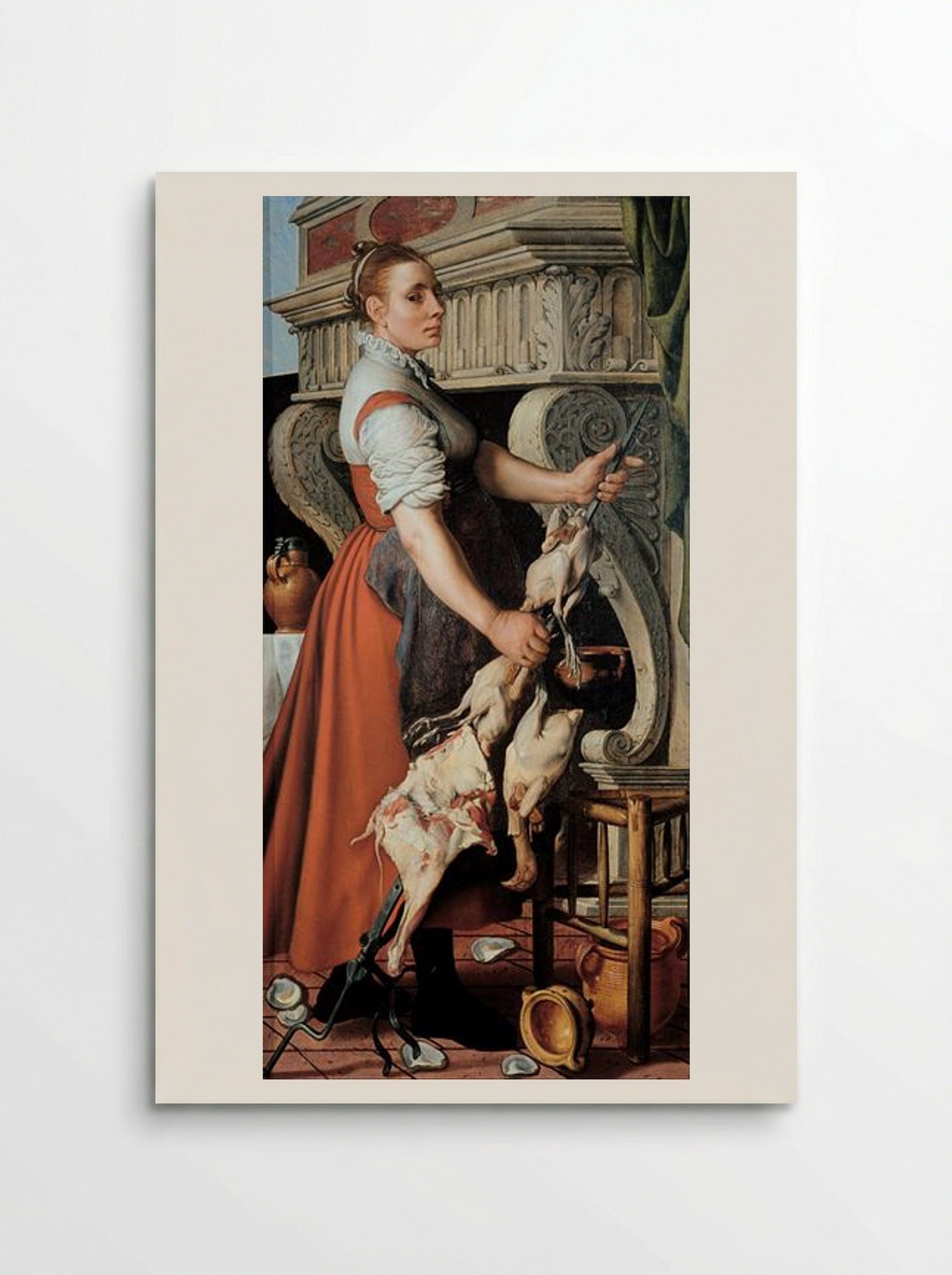
The Cook - Pieter Aertsen
Archival giclée
Frames arrive ready to hang
Secure checkout
Made to order
Description
Pieter Aertsen's "The Cook" depicts a woman preparing food in a kitchen setting, showcasing the artist's skill in rendering realistic textures and everyday scenes. This genre painting offers a glimpse into 16th-century domestic life.
Pieter Aertsen, a Dutch painter active in the 16th century, is known for his innovative genre scenes and still lifes. He often incorporated religious or moral messages into his seemingly secular works. Aertsen's style bridges the late Northern Renaissance and the emerging Baroque sensibilities. His attention to detail and realistic depiction of everyday objects set him apart from his contemporaries. He influenced later artists who specialised in still life and genre painting. In "The Cook", a woman stands in what appears to be a kitchen or pantry, holding a skewer of poultry. The composition is dominated by the figure of the cook and the array of foodstuffs around her. The background features architectural elements, including a stone fireplace or mantelpiece, adding depth to the scene. Various kitchen utensils and vessels are scattered on the floor, contributing to the sense of a busy, working environment. The woman's attire is simple, yet her posture and expression suggest a sense of dignity and competence. The painting is characterised by its realistic rendering of textures and surfaces, from the feathers of the birds to the rough surfaces of the pottery.
Return policy
Because every print is made to order, we don't offer change-of-mind returns, refunds or exchanges. If your order arrives faulty, damaged or incorrect, we'll replace it free of charge — just contact us within 48 hours of delivery. See our refunds page for full details.
Shipping
We ship worldwide, printing at the production hub nearest to your delivery address. Delivery times and costs vary by destination — you'll see the options available to you at checkout.
Manufacturing
Each print is produced to order using 12-colour giclée printing on FSC-certified archival paper. Designed in Britain and printed at your nearest production hub to reduce waste and speed up delivery.
Care and materials
Specific Features
Every Solis piece is made to order with archival, gallery-quality materials built to last.
- Museum-grade giclée printing for rich, fade-resistant colour
- Archival matte fine-art paper, FSC-certified
- Multiple sizes and framing options available
- Frames in black, natural wood, dark wood or white
- Framed prints arrive ready to hang
Care & Cleaning
To keep your artwork looking its best:
- Dust gently with a soft, dry cloth
- Avoid prolonged direct sunlight
- Never use liquid cleaners on the print or canvas surface
- Keep in a dry, room-temperature space
- Handle prints with clean, dry hands
Materials & Sizing
Museum-grade giclée on FSC-certified archival matte paper, with framed and canvas options.
- Paper sizes: A4, A3, A2, A1, A0 and B2 (50×70 cm)
- Canvas: XS (20×30 cm) to Large (60×90 cm)
- Frames: black, natural wood, dark wood or white
The Cook - Pieter Aertsen

Artist Biography
Pieter Aertsen
He was born in Amsterdam around 1508 and was known as "Lange Piet" (Tall Pete) because of his height. He apprenticed under Allaert Claesz in Amsterdam before moving to Antwerp, where he became a citizen in 1542 and worked for roughly fifteen years. His market and kitchen scenes placed food, cookware and domestic labour at enormous scale, transforming genre subjects into something approaching history painting's physical presence.
He married Kathelijne Beuckelaar, and three of their eight children became painters. His nephew and pupil Joachim Beuckelaer continued and developed his distinctive format. Many of Aertsen's later religious paintings were destroyed during the Beeldenstorm, the wave of Protestant iconoclasm in 1566. He returned to Amsterdam around 1556 and died there in 1575. His monumental kitchen and market scenes anticipate the still-life painting of the seventeenth century by half a century, and his compositional strategy of hiding the sacred behind the secular continues to generate scholarly argument about his intentions.
Why Choose Us ?
Damage-free delivery guarantee
Fast Shipping
Museum-Quality Materials
You May Also Like