



The Church Doorway - Grant Wood
Archival giclée
Ready to hang
Secure checkout
Made to order
Description
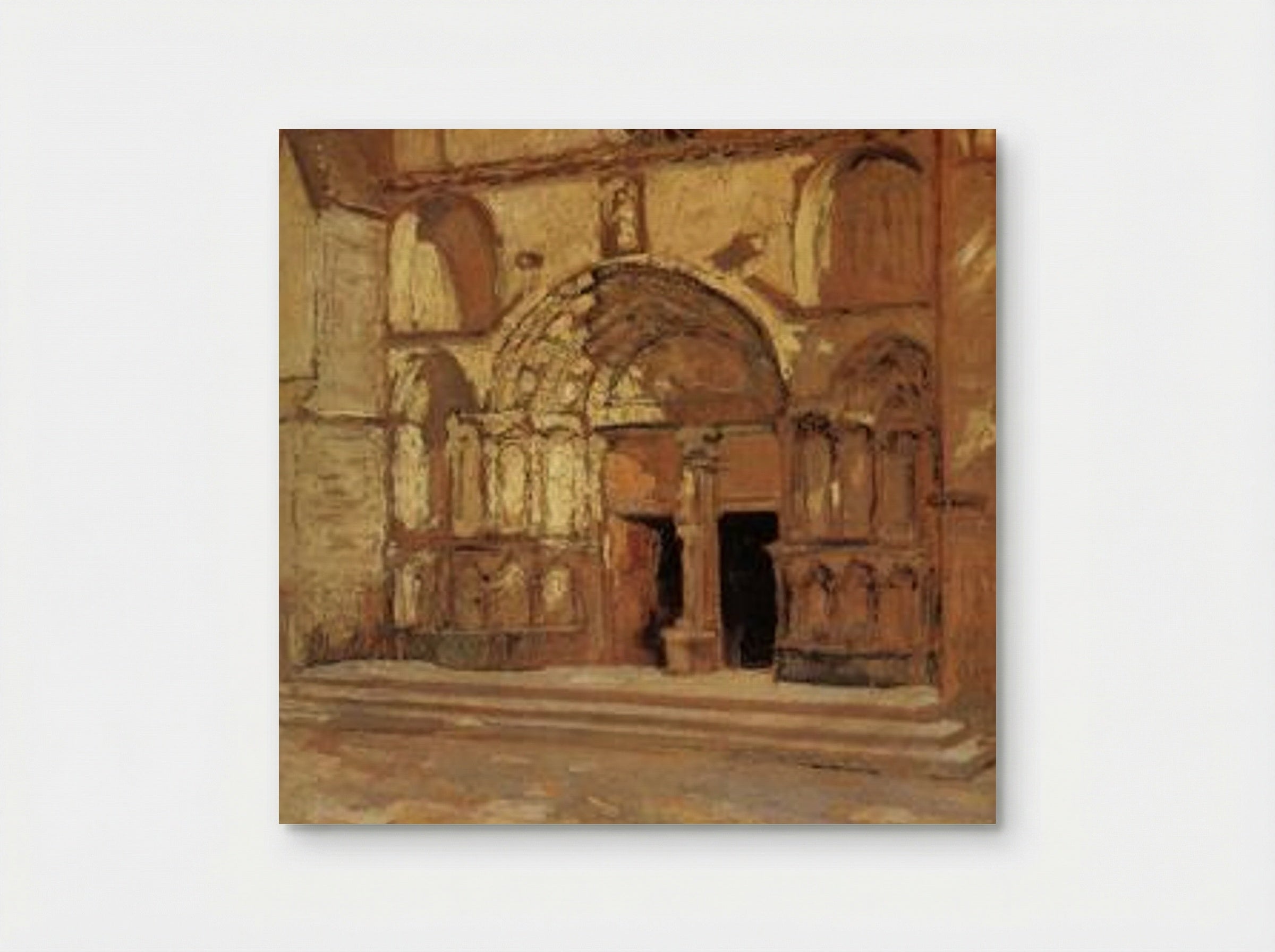
A muted palette of browns and tans defines Grant Wood's *The Church Doorway*, an architectural painting depicting the entrance to a Romanesque church. The visible brushstrokes give the surface a textured quality.
Grant Wood (1891-1942) was an American painter best known for his paintings depicting the rural American Midwest, particularly his iconic 1930 work, *American Gothic*. Wood studied at the School of the Art Institute of Chicago and later travelled to Europe, where he studied Impressionism and Post-Impressionism. However, he eventually rejected European abstraction in favour of a more realistic style that celebrated American subjects. He became a leading figure in the Regionalism movement, which sought to create an authentically American art, distinct from European influences. Wood taught art at the University of Iowa for many years. His work often presents an idealised view of rural life, but also contains elements of social commentary and satire. *The Church Doorway* depicts the entrance to a Romanesque church. The painting is rendered in a muted palette of browns and tans, with visible brushstrokes that give the surface a textured quality. The architectural details of the doorway are carefully observed, from the carved arches and columns to the small figures adorning the facade. The composition is symmetrical, with the doorway centred in the frame. The dark interior of the church contrasts with the sunlit exterior, creating a sense of depth and mystery.
Return policy
Because every print is made to order, we don't offer change-of-mind returns, refunds or exchanges. If your order arrives faulty, damaged or incorrect, we'll replace it free of charge — just contact us within 48 hours of delivery. EU customers have a 14-day cooling-off right. See our refunds page for full details.
Shipping
We ship worldwide, printing at the production hub nearest to your delivery address. Delivery times and costs vary by destination — you'll see the options available to you at checkout.
Manufacturing
Each print is produced to order using 12-colour giclée printing on FSC-certified archival paper. Designed in Britain and printed at your nearest production hub to reduce waste and speed up delivery.
The Church Doorway - Grant Wood
Our Features
Designed for Lasting Impact
Specific Features
Every Solis piece is made to order with archival, gallery-quality materials built to last.
- Museum-grade giclée printing for rich, fade-resistant colour
- Archival matte fine-art paper, FSC-certified
- Choose poster, framed print, canvas or framed canvas
- Frames in black, natural wood, dark wood or white
- Framed prints arrive ready to hang
Care & Cleaning
To keep your artwork looking its best:
- Dust gently with a soft, dry cloth
- Avoid prolonged direct sunlight
- Never use liquid cleaners on the print or canvas surface
- Keep in a dry, room-temperature space
- Handle prints with clean, dry hands
Materials & Sizing
Museum-grade giclée on FSC-certified archival matte paper, with framed and canvas options.
- Paper sizes: A4, A3, A2, A1, A0 and B2 (50×70 cm)
- Canvas: XS (20×30 cm) to Large (60×90 cm)
- Frames: black, natural wood, dark wood or white
Why Choose Us ?
100% Satisfaction Guarantee
Fast Shipping
Museum-Quality Materials

Artist Biography
Grant Wood
As a key figure in the Regionalism movement, Grant Wood rejected European abstraction in favour of celebrating rural American life. His most famous painting, *American Gothic* (1930), became an iconic, and often parodied, representation of the American character. Other notable works, like *The Midnight Ride of Paul Revere* (1931) and *Stone City, Iowa* (1930), further cemented his reputation as a painter of the American heartland. These paintings weren't simply landscapes; they were imbued with a sense of nostalgia, social commentary, and a deep connection to the land.
Despite his relatively short career, Grant Wood left an indelible mark on American art. His paintings continue to resonate with viewers today, offering a glimpse into a specific time and place, while simultaneously exploring universal themes of identity, community, and the relationship between humanity and nature. His work serves as a reminder of the beauty and complexity that can be found in the everyday, and the enduring power of art to capture the spirit of a nation.
You May Also Like