

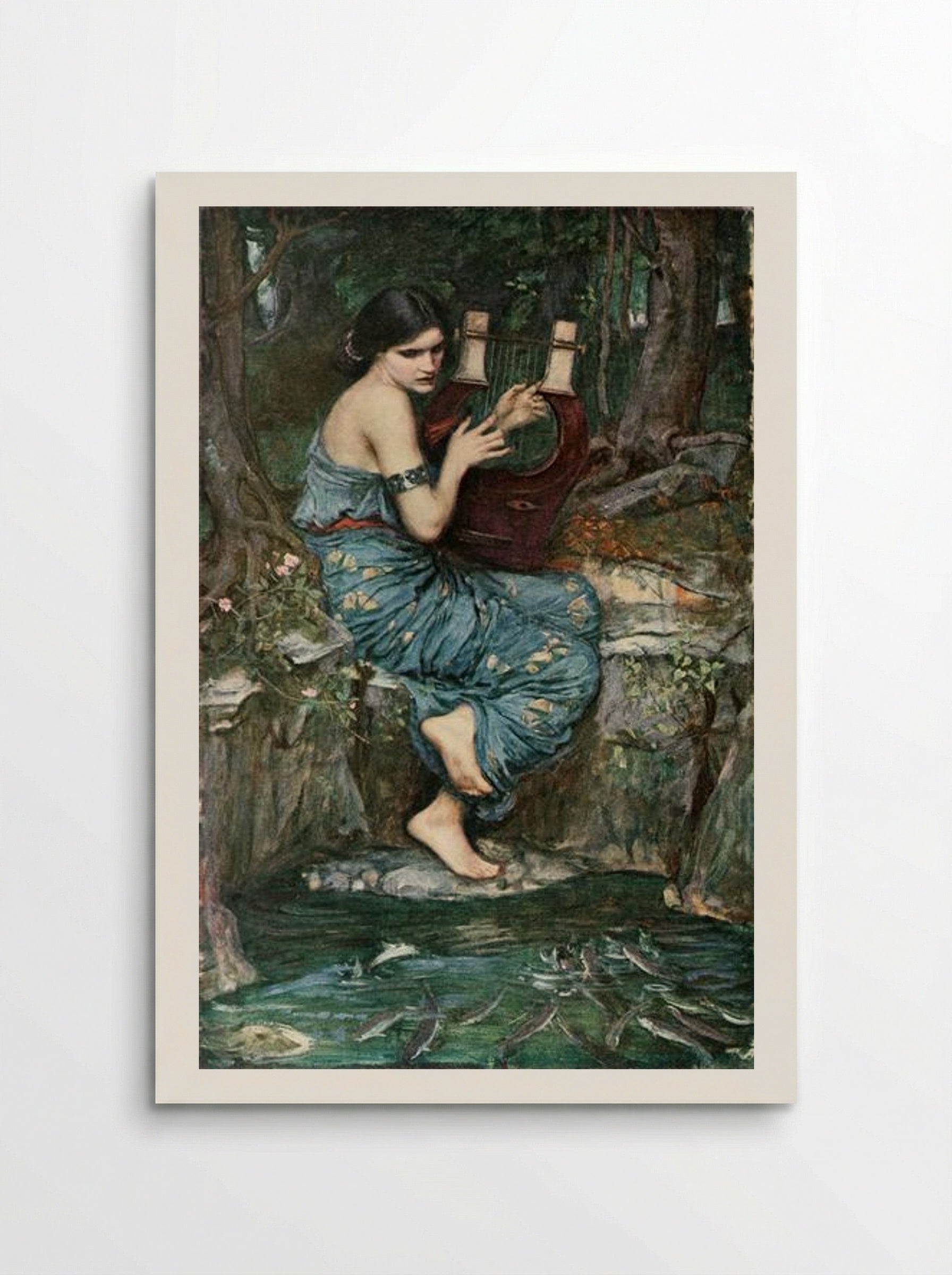
The Charmer - John William Waterhouse
Archival giclée
Frames arrive ready to hang
Secure checkout
Made to order
Description
A 1911 oil painting by John William Waterhouse depicting a woman playing a lyre by a woodland pool, rendered in the artist's signature Pre-Raphaelite style.
John William Waterhouse, a painter associated with the later phase of the Pre-Raphaelite movement, produced The Charmer in 1911. The composition depicts a woman seated upon a rocky ledge, her attention directed toward the water below. She holds a lyre, her fingers positioned as if plucking the strings to influence the fish gathering in the pool. The setting is a dense, shadowed woodland, which provides a dark backdrop for the figure. The artist employs a palette dominated by deep greens, earthy browns, and the muted blue of the subject's garment. The fabric of her dress is decorated with a subtle pattern, reflecting the artist's interest in classical motifs. Waterhouse often explored themes derived from mythology and literature, frequently placing his female subjects in natural environments that suggest a narrative beyond the frame. The figure's posture is relaxed yet focused, creating a sense of quiet activity. Technically, the work displays the artist's characteristic approach to light and texture. The skin tones are rendered with softness, contrasting with the more rugged treatment of the surrounding rocks and foliage. The fish in the water are painted with quick, fluid strokes, suggesting movement beneath the surface. This piece is representative of the artist's later career, during which he refined his focus on solitary figures within atmospheric, often mysterious, natural settings. The painting invites the viewer to consider the relationship between the human figure and the natural world, a recurring theme in his body of work.
Return policy
Because every print is made to order, we don't offer change-of-mind returns, refunds or exchanges. If your order arrives faulty, damaged or incorrect, we'll replace it free of charge — just contact us within 48 hours of delivery. See our refunds page for full details.
Shipping
We ship worldwide, printing at the production hub nearest to your delivery address. Delivery times and costs vary by destination — you'll see the options available to you at checkout.
Manufacturing
Each print is produced to order using 12-colour giclée printing on FSC-certified archival paper. Designed in Britain and printed at your nearest production hub to reduce waste and speed up delivery.
Care and materials
Specific Features
Every Solis piece is made to order with archival, gallery-quality materials built to last.
- Museum-grade giclée printing for rich, fade-resistant colour
- Archival matte fine-art paper, FSC-certified
- Multiple sizes and framing options available
- Frames in black, natural wood, dark wood or white
- Framed prints arrive ready to hang
Care & Cleaning
To keep your artwork looking its best:
- Dust gently with a soft, dry cloth
- Avoid prolonged direct sunlight
- Never use liquid cleaners on the print or canvas surface
- Keep in a dry, room-temperature space
- Handle prints with clean, dry hands
Materials & Sizing
Museum-grade giclée on FSC-certified archival matte paper, with framed and canvas options.
- Paper sizes: A4, A3, A2, A1, A0 and B2 (50×70 cm)
- Canvas: XS (20×30 cm) to Large (60×90 cm)
- Frames: black, natural wood, dark wood or white
The Charmer - John William Waterhouse

Artist Biography
John William Waterhouse
He was born in Rome to English parents (both painters) and grew up surrounded by Italian art before moving to London as a child. He studied at the Royal Academy Schools and exhibited there from 1874 until his death in 1917. He was a Royal Academician, successful, respected, and thoroughly Victorian.
His technique is Pre-Raphaelite in spirit but Impressionist in handling. The early works are tighter, more archaeological, influenced by Alma-Tadema's classical scenes. The later paintings are looser, with broader brushwork and richer colour. The Lady of Shalott (1888) combines both: precise detail in the boat and tapestry, atmospheric softness in the trees and water.
He painted several versions of the same subjects. Two versions of The Lady of Shalott. Two of Ophelia. Multiple paintings of Circe. He returned to the same stories because the stories gave him what he needed: a beautiful woman in a dramatic landscape at a moment of transformation. The formula was reliable and the execution was consistently good.
He is sometimes grouped with the Pre-Raphaelites but was a generation younger than Rossetti, Millais, and Hunt. He was closer to the Aesthetic Movement and to late Victorian narrative painting. He is one of the most reproduced painters in the history of art prints, which would have pleased him.
Why Choose Us ?
Damage-free delivery guarantee
Fast Shipping
Museum-Quality Materials
You May Also Like