

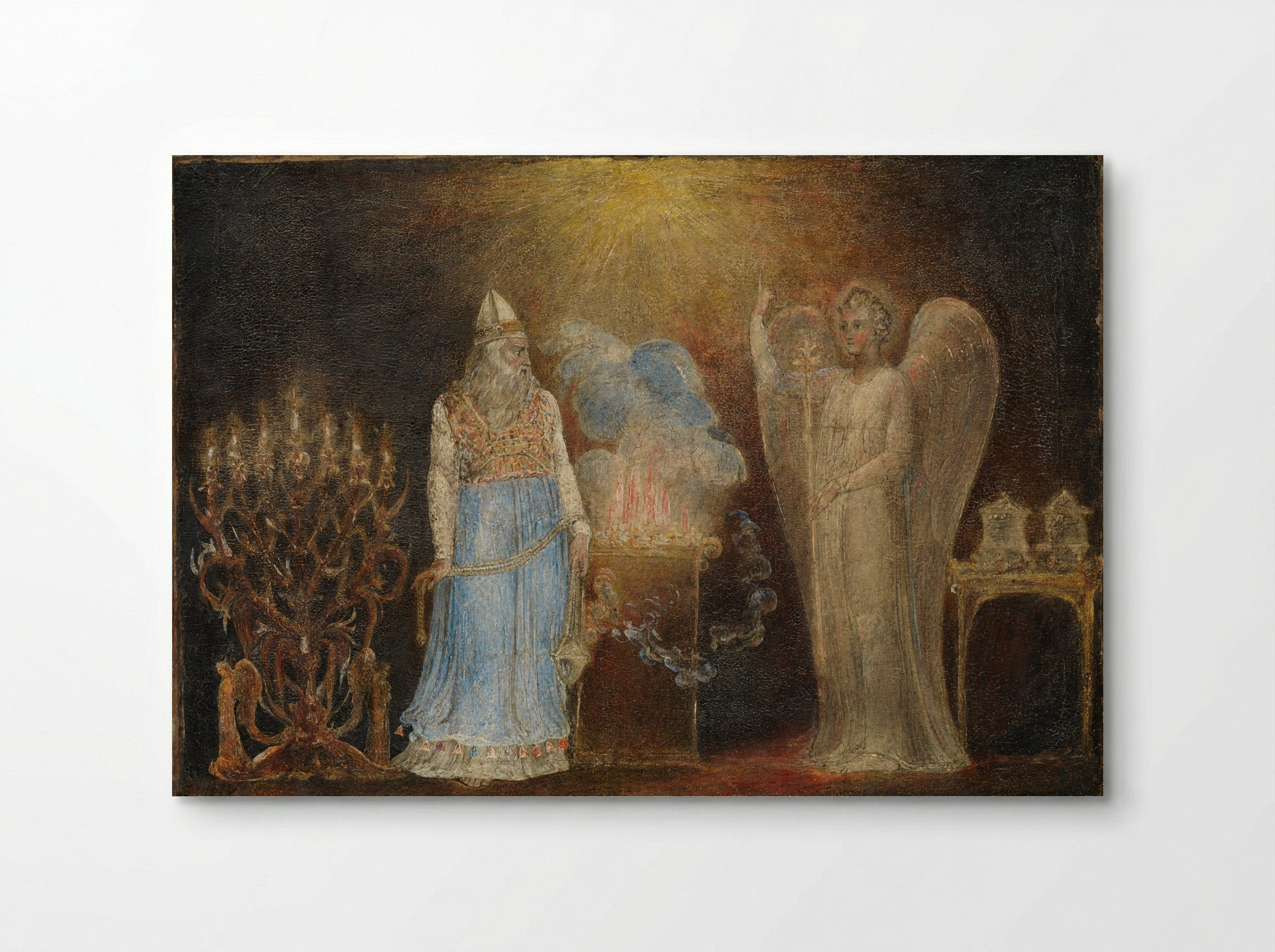
The Angel Appearing to Zacharias - William Blake
Archival giclée
Frames arrive ready to hang
Secure checkout
Made to order
Description
A tempera painting by William Blake depicting the biblical encounter between the angel Gabriel and the priest Zacharias.
William Blake produced this tempera painting during a period of intense focus on biblical themes. The composition depicts the moment the angel Gabriel appears to the priest Zacharias within the temple, as described in the Gospel of Luke. Blake employs a dark, atmospheric background to contrast with the ethereal light emanating from the celestial figure. Zacharias stands to the left, dressed in traditional priestly vestments, his posture conveying a mixture of awe and trepidation. The angel occupies the right side of the frame, rendered with elongated proportions and a sense of weightless grace. Between them, an altar emits smoke, adding a tactile element to the scene. Blake used a tempera technique, which allowed for the fine, linear detail characteristic of his work. The colour palette is dominated by deep shadows, punctuated by the golden glow of the divine presence and the blue of the priest's robes. This work reflects Blake's interest in visionary experiences and his rejection of conventional academic painting styles of the late eighteenth century. He prioritised symbolic clarity and emotional intensity over strict anatomical realism. The scene is contained within a shallow, stage-like space, typical of his narrative compositions. By focusing on the interaction between the mortal and the divine, Blake creates a sense of immediate, personal encounter. The painting remains a clear example of his unique approach to religious subject matter, where the physical world serves as a vessel for spiritual revelation. The textures of the paint, applied with precision, contribute to the dreamlike quality of the image, inviting the viewer to consider the narrative beyond the surface details.
Return policy
Because every print is made to order, we don't offer change-of-mind returns, refunds or exchanges. If your order arrives faulty, damaged or incorrect, we'll replace it free of charge — just contact us within 48 hours of delivery. See our refunds page for full details.
Shipping
We ship worldwide, printing at the production hub nearest to your delivery address. Delivery times and costs vary by destination — you'll see the options available to you at checkout.
Manufacturing
Each print is produced to order using 12-colour giclée printing on FSC-certified archival paper. Designed in Britain and printed at your nearest production hub to reduce waste and speed up delivery.
The Angel Appearing to Zacharias - William Blake

Artist Biography
William Blake
He married Catherine Boucher in 1782. She was illiterate at the time and signed the marriage register with an X. He taught her to read, write, and engrave, and she became his collaborator for the next forty-five years: mixing paint, operating the printing press, hand-colouring plates, and binding the finished pages into covers.
Their working method was Blake's own invention, revealed to him (he said) in a dream by the spirit of his dead brother Robert. Relief etching reversed the standard printmaking process: instead of cutting lines into copper, Blake wrote and drew on the plate in acid-resistant varnish, then dissolved the surrounding metal with acid, leaving text and image raised. This allowed him to compose poetry and illustration simultaneously on a single plate, print them together, then hand-colour each sheet in watercolour. Every copy was therefore unique. Songs of Innocence and of Experience was produced this way. He sold fewer than thirty copies during his lifetime.
In 1803, he physically threw a soldier named John Schofield out of his garden in Felpham. He was charged with assault and with uttering treasonable expressions against the King. He was acquitted at the Chichester assizes in January 1804.
Newton, painted in 1795, shows the scientist as a young man with the body of a Greek god, bent forward at the bottom of a dark ocean, fixing his gaze on a pair of compasses, measuring and drawing on a scroll that appears to project from his own head. It is a painting about the limits of reason: beautiful, precise, and missing everything beyond the edge of the paper. The Ancient of Days, from the same period, depicts his mythological figure Urizen crouching at the edge of a void, reaching down with a compass to measure the darkness below.
He died on 12 August 1827, working on illustrations for Dante's Divine Comedy. He was buried at Bunhill Fields. The wider recognition came decades later.
Our Features
Designed for Lasting Impact
Specific Features
Every Solis piece is made to order with archival, gallery-quality materials built to last.
- Museum-grade giclée printing for rich, fade-resistant colour
- Archival matte fine-art paper, FSC-certified
- Multiple sizes and framing options available
- Frames in black, natural wood, dark wood or white
- Framed prints arrive ready to hang
Care & Cleaning
To keep your artwork looking its best:
- Dust gently with a soft, dry cloth
- Avoid prolonged direct sunlight
- Never use liquid cleaners on the print or canvas surface
- Keep in a dry, room-temperature space
- Handle prints with clean, dry hands
Materials & Sizing
Museum-grade giclée on FSC-certified archival matte paper, with framed and canvas options.
- Paper sizes: A4, A3, A2, A1, A0 and B2 (50×70 cm)
- Canvas: XS (20×30 cm) to Large (60×90 cm)
- Frames: black, natural wood, dark wood or white
Why Choose Us ?
Damage-free delivery guarantee
Fast Shipping
Museum-Quality Materials
Artist Biography
William Blake
He married Catherine Boucher in 1782. She was illiterate at the time and signed the marriage register with an X. He taught her to read, write, and engrave, and she became his collaborator for the next forty-five years: mixing paint, operating the printing press, hand-colouring plates, and binding the finished pages into covers.
Their working method was Blake's own invention, revealed to him (he said) in a dream by the spirit of his dead brother Robert. Relief etching reversed the standard printmaking process: instead of cutting lines into copper, Blake wrote and drew on the plate in acid-resistant varnish, then dissolved the surrounding metal with acid, leaving text and image raised. This allowed him to compose poetry and illustration simultaneously on a single plate, print them together, then hand-colour each sheet in watercolour. Every copy was therefore unique. Songs of Innocence and of Experience was produced this way. He sold fewer than thirty copies during his lifetime.
In 1803, he physically threw a soldier named John Schofield out of his garden in Felpham. He was charged with assault and with uttering treasonable expressions against the King. He was acquitted at the Chichester assizes in January 1804.
Newton, painted in 1795, shows the scientist as a young man with the body of a Greek god, bent forward at the bottom of a dark ocean, fixing his gaze on a pair of compasses, measuring and drawing on a scroll that appears to project from his own head. It is a painting about the limits of reason: beautiful, precise, and missing everything beyond the edge of the paper. The Ancient of Days, from the same period, depicts his mythological figure Urizen crouching at the edge of a void, reaching down with a compass to measure the darkness below.
He died on 12 August 1827, working on illustrations for Dante's Divine Comedy. He was buried at Bunhill Fields. The wider recognition came decades later.
You May Also Like