

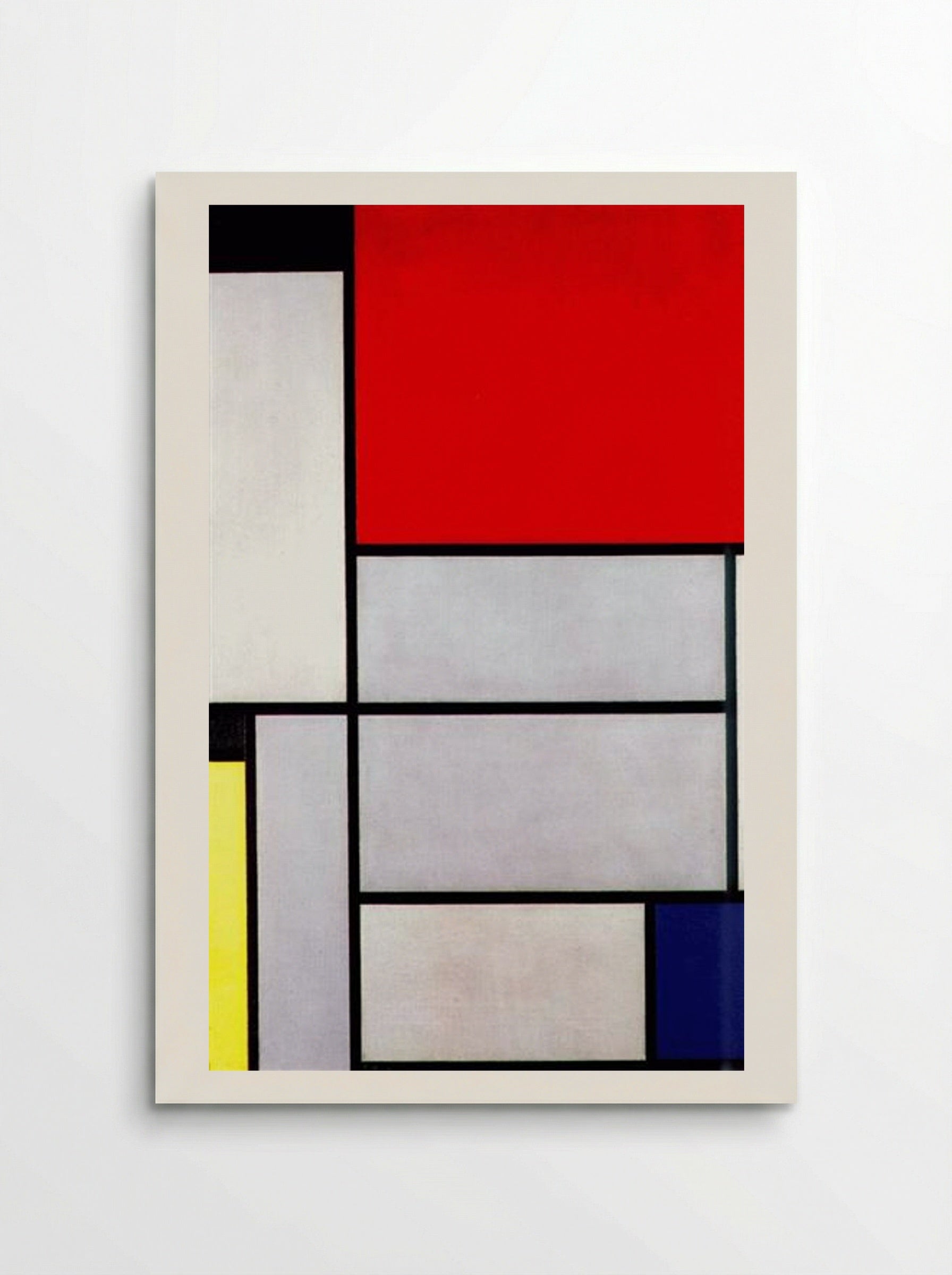
Tableau I - Piet Mondrian
Archival giclée
Frames arrive ready to hang
Secure checkout
Made to order
Description
A seminal work of Neoplasticism, Tableau I by Piet Mondrian uses a grid of black lines and primary colours to achieve a balanced, abstract composition.
Tableau I, painted by Piet Mondrian in 1921, represents the artist's mature exploration of Neoplasticism. This movement sought to express universal harmony through a restricted visual vocabulary. Mondrian limits his palette to the three primary colours: red, yellow, and blue, alongside the non-colours of black, white, and grey. These elements are organised within a grid of thick black lines that divide the canvas into rectangular planes of varying sizes. The composition avoids symmetry, relying instead on a dynamic balance of weights and proportions. The large red rectangle at the top provides a visual anchor, while the smaller blocks of yellow and blue create tension against the neutral white and grey areas. By stripping away representational imagery, Mondrian aimed to reach a state of pure abstraction that reflected the underlying order of the universe. The paint application is flat, with the black lines acting as structural boundaries rather than outlines for forms. This work is characteristic of the period when Mondrian lived in Paris, having moved from the Netherlands to engage with the international avant-garde. His approach to painting during these years was methodical, often involving the adjustment of line thickness and colour placement until the composition achieved a state of equilibrium. The lack of depth or perspective forces the viewer to engage with the surface of the canvas as a two-dimensional plane. This reductionist method influenced many subsequent developments in abstract art, architecture, and design throughout the twentieth century. The print captures the precise edges and the matte quality of the original oil paint, allowing for a clear appreciation of the geometric arrangement.
Return policy
Because every print is made to order, we don't offer change-of-mind returns, refunds or exchanges. If your order arrives faulty, damaged or incorrect, we'll replace it free of charge — just contact us within 48 hours of delivery. See our refunds page for full details.
Shipping
We ship worldwide, printing at the production hub nearest to your delivery address. Delivery times and costs vary by destination — you'll see the options available to you at checkout.
Manufacturing
Each print is produced to order using 12-colour giclée printing on FSC-certified archival paper. Designed in Britain and printed at your nearest production hub to reduce waste and speed up delivery.
Care and materials
Specific Features
Every Solis piece is made to order with archival, gallery-quality materials built to last.
- Museum-grade giclée printing for rich, fade-resistant colour
- Archival matte fine-art paper, FSC-certified
- Multiple sizes and framing options available
- Frames in black, natural wood, dark wood or white
- Framed prints arrive ready to hang
Care & Cleaning
To keep your artwork looking its best:
- Dust gently with a soft, dry cloth
- Avoid prolonged direct sunlight
- Never use liquid cleaners on the print or canvas surface
- Keep in a dry, room-temperature space
- Handle prints with clean, dry hands
Materials & Sizing
Museum-grade giclée on FSC-certified archival matte paper, with framed and canvas options.
- Paper sizes: A4, A3, A2, A1, A0 and B2 (50×70 cm)
- Canvas: XS (20×30 cm) to Large (60×90 cm)
- Frames: black, natural wood, dark wood or white
Tableau I - Piet Mondrian

Artist Biography
Piet Mondrian
Mondrian's move towards abstraction was gradual but decisive. He was influenced by Cubism after moving to Paris, but he ultimately distilled his art to its most essential elements. This radical simplification led to the birth of De Stijl, a Dutch artistic movement that sought universal harmony through pure abstraction. Mondrian believed that by reducing painting to its fundamental components – line, colour, and form – he could reveal a deeper, more spiritual reality.
Though he lived and worked in Europe for much of his life, Mondrian eventually settled in New York City during World War II. His final paintings, such as "Broadway Boogie Woogie," reflect the vibrant energy of his new urban environment. This iconic work, with its pulsating rhythms and dynamic composition, stands as a testament to Mondrian's enduring quest to capture the essence of modern life through the language of pure abstraction. His legacy continues to inspire artists and designers today.
Why Choose Us ?
Damage-free delivery guarantee
Fast Shipping
Museum-Quality Materials
You May Also Like