

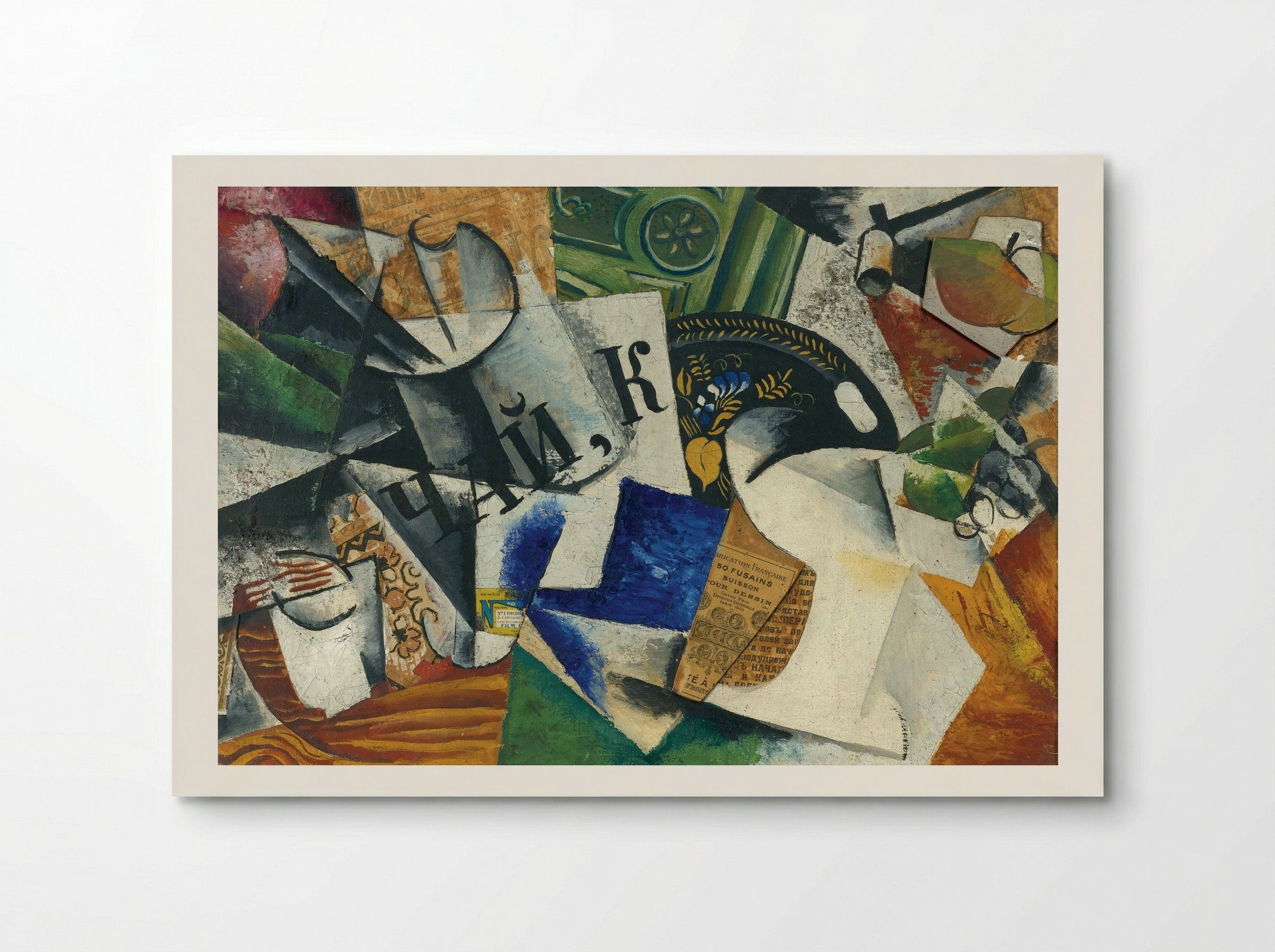
Still Life with Tray - Lyubov Popova
Archival giclée
Frames arrive ready to hang
Secure checkout
Made to order
Description
A Cubo-Futurist composition by Lyubov Popova from 1915. It features a deconstructed tea service and a traditional Russian tray rendered in geometric planes.
Lyubov Popova painted Still Life with Tray in 1915 during a period of intense experimentation within the Russian Avant-Garde. The work is a primary example of Cubo-Futurism, a movement that merged the fragmented spatial logic of Parisian Cubism with the kinetic energy of Italian Futurism. Popova spent time in Paris studying under Jean Metzinger and Henri Le Fauconnier, which informed her approach to deconstructing three-dimensional objects into flat, overlapping planes. The composition centres on a black Zhostovo tray, a traditional Russian handicraft decorated with floral motifs. This inclusion of folk art elements was common among Russian modernists who sought to ground their radical abstractions in national traditions. Surrounding the tray are various elements of a tea service, including a cup and saucer, which are broken down into sharp geometric shards. The Cyrillic letters for tea (ЧАЙ) appear prominently, using typography as a formal element rather than just a label. Popova uses a palette of earthy ochres and greens contrasted against a deep cobalt blue and the stark black of the tray. The surface is dense with overlapping shapes that create a sense of rhythmic movement across the canvas. Unlike the more monochromatic works of her French contemporaries, Popova maintains a varied range of colours and textures. The inclusion of what appears to be printed matter or labels suggests the influence of synthetic cubism and collage techniques. This painting represents a transition towards the purely non-objective architectonic compositions that Popova would develop later in her career. The spatial arrangement rejects traditional perspective in favour of a shallow, compressed field. Each object is viewed from multiple angles simultaneously, a technique intended to represent the experience of modern life. The heavy outlines and bold application of paint emphasise the physical presence of the work. Popova's interest in the structural properties of objects is evident in the way the cylindrical forms of the tea service are flattened into rectangles and arcs. This analytical approach to form would eventually lead her to abandon representational painting entirely in favour of industrial design and constructivism.
Return policy
Because every print is made to order, we don't offer change-of-mind returns, refunds or exchanges. If your order arrives faulty, damaged or incorrect, we'll replace it free of charge — just contact us within 48 hours of delivery. See our refunds page for full details.
Shipping
We ship worldwide, printing at the production hub nearest to your delivery address. Delivery times and costs vary by destination — you'll see the options available to you at checkout.
Manufacturing
Each print is produced to order using 12-colour giclée printing on FSC-certified archival paper. Designed in Britain and printed at your nearest production hub to reduce waste and speed up delivery.
Still Life with Tray - Lyubov Popova
Our Features
Designed for Lasting Impact
Specific Features
Every Solis piece is made to order with archival, gallery-quality materials built to last.
- Museum-grade giclée printing for rich, fade-resistant colour
- Archival matte fine-art paper, FSC-certified
- Multiple sizes and framing options available
- Frames in black, natural wood, dark wood or white
- Framed prints arrive ready to hang
Care & Cleaning
To keep your artwork looking its best:
- Dust gently with a soft, dry cloth
- Avoid prolonged direct sunlight
- Never use liquid cleaners on the print or canvas surface
- Keep in a dry, room-temperature space
- Handle prints with clean, dry hands
Materials & Sizing
Museum-grade giclée on FSC-certified archival matte paper, with framed and canvas options.
- Paper sizes: A4, A3, A2, A1, A0 and B2 (50×70 cm)
- Canvas: XS (20×30 cm) to Large (60×90 cm)
- Frames: black, natural wood, dark wood or white
Why Choose Us ?
Damage-free delivery guarantee
Fast Shipping
Museum-Quality Materials
Artist Biography
Lyubov Popova
You May Also Like