

Fine Art Poster
From £28
A giclée print on 200gsm matte fine art paper, using a twelve-colour process for accurate, fade-resistant colour. Supplied unframed, delivered flat or rolled.



Archival giclée
Frames arrive ready to hang
Secure checkout
Made to order
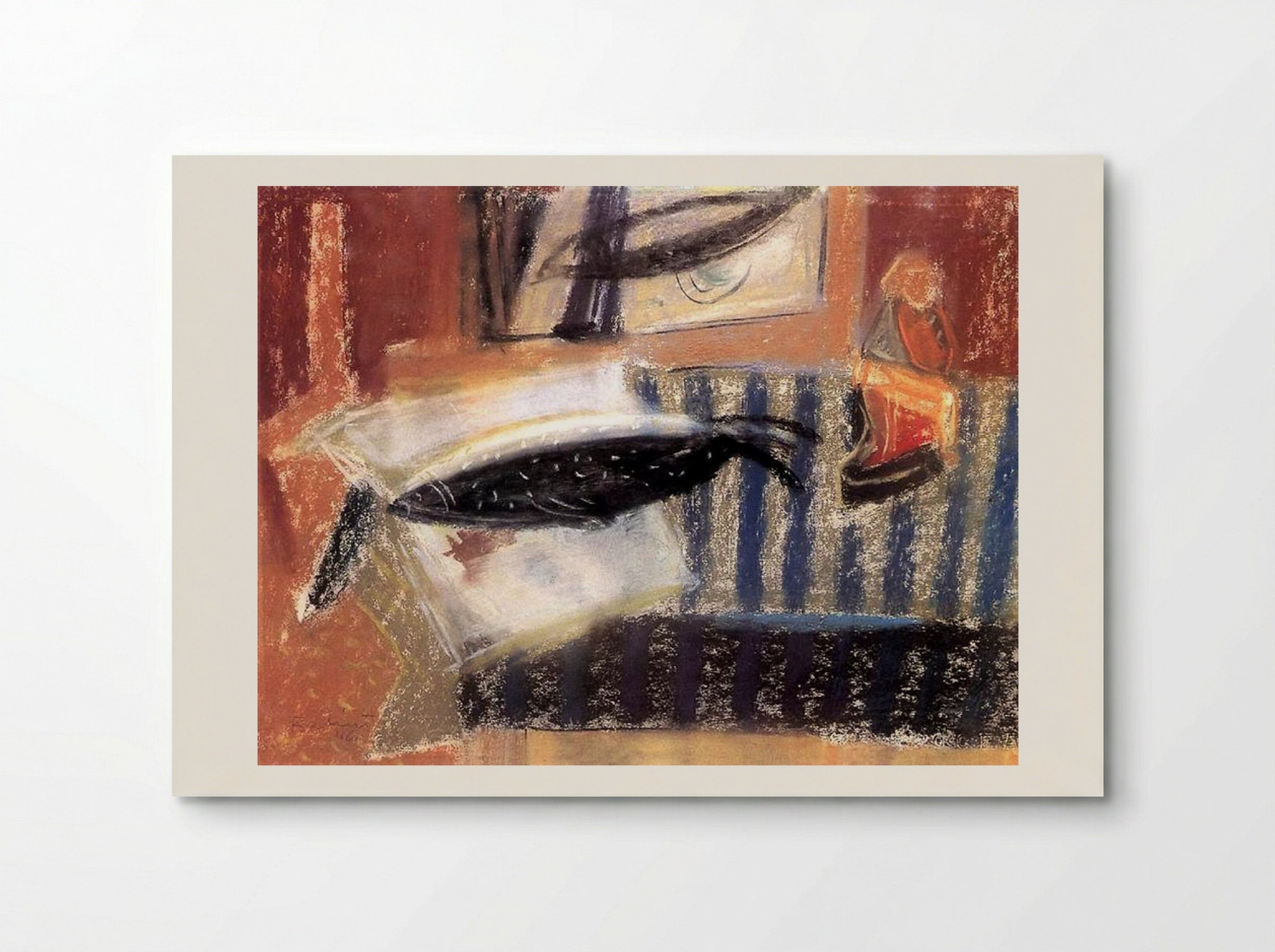
A 1960 pastel work by Hungarian artist Endre Bálint, featuring a fish set against a backdrop of bold stripes and warm, earthy tones.
Endre Bálint, a significant figure in twentieth-century Hungarian art, produced this work in 1960. The composition features a central fish rendered in dark, gestural strokes, resting upon a surface that contrasts with the surrounding environment. Bálint employs a palette dominated by earthy ochres, deep reds, and sharp blue-and-white stripes, which create a sense of spatial tension. The background elements appear semi-abstract, suggesting an interior setting where domestic objects are reduced to their essential forms. The application of pastel allows for a tactile quality, where the texture of the paper interacts with the pigment. Bálint often explored the relationship between objects and their surroundings, moving away from strict representation toward a more subjective interpretation of space. The striped fabric provides a rhythmic element that anchors the composition, while the figure to the right introduces a sense of ambiguity. This work reflects the artist's interest in the interplay of colour and form, characteristic of his mid-career output. His approach to the still life genre avoids traditional realism, opting instead for a synthesis of memory and observation. The stark contrast between the dark, elongated shape of the fish and the lighter, patterned surfaces demonstrates his command of tonal balance. By simplifying the visual information, Bálint invites the viewer to focus on the arrangement of shapes and the emotional weight of the colour choices. This piece remains a representative example of his ability to transform mundane subjects into compositions of structural interest.
Because every print is made to order, we don't offer change-of-mind returns, refunds or exchanges. If your order arrives faulty, damaged or incorrect, we'll replace it free of charge — just contact us within 48 hours of delivery. See our refunds page for full details.
We ship worldwide, printing at the production hub nearest to your delivery address. Delivery times and costs vary by destination — you'll see the options available to you at checkout.
Each print is produced to order using 12-colour giclée printing on FSC-certified archival paper. Designed in Britain and printed at your nearest production hub to reduce waste and speed up delivery.
Specific Features
Every Solis piece is made to order with archival, gallery-quality materials built to last.
Care & Cleaning
To keep your artwork looking its best:
Materials & Sizing
Museum-grade giclée on FSC-certified archival matte paper, with framed and canvas options.
Made to order
Every piece is printed to order. These are the five finishes, and what makes each one different.
From £28
A giclée print on 200gsm matte fine art paper, using a twelve-colour process for accurate, fade-resistant colour. Supplied unframed, delivered flat or rolled.

From £45
The same fine art print in a solid wood frame with UV-protective acrylic glaze and rigid backing. Five frame colours. Arrives ready to hang.

From £85
A deeper solid wood frame: 33mm deep with a 20mm face and Perspex glaze. The print sits unmounted for a clean gallery presentation. Black, white or natural.

From £30
Hand-stretched canvas with neat gallery-wrapped edges, giving the artwork surface texture and depth. Arrives ready to hang.

From £135
Stretched canvas set in a floating wood frame, our most substantial finish. Arrives ready to hang.
Why Choose Us ?
Damage-free delivery guarantee
Fast Shipping
Museum-Quality Materials
You May Also Like
We use cookies to measure our marketing and see which prints people love.We use cookies to measure our marketing.
By continuing to browse, you agree · Privacy Policy