

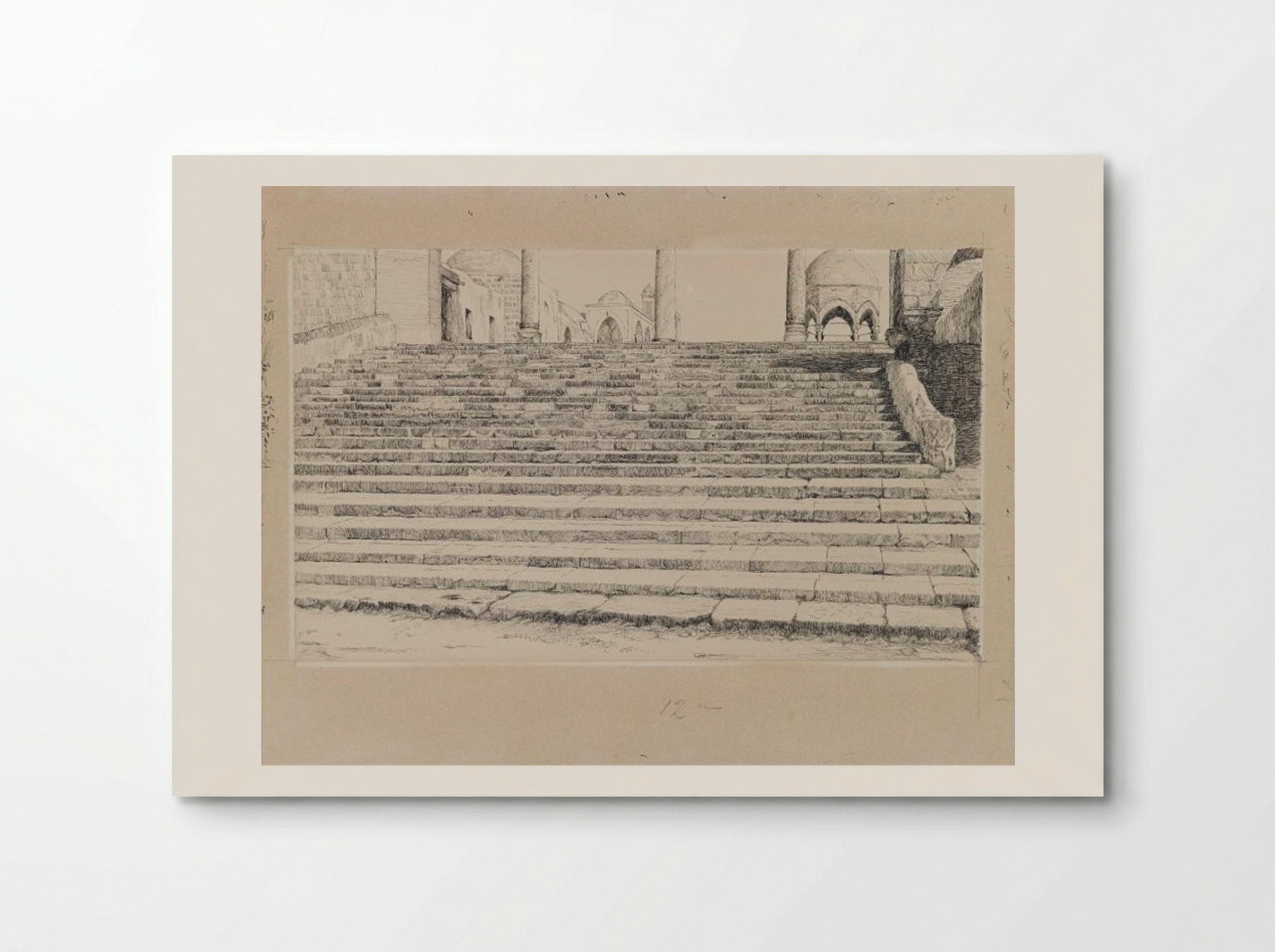
Staircase of the Court, Haram - James Tissot
Archival giclée
Frames arrive ready to hang
Secure checkout
Made to order
Description
An etching by James Tissot, this work depicts a staircase within the Haram al-Sharif complex in Jerusalem, showcasing the artist's meticulous attention to architectural detail and historical context.
This etching by James Tissot (1836-1902), a French artist known for his genre scenes and society portraits, presents a detailed study of a staircase within the Haram al-Sharif (Temple Mount) complex in Jerusalem. Tissot travelled extensively in the Middle East later in his career, producing numerous watercolours and etchings documenting biblical sites and scenes. These works reflect an interest in historical accuracy and a desire to visualise the world of the Bible. The composition focuses on the monumental staircase, rendered with precise linework that captures the texture of the stone steps and the architectural details of the surrounding structures. The perspective draws the viewer's eye upward, emphasising the scale and grandeur of the setting. The use of light and shadow creates depth and volume, adding to the realism of the image. The etching technique allows for fine details, from the individual stones of the staircase to the distant arches and domes of the Haram complex. The overall effect is one of quiet contemplation, inviting the viewer to imagine the historical and religious significance of this location.
Return policy
Because every print is made to order, we don't offer change-of-mind returns, refunds or exchanges. If your order arrives faulty, damaged or incorrect, we'll replace it free of charge — just contact us within 48 hours of delivery. See our refunds page for full details.
Shipping
We ship worldwide, printing at the production hub nearest to your delivery address. Delivery times and costs vary by destination — you'll see the options available to you at checkout.
Manufacturing
Each print is produced to order using 12-colour giclée printing on FSC-certified archival paper. Designed in Britain and printed at your nearest production hub to reduce waste and speed up delivery.
Care and materials
Specific Features
Every Solis piece is made to order with archival, gallery-quality materials built to last.
- Museum-grade giclée printing for rich, fade-resistant colour
- Archival matte fine-art paper, FSC-certified
- Multiple sizes and framing options available
- Frames in black, natural wood, dark wood or white
- Framed prints arrive ready to hang
Care & Cleaning
To keep your artwork looking its best:
- Dust gently with a soft, dry cloth
- Avoid prolonged direct sunlight
- Never use liquid cleaners on the print or canvas surface
- Keep in a dry, room-temperature space
- Handle prints with clean, dry hands
Materials & Sizing
Museum-grade giclée on FSC-certified archival matte paper, with framed and canvas options.
- Paper sizes: A4, A3, A2, A1, A0 and B2 (50×70 cm)
- Canvas: XS (20×30 cm) to Large (60×90 cm)
- Frames: black, natural wood, dark wood or white
Staircase of the Court, Haram - James Tissot

Artist Biography
James Tissot
He grew up in the port city of Nantes, the son of a milliner and dressmaker. His mother's trade shows in the paintings: nobody in nineteenth-century art rendered fabric, lace, ribbons and the cut of a sleeve with more attention than Tissot. He studied in Paris under Hippolyte Flandrin and exhibited at the Salon from 1859, shifting quickly from medieval subjects to modern life.
He fought in the Franco-Prussian War and was implicated in the Paris Commune of 1871, though the extent of his involvement remains unclear. What is clear is that he left Paris in a hurry after Bloody Week and turned up in London, where his detailed paintings of Victorian society made him wealthy within a few years. The English liked his work because it showed them as they wished to be seen: well-dressed, leisured, and slightly mysterious. The sexual tension in many of his compositions, the glances exchanged between men and women across the rigid codes of Victorian propriety, is always present and never explicit.
He drew caricatures for Vanity Fair under the pseudonym Coide. He was also a serious collector of Japanese art, and the influence of Japanese composition and textile patterns runs through his work alongside the European tradition.
In London he began a relationship with Kathleen Newton, an Irishwoman who became his constant model and companion until her death from tuberculosis in 1882. He returned to Paris after she died and spent his final years painting a monumental series of 350 gouaches illustrating the life of Christ, based on research trips to the Middle East.
Why Choose Us ?
Damage-free delivery guarantee
Fast Shipping
Museum-Quality Materials
You May Also Like