

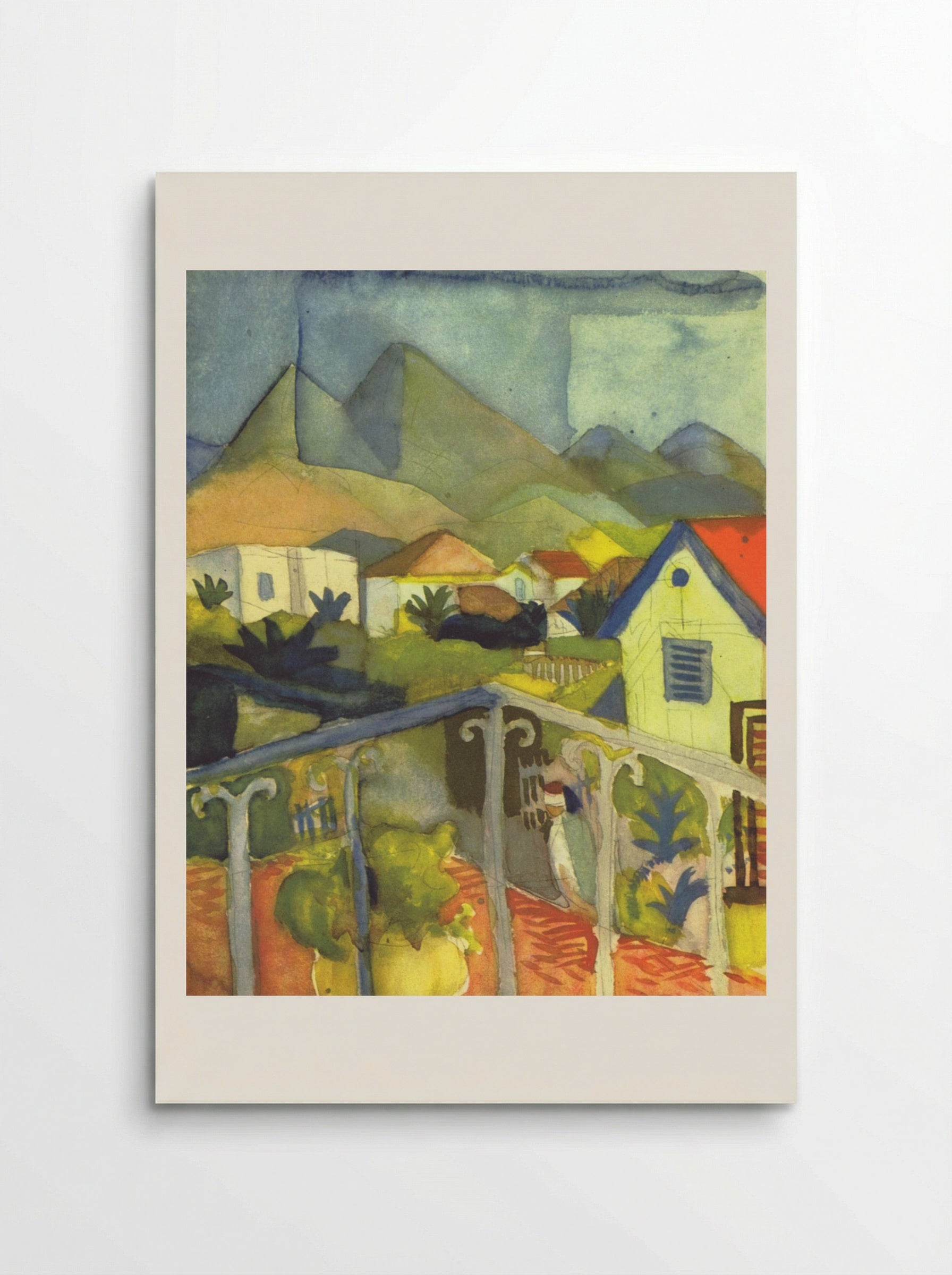
St. Germain near Tunis - August Macke
Archival giclée
Frames arrive ready to hang
Secure checkout
Made to order
Description
A luminous watercolour by August Macke, capturing a balcony view in Tunisia with fluid lines and clear, expressive colour washes.
August Macke produced this watercolour during his brief but transformative journey to Tunisia in April 1914, alongside Paul Klee and Louis Moilliet. The trip provided the artist with a new visual vocabulary, allowing him to explore the effects of Mediterranean light on colour and form. In this composition, Macke captures a view from a balcony, looking out over the town of St. Germain towards the distant mountains. The work displays the artist's characteristic approach to light and space. Rather than relying on traditional perspective, Macke uses overlapping planes of colour to define the depth of the scene. The foreground features a balcony railing, rendered with fluid, calligraphic lines that guide the eye towards the houses and the mountainous backdrop. The palette is bright and clear, reflecting the intensity of the North African sun. Macke applies the watercolour in translucent washes, allowing the white of the paper to contribute to the luminosity of the image. This piece demonstrates the influence of the Fauvist movement on Macke's practice, particularly in his use of non-naturalistic colour to convey the atmosphere of the location. The houses are simplified into geometric shapes, while the vegetation is suggested through gestural brushwork. The composition balances the domestic intimacy of the balcony with the expansive scale of the Tunisian terrain. This work remains a clear example of the artist's ability to synthesise his observations into a cohesive, modern aesthetic. It captures a moment of clarity and discovery, marking a final period of creative output before his death later that year during the First World War.
Return policy
Because every print is made to order, we don't offer change-of-mind returns, refunds or exchanges. If your order arrives faulty, damaged or incorrect, we'll replace it free of charge — just contact us within 48 hours of delivery. See our refunds page for full details.
Shipping
We ship worldwide, printing at the production hub nearest to your delivery address. Delivery times and costs vary by destination — you'll see the options available to you at checkout.
Manufacturing
Each print is produced to order using 12-colour giclée printing on FSC-certified archival paper. Designed in Britain and printed at your nearest production hub to reduce waste and speed up delivery.
Care and materials
Specific Features
Every Solis piece is made to order with archival, gallery-quality materials built to last.
- Museum-grade giclée printing for rich, fade-resistant colour
- Archival matte fine-art paper, FSC-certified
- Multiple sizes and framing options available
- Frames in black, natural wood, dark wood or white
- Framed prints arrive ready to hang
Care & Cleaning
To keep your artwork looking its best:
- Dust gently with a soft, dry cloth
- Avoid prolonged direct sunlight
- Never use liquid cleaners on the print or canvas surface
- Keep in a dry, room-temperature space
- Handle prints with clean, dry hands
Materials & Sizing
Museum-grade giclée on FSC-certified archival matte paper, with framed and canvas options.
- Paper sizes: A4, A3, A2, A1, A0 and B2 (50×70 cm)
- Canvas: XS (20×30 cm) to Large (60×90 cm)
- Frames: black, natural wood, dark wood or white
St. Germain near Tunis - August Macke

Artist Biography
August Macke
He grew up in a family of building contractors in Meschede, Westphalia, with no artistic connections. He visited Paris multiple times and absorbed Impressionism, Fauvism and Cubism in rapid succession, but his paintings look like none of those movements. What he took from France was colour: warm, saturated, joyful. His street scenes, market squares and park promenades glow with a light that belongs to someone who finds the world beautiful and wants to record it before it changes.
He met Franz Marc in 1910, and through Marc became involved with Der Blaue Reiter. His temperament was the opposite of Kandinsky's theoretical intensity. Macke painted intuitively, quickly, and with an optimism that made him the most approachable of the German Expressionists.
The Tunisian watercolours are his finest work: small, luminous, almost abstract in their reduction of architecture and figures to planes of colour. Klee wrote afterward that colour had taken possession of him. The same could be said of Macke, who had been working toward that moment for years.
He was drafted immediately when war broke out. His wife Elisabeth received notification of his death six weeks later. Marc, his closest friend, was killed at Verdun in 1916.
Why Choose Us ?
Damage-free delivery guarantee
Fast Shipping
Museum-Quality Materials
You May Also Like