

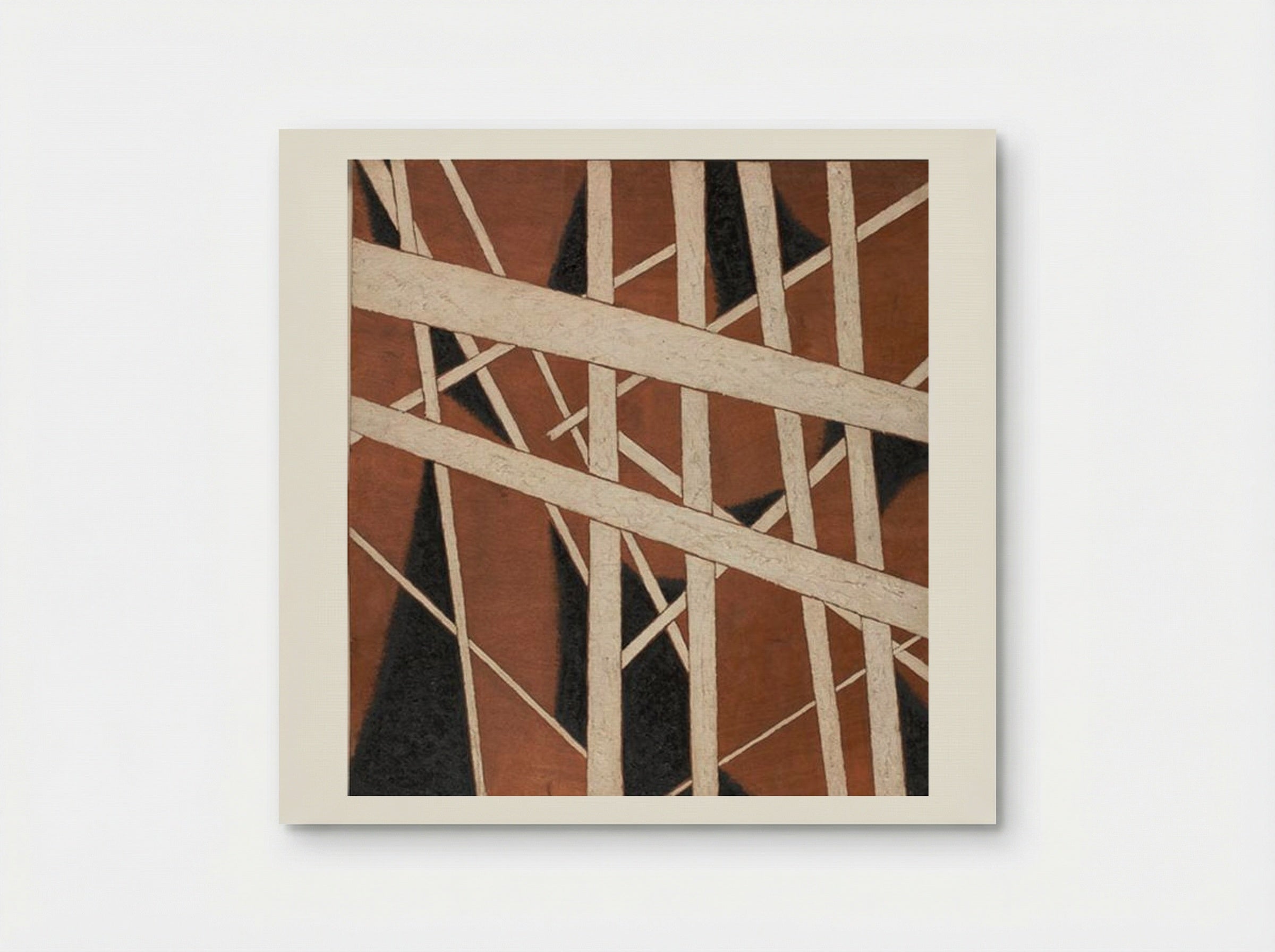
Space-Force Construction - Lyubov Popova
Archival giclée
Frames arrive ready to hang
Secure checkout
Made to order
Description
A 1921 Constructivist masterpiece by Lyubov Popova. This abstract composition uses intersecting lines and textured paint to explore structural tension and spatial dynamics.
Lyubov Popova was a central figure in the Russian avant-garde. This 1921 work belongs to her series of Space-Force Constructions. These paintings marked her transition from traditional easel painting toward the industrial and architectural applications of Constructivism. The composition consists of intersecting linear bands that traverse a dark, textured background. Popova used a limited palette of terracotta, black, and off-white. The surface is not smooth: she mixed sand or silicate with her paint to create a physical, tactile quality. This material approach reflects the Constructivist interest in "faktura," which refers to the specific handling of materials. The lines do not represent objects. Instead, they suggest structural tension and the intersection of planes in three-dimensional space. The arrangement of the white bands creates a sense of scaffolding or skeletal architecture. By stripping away representational elements, Popova focused on the mechanics of composition. The diagonal lines suggest movement and energy without relying on a single central element. This work was produced during a period when many Soviet artists were abandoning "pure art" to design textiles, stage sets, and buildings for the new state. Popova studied in Paris before the First World War, where she encountered Cubism and Futurism. She integrated these styles into a unique Russian context. In this series, she moved away from the spiritual concerns of Suprematism toward a more scientific and materialist view of art. The work is an exercise in "tektonika," the socially responsible use of industrial materials. Each line acts as a vector of force, creating a balanced yet dynamic equilibrium. The use of plywood as a support further emphasises the move away from the bourgeois traditions of canvas painting.
Return policy
Because every print is made to order, we don't offer change-of-mind returns, refunds or exchanges. If your order arrives faulty, damaged or incorrect, we'll replace it free of charge — just contact us within 48 hours of delivery. See our refunds page for full details.
Shipping
We ship worldwide, printing at the production hub nearest to your delivery address. Delivery times and costs vary by destination — you'll see the options available to you at checkout.
Manufacturing
Each print is produced to order using 12-colour giclée printing on FSC-certified archival paper. Designed in Britain and printed at your nearest production hub to reduce waste and speed up delivery.
Space-Force Construction - Lyubov Popova
Our Features
Designed for Lasting Impact
Specific Features
Every Solis piece is made to order with archival, gallery-quality materials built to last.
- Museum-grade giclée printing for rich, fade-resistant colour
- Archival matte fine-art paper, FSC-certified
- Multiple sizes and framing options available
- Frames in black, natural wood, dark wood or white
- Framed prints arrive ready to hang
Care & Cleaning
To keep your artwork looking its best:
- Dust gently with a soft, dry cloth
- Avoid prolonged direct sunlight
- Never use liquid cleaners on the print or canvas surface
- Keep in a dry, room-temperature space
- Handle prints with clean, dry hands
Materials & Sizing
Museum-grade giclée on FSC-certified archival matte paper, with framed and canvas options.
- Paper sizes: A4, A3, A2, A1, A0 and B2 (50×70 cm)
- Canvas: XS (20×30 cm) to Large (60×90 cm)
- Frames: black, natural wood, dark wood or white
Why Choose Us ?
Damage-free delivery guarantee
Fast Shipping
Museum-Quality Materials
Artist Biography
Lyubov Popova
You May Also Like