

Solitude - Maxfield Parrish
Archival giclée
Frames arrive ready to hang
Secure checkout
Made to order
Description
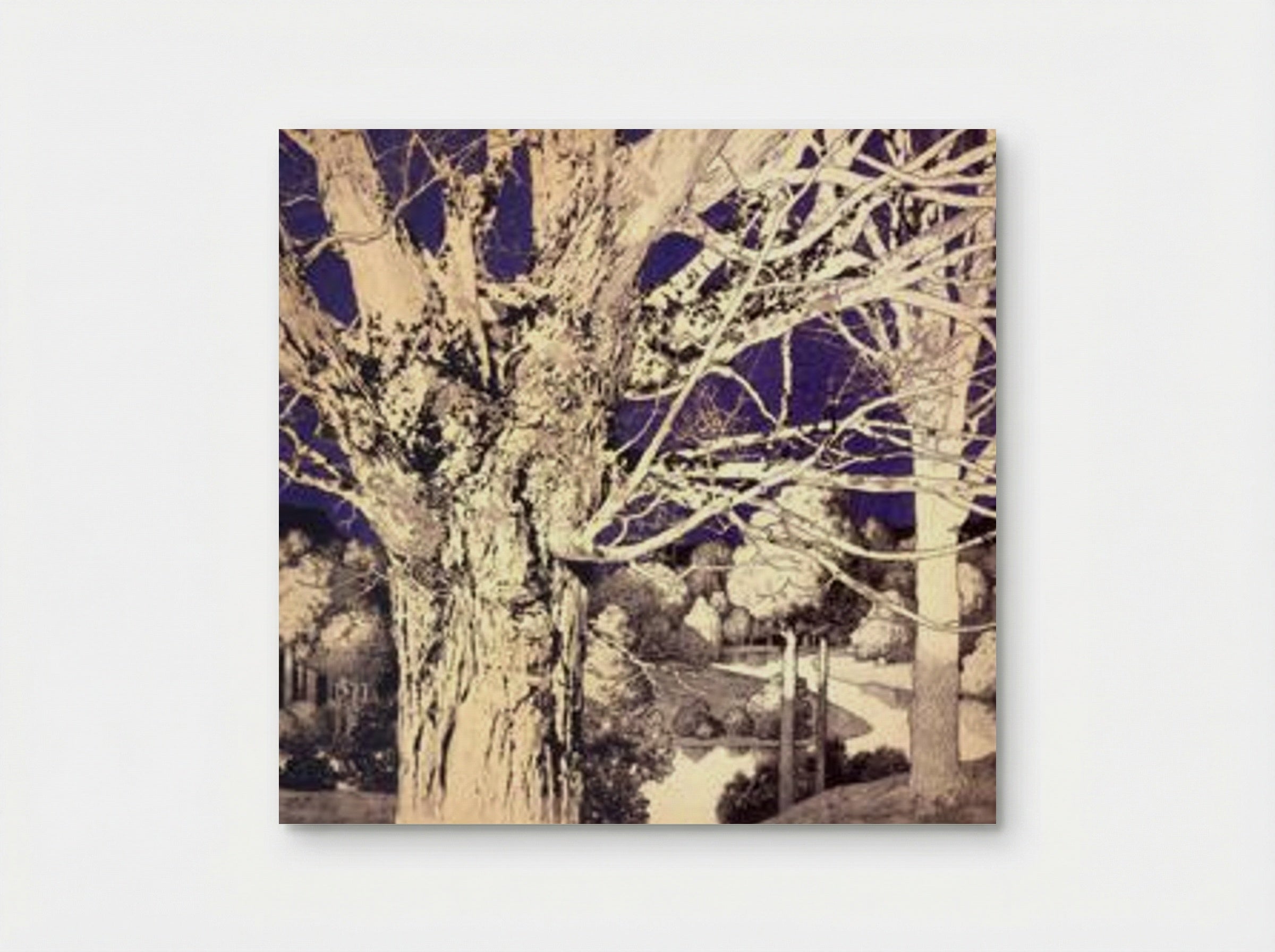
A serene illustration by Maxfield Parrish, featuring a gnarled tree set against a deep blue night sky.
Maxfield Parrish was a master of the American Golden Age of Illustration, known for his technical precision and his ability to manipulate light. Solitude displays his characteristic approach to composition, where the foreground is occupied by a gnarled, textured tree trunk that draws the viewer into the scene. The stark, pale bark of the tree contrasts with the deep, saturated blue of the night sky, a colour often referred to as Parrish Blue. This specific pigment was achieved through the application of multiple thin glazes of oil paint, creating a luminous quality that remains difficult to replicate. The composition is carefully balanced. The heavy, detailed form of the foreground tree acts as a frame for the more distant, softer elements of the scene, which include a winding path and a quiet body of water. Parrish utilised a technique involving the projection of photographs onto his canvas, which allowed him to achieve a high degree of realism in his structural forms while maintaining a dreamlike, theatrical atmosphere. The absence of human figures in this work reinforces the title, focusing the viewer on the stillness of the natural environment. This piece demonstrates the artist's interest in the interplay between light and shadow. The light source appears to emanate from the background, casting the tree in a silhouette that emphasises its rugged texture. By avoiding excessive detail in the background, Parrish directs attention to the immediate presence of the tree. His work from this period often appeared in popular magazines and advertisements, yet it maintains a painterly quality that transcends its commercial origins. The print captures the depth of the original glazing techniques, offering a clear view of the contrast between the dark sky and the pale, illuminated wood.
Return policy
Because every print is made to order, we don't offer change-of-mind returns, refunds or exchanges. If your order arrives faulty, damaged or incorrect, we'll replace it free of charge — just contact us within 48 hours of delivery. See our refunds page for full details.
Shipping
We ship worldwide, printing at the production hub nearest to your delivery address. Delivery times and costs vary by destination — you'll see the options available to you at checkout.
Manufacturing
Each print is produced to order using 12-colour giclée printing on FSC-certified archival paper. Designed in Britain and printed at your nearest production hub to reduce waste and speed up delivery.
Solitude - Maxfield Parrish

Artist Biography
Maxfield Parrish
He called himself a mechanic who paints. Beneath his studio he built a workshop filled with machines, and used them to construct model scenes, props and lighting rigs for his paintings. The process was closer to set design than to plein air. He would build a miniature landscape, light it from specific angles, photograph it, then paint from the photograph using a layering technique borrowed from the Old Masters: thin coats of transparent oil glaze over a plaster base, each layer drying before the next, so the under-colours shone through. The method eliminated visible brushstrokes and produced a luminosity that looked like stained glass.
Daybreak, painted in 1922, became the most reproduced art print of the twentieth century. It outsold Warhol's Campbell's Soup Cans and Da Vinci's Last Supper in print form. By the mid-1920s it was estimated that one in four American households had a Parrish print on the wall. The image appeared in Terrence Malick's Badlands and inspired the poster for The Princess Bride. For three models he used his own daughter Jean, Kitty Owen (granddaughter of William Jennings Bryan), and his young nanny Susan Lewin.
In 1900, tuberculosis followed by a nervous breakdown forced him to stop working. The recovery period changed his technique: it was during this convalescence that he developed the glazing method that defined the rest of his career. He lived to ninety-five, painting until the last few years.
Our Features
Designed for Lasting Impact
Specific Features
Every Solis piece is made to order with archival, gallery-quality materials built to last.
- Museum-grade giclée printing for rich, fade-resistant colour
- Archival matte fine-art paper, FSC-certified
- Multiple sizes and framing options available
- Frames in black, natural wood, dark wood or white
- Framed prints arrive ready to hang
Care & Cleaning
To keep your artwork looking its best:
- Dust gently with a soft, dry cloth
- Avoid prolonged direct sunlight
- Never use liquid cleaners on the print or canvas surface
- Keep in a dry, room-temperature space
- Handle prints with clean, dry hands
Materials & Sizing
Museum-grade giclée on FSC-certified archival matte paper, with framed and canvas options.
- Paper sizes: A4, A3, A2, A1, A0 and B2 (50×70 cm)
- Canvas: XS (20×30 cm) to Large (60×90 cm)
- Frames: black, natural wood, dark wood or white
Why Choose Us ?
Damage-free delivery guarantee
Fast Shipping
Museum-Quality Materials
Artist Biography
Maxfield Parrish
He called himself a mechanic who paints. Beneath his studio he built a workshop filled with machines, and used them to construct model scenes, props and lighting rigs for his paintings. The process was closer to set design than to plein air. He would build a miniature landscape, light it from specific angles, photograph it, then paint from the photograph using a layering technique borrowed from the Old Masters: thin coats of transparent oil glaze over a plaster base, each layer drying before the next, so the under-colours shone through. The method eliminated visible brushstrokes and produced a luminosity that looked like stained glass.
Daybreak, painted in 1922, became the most reproduced art print of the twentieth century. It outsold Warhol's Campbell's Soup Cans and Da Vinci's Last Supper in print form. By the mid-1920s it was estimated that one in four American households had a Parrish print on the wall. The image appeared in Terrence Malick's Badlands and inspired the poster for The Princess Bride. For three models he used his own daughter Jean, Kitty Owen (granddaughter of William Jennings Bryan), and his young nanny Susan Lewin.
In 1900, tuberculosis followed by a nervous breakdown forced him to stop working. The recovery period changed his technique: it was during this convalescence that he developed the glazing method that defined the rest of his career. He lived to ninety-five, painting until the last few years.
You May Also Like