

Smoke Stack - Joseph Stella
Archival giclée
Ready to hang
Secure checkout
Made to order
Description
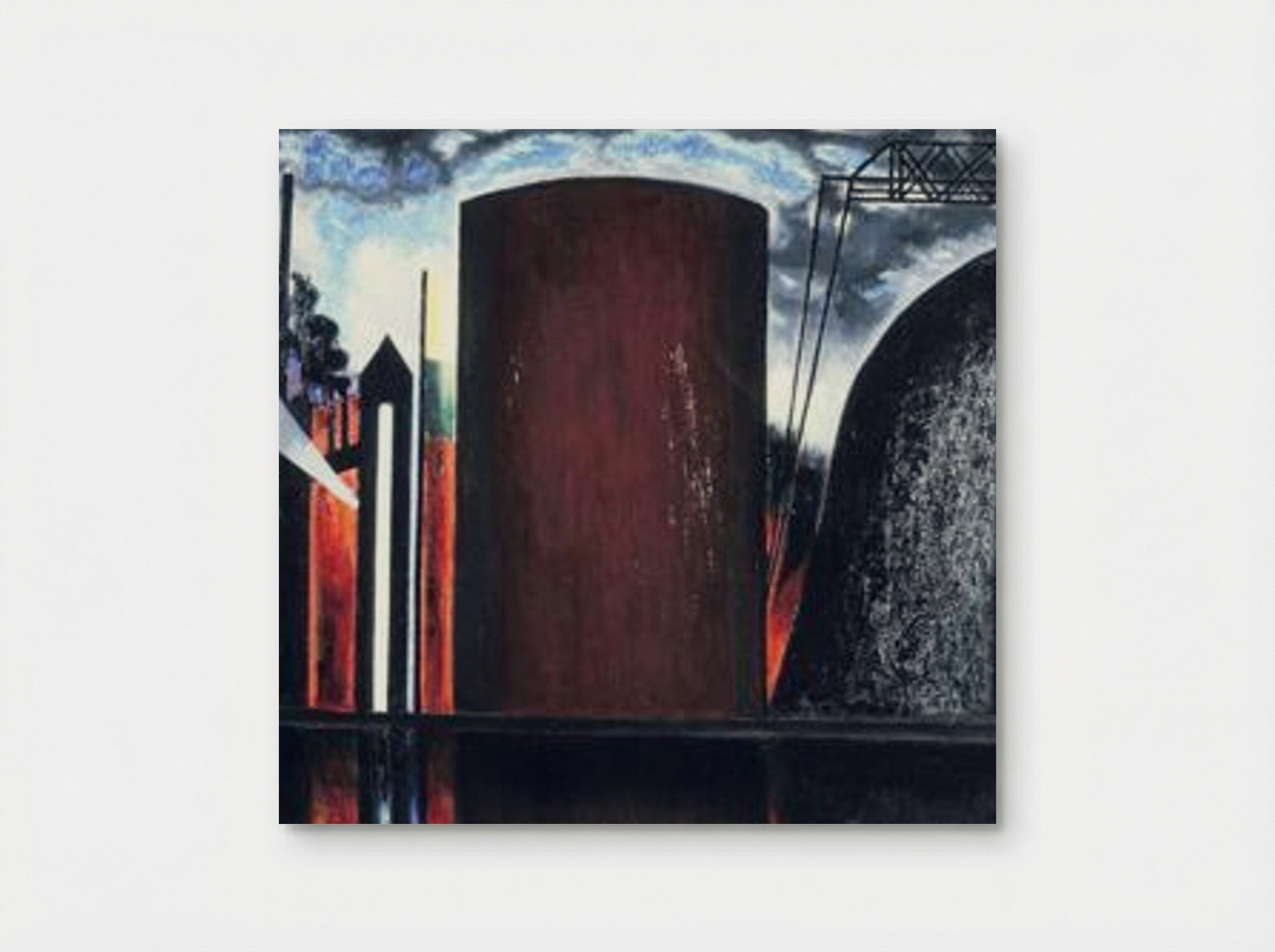
A powerful industrial scene by Joseph Stella, 'Smoke Stack' captures the dynamism of the machine age through bold forms and turbulent skies. This work blends elements of Futurism and Precisionism.
Joseph Stella, an Italian-American artist (1877-1946), is known for his depictions of American industrial subjects, particularly those of New York City. He explored themes of modernity and the machine age. Stella's work often blends elements of Futurism and Precisionism, characterised by sharp, geometric forms and a focus on industrial subjects. 'Smoke Stack' presents a stark, industrial scene. The composition is dominated by the cylindrical form of a large smoke stack, rendered in deep red-brown tones. Other industrial structures are visible, including what appears to be a gantry or bridge-like construction in the background. The sky is turbulent, with swirling clouds rendered in shades of blue and grey. The overall effect is one of imposing industrial power, with a sense of dynamism and energy conveyed through the brushwork and composition. The reflection of the structures in the water adds depth and complexity to the scene.
Return policy
Because every print is made to order, we don't offer change-of-mind returns, refunds or exchanges. If your order arrives faulty, damaged or incorrect, we'll replace it free of charge — just contact us within 48 hours of delivery. EU customers have a 14-day cooling-off right. See our refunds page for full details.
Shipping
We ship worldwide, printing at the production hub nearest to your delivery address. Delivery times and costs vary by destination — you'll see the options available to you at checkout.
Manufacturing
Each print is produced to order using 12-colour giclée printing on FSC-certified archival paper. Designed in Britain and printed at your nearest production hub to reduce waste and speed up delivery.
Smoke Stack - Joseph Stella
Our Features
Designed for Lasting Impact
Specific Features
Every Solis piece is made to order with archival, gallery-quality materials built to last.
- Museum-grade giclée printing for rich, fade-resistant colour
- Archival matte fine-art paper, FSC-certified
- Choose poster, framed print, canvas or framed canvas
- Frames in black, natural wood, dark wood or white
- Framed prints arrive ready to hang
Care & Cleaning
To keep your artwork looking its best:
- Dust gently with a soft, dry cloth
- Avoid prolonged direct sunlight
- Never use liquid cleaners on the print or canvas surface
- Keep in a dry, room-temperature space
- Handle prints with clean, dry hands
Materials & Sizing
Museum-grade giclée on FSC-certified archival matte paper, with framed and canvas options.
- Paper sizes: A4, A3, A2, A1, A0 and B2 (50×70 cm)
- Canvas: XS (20×30 cm) to Large (60×90 cm)
- Frames: black, natural wood, dark wood or white
Why Choose Us ?
100% Satisfaction Guarantee
Fast Shipping
Museum-Quality Materials

Artist Biography
Joseph Stella
He was born Giuseppe Michele Stella in Muro Lucano, near Potenza, Italy, in 1877. His father and grandfather were attorneys. In 1896 he emigrated to New York to study medicine, following his older brother, a doctor, but abandoned that plan almost immediately and enrolled at the Art Students League, then studied under William Merritt Chase. A return trip to Europe in 1909 exposed him to Fauvism, Cubism and Futurism at exactly the right moment.
The Brooklyn Bridge became his obsession. He first painted it in 1919 after standing alone on the promenade late at night, listening to what he described as "the underground tumult of the trains in perpetual motion" and "the shrill sulphurous voice of the trolley wires". He later wrote that he felt "as if on the threshold of a new religion". His Brooklyn Bridge paintings, of which he made several versions over two decades, use Futurist fragmentation and Gothic verticality to transform an engineering structure into something approaching the sacred.
He was never fully at home in America. He spent long periods in Europe, North Africa and the Caribbean, producing collages from urban ephemera (paper scraps, wrappers with visible branding, bits of street life) that were never exhibited in his lifetime and only discovered by his circle after his death. He died in New York in 1946, at sixty-nine.
You May Also Like