

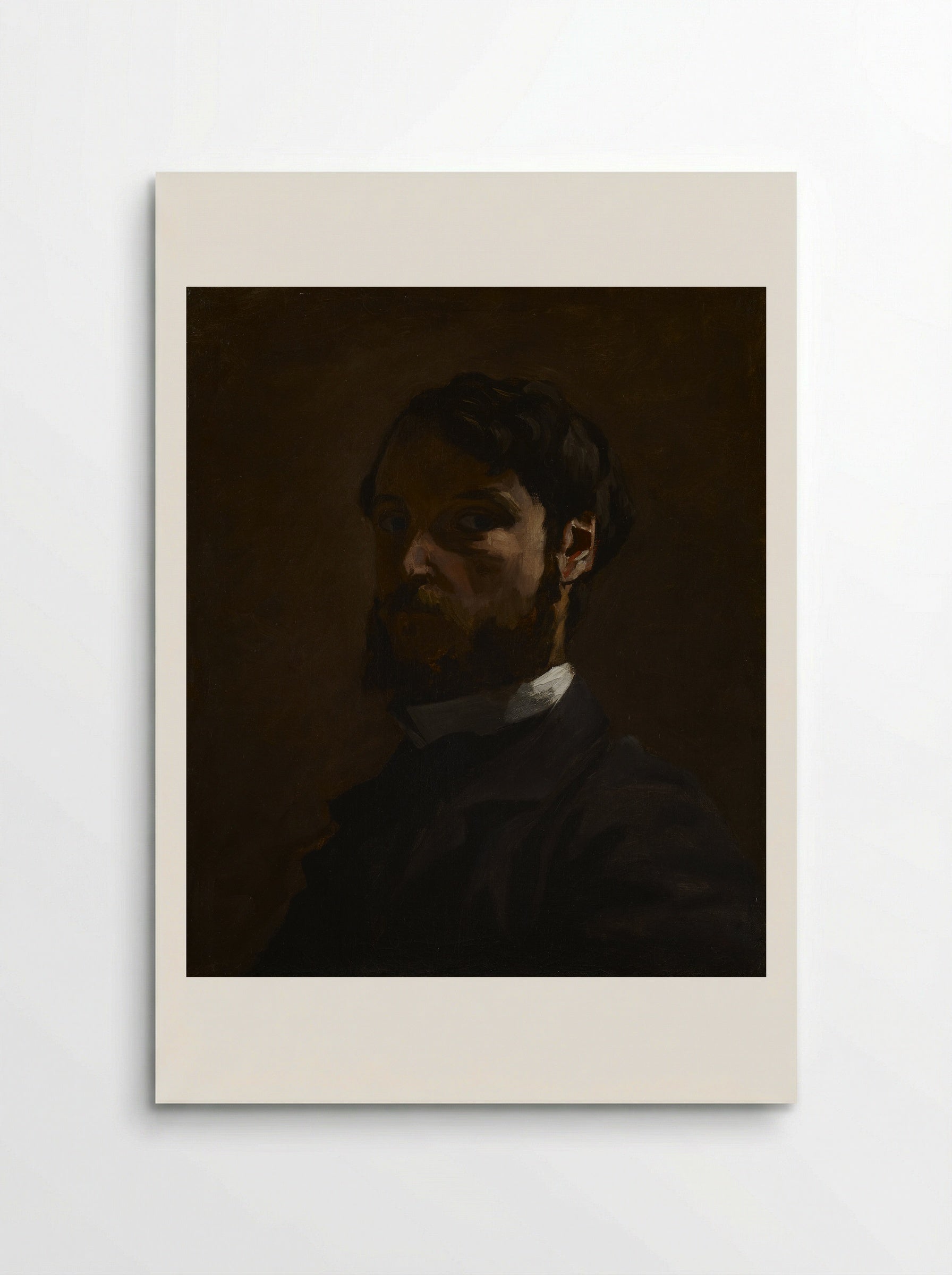
Self-Portrait - Frederic Bazille
Archival giclée
Frames arrive ready to hang
Secure checkout
Made to order
Description
A sombre and introspective self-portrait by the French Impressionist painter Frederic Bazille, featuring dramatic use of light and shadow.
This self-portrait by Frederic Bazille captures the artist in a moment of quiet introspection. Painted during the mid-1860s, the work reflects the early development of the Impressionist circle in Paris. Bazille, a close associate of Claude Monet and Auguste Renoir, often experimented with light and shadow in his portraiture. The composition is defined by a stark chiaroscuro effect. The artist emerges from a dark, indistinct background, with light falling selectively upon his face and the white collar of his shirt. This focus creates a sense of psychological weight. His gaze is direct, meeting the viewer with a calm, steady expression. The brushwork is controlled yet expressive, showing the artist's interest in the physical application of paint. Unlike the later, more fragmented style associated with the full Impressionist movement, this piece retains a traditional grounding in tonal values. It demonstrates the technical rigour Bazille brought to his studies before his untimely death in the Franco-Prussian War. The palette is restrained, relying on deep browns, blacks, and muted ochres to construct the form. This print offers a clear view of the artist's early mastery of light and his ability to convey character through minimal visual information. It is a piece that rewards close observation, revealing the subtle shifts in tone that define the contours of the face and the texture of the clothing.
Return policy
Because every print is made to order, we don't offer change-of-mind returns, refunds or exchanges. If your order arrives faulty, damaged or incorrect, we'll replace it free of charge — just contact us within 48 hours of delivery. See our refunds page for full details.
Shipping
We ship worldwide, printing at the production hub nearest to your delivery address. Delivery times and costs vary by destination — you'll see the options available to you at checkout.
Manufacturing
Each print is produced to order using 12-colour giclée printing on FSC-certified archival paper. Designed in Britain and printed at your nearest production hub to reduce waste and speed up delivery.
Self-Portrait - Frederic Bazille
Our Features
Designed for Lasting Impact
Specific Features
Every Solis piece is made to order with archival, gallery-quality materials built to last.
- Museum-grade giclée printing for rich, fade-resistant colour
- Archival matte fine-art paper, FSC-certified
- Multiple sizes and framing options available
- Frames in black, natural wood, dark wood or white
- Framed prints arrive ready to hang
Care & Cleaning
To keep your artwork looking its best:
- Dust gently with a soft, dry cloth
- Avoid prolonged direct sunlight
- Never use liquid cleaners on the print or canvas surface
- Keep in a dry, room-temperature space
- Handle prints with clean, dry hands
Materials & Sizing
Museum-grade giclée on FSC-certified archival matte paper, with framed and canvas options.
- Paper sizes: A4, A3, A2, A1, A0 and B2 (50×70 cm)
- Canvas: XS (20×30 cm) to Large (60×90 cm)
- Frames: black, natural wood, dark wood or white
Why Choose Us ?
Damage-free delivery guarantee
Fast Shipping
Museum-Quality Materials
Artist Biography
Frederic Bazille
You May Also Like